
How secure are managed IT service providers for handling industrial control systems?
How secure are managed IT service providers for handling industrial control systems? No managed IT provider can guarantee security for every industrial control system (ICS). A provider can manage monitoring, network segmentation, patch planning, and access controls, but legacy equipment, machine-builder decisions, and production constraints remain part of your risk.
Key Takeaways
- No provider can promise complete security for your industrial control systems, because legacy controllers and machine-builder choices sit outside any contract.
- A capable provider should manage monitoring, network segmentation, patch planning, and access controls so unpatchable equipment is harder to reach.
- Segmentation matters most on the plant floor, where machines that cannot be patched should not share a network with office devices that handle email.
- Production constraints like limited maintenance windows shape what patching is realistic, and your provider should plan around them instead of ignoring them.
- Ask any prospective provider how they handle operational technology specifically, because a generalist approach often misses what keeps production running.
The buying question is whether the provider understands those limits before making changes. Andromeda Managed IT Services for Industrial/Manufacturing Clients takes a manufacturing-focused approach to IT and operational technology (OT), sequencing changes to protect production uptime.
Can a Managed IT Provider Actually Guarantee Security for Industrial Control Systems?
No. A provider can reduce exposure and improve detection, but it cannot control every device, connection, or operational decision in your plant. A credible answer to “How secure are managed IT service providers for handling industrial control systems?” identifies what the provider manages, what your team or equipment vendors manage, and how those boundaries are documented.
What a Provider Can Control on Your Plant Floor
Your provider can monitor network activity, design segmentation between business systems and plant equipment, coordinate patches, and restrict access by user and device. Segmentation limits which systems can communicate; it does not require replacing a controller that cannot be patched. A provider can document approved connections, review alerts, and establish change controls so routine IT work does not reach production systems without planning.
Ask for evidence such as network diagrams, access records, patch decisions, and escalation procedures. A security tool alone does not establish who responds when an alert involves a production line. The service agreement should identify responsibilities for your internal team, the provider, and equipment vendors. Andromeda Managed IT Services for Industrial/Manufacturing Clients is one option to assess against those requirements.
What No Provider Can Control, No Matter What the Proposal Says
A provider cannot make an unsupported machine controller safe to patch when the equipment maker does not approve the update. It cannot dictate a machine builder’s firmware quality or guarantee that an integrator will close a remote connection after service. Patching, scanning, or rebooting may affect a line, so those decisions require coordination with your operations team and equipment vendors.
Security is shared responsibility, not a blanket guarantee. Before signing, require a written boundary for monitoring, changes, remote access, incident response, and production approval. A realistic provider explains residual risk instead of hiding it in broad assurances.
Why Industrial Control Systems Break the Standard IT Security Playbook

Office IT Risk Versus Plant Floor Risk: A Side-by-Side Comparison
On the production floor, a routine security action can affect throughput, product quality, and shipping commitments. Business IT often prioritizes keeping information confidential; OT must also keep physical processes available and predictable. That changes how you assess patching, network scans, and system restarts.
Compare ordinary office systems with production equipment:
| Security decision | Office IT | Plant-floor OT |
|---|---|---|
| Primary concern | Protect data and user access | Maintain safe, reliable process availability |
| Patch timing | Often scheduled through standard update cycles | Requires testing, vendor input, and an approved maintenance window |
| Unsupported systems | May be replaced or isolated through standard IT planning | Machine controllers may depend on older operating systems that cannot be patched normally |
| Scanning or rebooting | May interrupt an employee’s work | Can disrupt communications, halt a process, or require production recovery |
| Network structure | Commonly organized around business applications and users | Flat networks may allow unnecessary traffic between plant devices |
The Uptime-Versus-Patching Trade-Off Worth Naming
How secure are managed IT service providers for handling industrial control systems when a controller cannot take a normal patch? The answer depends on risk management, not a forced update. Your provider should identify the exposure, check vendor guidance, evaluate compensating controls, and document who approves the remaining risk.
That work takes coordination. A maintenance window may need to align with a planned shutdown, parts availability, and production schedules. Patching without review can trade a known vulnerability for an avoidable outage. Leaving a system unchanged without documented safeguards also leaves risk unmanaged.
Flat Networks and Legacy Controllers: The Real Starting Point
Many plants have grown their networks over years of equipment additions. On a flat network, office workstations, servers, and machine controllers may have more paths between them than the business needs. Older programmable logic controllers (PLCs) and human-machine interfaces may be difficult to update, yet still depend on reliable connections to supervisory systems, manufacturing execution systems (MES), or enterprise resource planning (ERP) software.
Here is what that looks like on the floor: a scan reaches a controller during an active run, communications falter, and operators pause production while the team determines whether the line can resume safely. The cost may include lost shift time, scrap, and delayed orders. Your provider should map dependencies first, then propose changes that fit the plant’s operating schedule.
The Standards That Actually Apply to a Mid-Size Manufacturer
Standards turn broad security claims into work you can verify. For industrial control systems, IEC 62443 and NIST SP 800-82 provide guidance for protecting operational technology (OT). They are frameworks, not certifications issued by Andromeda. If defense contracts apply, NIST SP 800-171 and the Cybersecurity Maturity Model Certification (CMMC) may also shape requirements for systems that handle controlled information.
Ask a provider to connect each framework to plant network diagrams, firewall rules, access controls, and documented change approvals. Andromeda Managed IT Services for Industrial/Manufacturing Clients is designed for manufacturing environments where security decisions must account for equipment dependencies and production schedules.
| Framework | What it addresses | Evidence to request |
|---|---|---|
| IEC 62443 | Industrial automation and control system security, including zones and conduits that organize systems and govern communications between them. | A network diagram showing defined zones, approved conduits, firewall rules, and the process for reviewing changes. |
| NIST SP 800-82 | Security guidance for industrial control systems, including supervisory control and data acquisition (SCADA) environments and OT constraints. | A risk assessment that accounts for availability, legacy equipment, remote access, monitoring, and safe maintenance windows. |
| NIST SP 800-171 and CMMC | Protection of controlled unclassified information when defense contract requirements apply. CMMC establishes assessment requirements tied to applicable practices. | A documented scope identifying systems that process, store, or transmit controlled information, with assigned controls and evidence owners. |
IEC 62443: Zones, Conduits, and What Auditors Expect
A zone groups systems with similar security needs. A conduit defines and controls communication between zones. A provider should show how business systems, plant operations, and machine cells are separated, then identify permitted traffic across each boundary. Ask how firewall rules are documented, tested, and reviewed after equipment or production changes.
NIST SP 800-82: OT Security Guidance in Plain Terms
NIST SP 800-82 addresses OT security, where availability and safe operation affect physical processes. A useful provider response accounts for legacy controllers, vendor dependencies, and the risk of scanning or patching active equipment. Request a written risk-based plan, including compensating controls when a device cannot be updated and change control before work touches production.
CMMC and NIST 800-171: When Defense Contracts Pull Compliance Onto the Floor
Defense work can bring cybersecurity requirements into the plant when production systems handle controlled information or connect to systems that do. Ask the provider to define the compliance boundary, identify who maintains evidence, and explain how network segmentation supports that scope. A claim of being “compliant” is not enough without a clear system boundary, assigned responsibilities, and records that support assessment.
The Provider Interview Script: 10 Questions That Separate OT Competence From Marketing
Use these questions in a provider interview, then request examples of the records or procedures behind each answer. Strong responses describe a process, an owner, and evidence. Vague assurances leave you unable to determine who approves production changes or responds when a security action affects a line.
Questions About Segmentation, Patching, and Maintenance Windows
- How would you map and segment our plant network? Strong: the provider begins with asset and communication discovery, then proposes zones, conduits, and documented firewall rules. Weak: “We install a firewall.”
- How do you identify dependencies before changing a controller connection? Strong: review traffic, machine documentation, and input from operations before restricting communications. Weak: “We can adjust it if anything breaks.”
- What happens when a machine controller cannot be patched? Strong: document exposure, vendor guidance, compensating controls, and the person accepting residual risk. Weak: “We patch everything automatically.”
- Who approves scans, reboots, and patching during production? Strong: changes follow written approval and a maintenance window agreed upon with plant leadership. Weak: routine IT schedules apply to every device.
- How do you test and reverse a plant network change? Strong: define a test plan, recovery steps, rollback owner, and production acceptance criteria before implementation. Weak: “We monitor it afterward.”
Questions About Remote Vendor and Machine Builder Access
- How is integrator or machine-builder access approved? Strong: named accounts, limited permissions, time-bounded access, and an internal sponsor. Weak: shared credentials remain available for future service.
- How do you confirm remote access ends after the work is complete? Strong: access is disabled or expires, and closure is recorded. Weak: the vendor is expected to disconnect independently.
Contract and Liability Language: Reading the Exclusions
- Which plant systems are excluded from monitoring or response? Strong: exclusions identify specific devices, duties, and escalation paths in writing. Weak: “OT is outside our standard scope,” with no ownership plan.
- Who coordinates the response if your action disrupts production? Strong: the agreement names notification, escalation, investigation, and incident documentation responsibilities. Weak: responsibility is deferred to a third-party vendor without a coordination process.
How to Score Each Answer: Strong Responses Versus Vague Ones
- What evidence will you provide to show these controls are operating? Strong: sample diagrams, access reviews, change records, and incident procedures, with sensitive details protected. Weak: a slide deck of security tools or an unsupported promise.
For each answer, mark whether it includes a named owner, written procedure, and evidence you can inspect. A response that lacks all three needs follow-up before you grant access to production systems. Andromeda Managed IT Services for Industrial/Manufacturing Clients can be assessed using the same questions, scope requirements, and documentation criteria as any provider.
What a Manufacturing-Focused Operating Model Looks Like in Practice
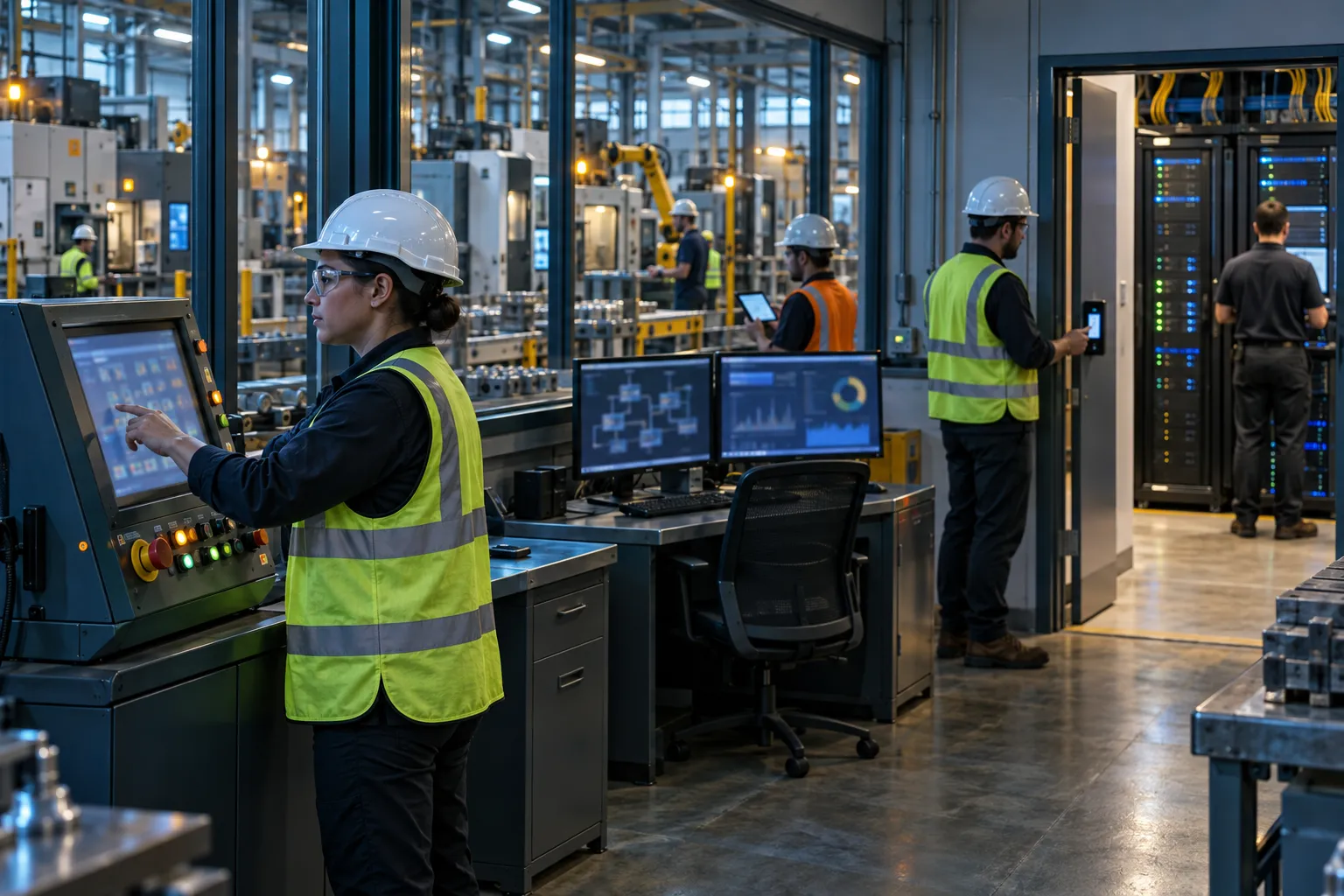
Your plant needs more than alerts when a server or network device fails. A useful operating model connects monitoring, backup, identity controls, and leadership reporting to production priorities. It defines who approves changes and how your team learns about risk. Andromeda Managed IT Services for Industrial/Manufacturing Clients is designed around manufacturing requirements, including support for business systems and operational technology.
Baseline Expectations: Monitoring, Backups, Identity, and Reporting
Monitoring should identify service interruptions and unusual activity without treating every plant device like an office workstation. Backup and business continuity planning should establish which systems can be restored, in what order, and who tests recovery. Identity controls should limit access to the people and vendors who need it, with remote permissions reviewed and removed when no longer required.
Leadership reporting should show unresolved risks, recurring incidents, backup status, and decisions that need operations approval. Ask for records your team can use, not a dashboard that hides work behind a single status light. Useful operating practices include:
- Documented monitoring scope for business and production systems.
- Recovery procedures tested against operational priorities.
- Named owners for user, vendor, and service accounts.
- Regular reporting on trends, risks, and agreed actions.
Multi-Site Consistency and Root-Cause Discipline
When your company runs multiple facilities, inconsistent access rules or undocumented network changes can create gaps between sites. A shared operating process should preserve local production constraints while making responsibilities, escalation, and reporting clear across locations. The goal is not identical equipment everywhere. It is a documented baseline and a controlled way to approve site-specific exceptions.
Andromeda reports a roughly 50% decrease in IT issues for a Chicagoland multi-site manufacturer. Many clients see a steady decline in service desk tickets during months four through nine, after an approximately three-month normalization period. That is the pattern in our data, not a promise. Eight-plus years of average employee retention can help preserve plant-specific knowledge across support interactions.
Your Next Step: Judge Any Provider on the Floor, Not the Brochure
Ask how proposed controls affect shift schedules, machine dependencies, and recovery responsibilities. A generalist approach can leave your team translating between IT procedures and production needs, an ongoing source of IT Drag™. Look for a provider that documents decisions, explains open risks, and assigns an owner to each follow-up. Andromeda Managed IT Services for Industrial/Manufacturing Clients can be assessed against those same practical expectations.
Andromeda reports a 12.0-minute median ticket response time and resolution of 97% of issues within eight business hours. Those measures describe response and resolution, not a guarantee that every plant incident will be resolved on the same schedule. If you want to discuss your environment, schedule a 30-minute discovery call. If you are not ready to talk, use the IT Drag™ Calculator to consider where recurring technology issues may affect operations.
Frequently Asked Questions
Can a managed IT provider guarantee security for industrial control systems?
No managed IT provider can guarantee security for every industrial control system (ICS). A provider can reduce exposure through monitoring, network segmentation, and access controls, but legacy equipment, machine-builder decisions, and production constraints remain part of your risk. A credible provider explains residual risk instead of hiding it in broad assurances.
What makes OT security different from standard IT security?
Operational technology (OT) security must keep physical processes safe, available, and predictable, while office IT primarily protects data and user access. On the plant floor, a routine security action like patching or rebooting can halt a process, create scrap, or delay orders. That is why patch decisions on production equipment require testing, vendor input, and an approved maintenance window.
What should a manufacturer ask an MSP before letting it touch the plant floor?
Ask the provider what it controls, what your team and equipment vendors control, and how those boundaries are documented. Request network diagrams, access records, patch decisions, and escalation procedures, plus a written boundary covering monitoring, changes, remote access, incident response, and production approval. A provider that cannot show that evidence is not ready for your production floor.
How do IEC 62443 and NIST SP 800-82 apply to a mid-size manufacturer?
IEC 62443 and NIST SP 800-82 are frameworks that provide guidance for protecting operational technology in plants like yours. They turn broad security claims into verifiable work, such as segmentation plans and documented patch decisions. If defense contracts apply to your business, NIST SP 800-171 and CMMC requirements may also come into play.
Should the plant network be fully separated from the business network?
Full separation is not always practical, but segmentation between business systems and plant equipment is the right starting point. Many plants have grown flat networks where office laptops and machine controllers share unnecessary paths. Segmentation limits which systems can communicate without requiring you to replace controllers that cannot be patched.
Should a legacy machine controller be patched even if it cannot be?
No provider can make an unsupported machine controller safe to patch when the equipment maker does not approve the update. The right approach is risk management: identify the exposure, check vendor guidance, evaluate compensating controls like segmentation, and document who approves the remaining risk. Forcing a patch can trade a known vulnerability for an avoidable outage.
Why can a network scan disrupt production equipment?
A scan that reaches a controller during an active run can cause communications to falter, forcing operators to pause production while the team determines whether the line can resume safely. The cost can include lost shift time, scrap, and delayed orders. Your provider should map dependencies first and sequence security work around your production schedule.