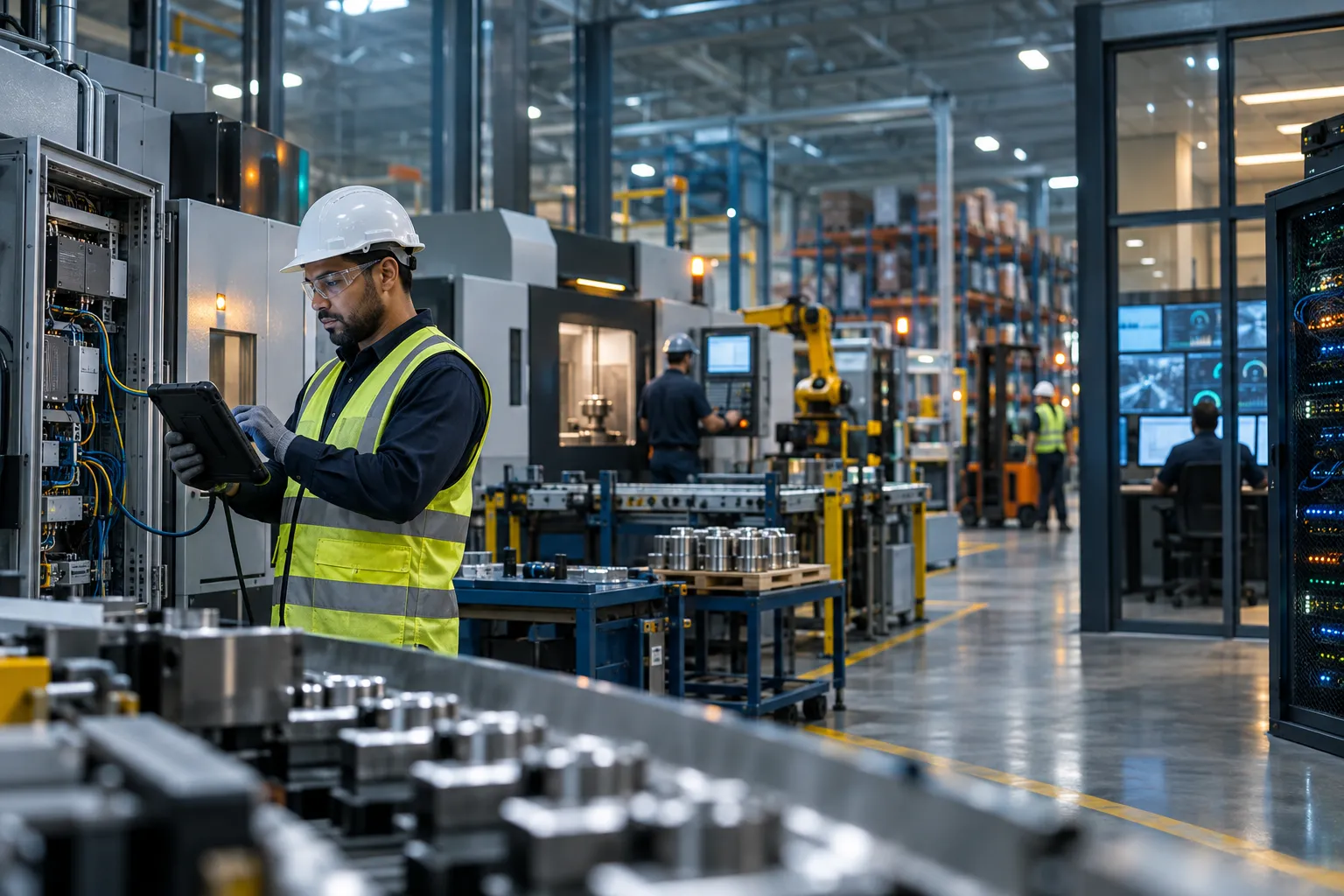
in manufacturing
When a production system loses network access, a stalled workstation can become a delayed shipment. Your manufacturing process determines how much downtime the floor can absorb and which technology risks need attention first.
Key Takeaways
- A stalled workstation on a networked production system rarely stays a technology problem; it becomes a delayed shipment and a day of catch-up on the floor.
- Your manufacturing process type determines how much downtime the plant can absorb and which technology risks deserve attention first.
- Managed monitoring and proactive patching reduce the recurring issues that turn small faults into lost shift hours.
- Stability does not come from fixing problems faster; it comes from having fewer problems in the first place.
- We have seen clients see ticket volumes decline steadily within the first 3 to 9 months, after an expected normalization period of about 3 months.
Discrete and process operations have different failure points, data needs, and recovery constraints. Artificial intelligence, sensors, and robotics also depend on infrastructure that supports them without putting production at risk.
What Manufacturing Actually Means in 2026: The Discrete vs. Process Split
Discrete manufacturing produces countable items, such as machines or appliances. Process manufacturing transforms ingredients or raw materials through mixing, heating, or refining. Within either category, the process affects how production responds to an outage. A job shop may pause one custom order; a continuous operation may face a difficult, costly shutdown. Your IT and operational technology (OT) plan should reflect that difference.
Discrete Manufacturing: Building Countable Things
Discrete production makes identifiable units, from individual components to finished products. Job shops handle varied, often custom work, while repetitive production and assembly lines follow recurring sequences. Mass production increases volume and standardization. Additive manufacturing builds parts layer by layer and can introduce specialized design and production data into established workflows.
When a system fails, effects vary by work order and line. A job shop might reschedule a custom job; an assembly line may lose instructions, inventory records, or machine data across several stations. Production depends on reliable connections among the enterprise resource planning (ERP) system, shop-floor applications, and equipment.
Process Manufacturing: Blending, Mixing, and Refining
Process manufacturing transforms materials into products measured by weight, volume, or formula. Batch operations produce defined quantities in stages. Continuous operations move material through a process with fewer natural stopping points. Food and beverage, chemical, and materials plants may use both approaches in different production areas.
Control systems, recipes, sensors, and production records must stay available and accurate. A batch may be held during an investigation. A continuous process can require careful coordination to reach a safe operating state before work stops. Recovery planning must account for process controls and material conditions, not just server restoration.
Why Your Process Type Sets Your Uptime Tolerance
Uptime tolerance is the disruption your operation can absorb before product quality, safety, or delivery commitments are affected. It depends on production methods, equipment behavior, and available workarounds. A disconnected workstation may have a local fallback; a line that depends on shared production data may not.
Map critical applications and equipment to the production steps they support. Identify which assets can pause safely, which need a planned stop, and which depend on uninterrupted data exchange. Operations and IT can then sequence maintenance and recovery work around actual production needs.
Every Process Type, Mapped to Its IT/OT Risk Profile
This overview connects common production types with infrastructure concerns that shape uptime planning. It is a starting point; actual risk depends on equipment, controls, and production schedules.
| Production type | Typical production pattern | Uptime and IT/OT consideration |
|---|---|---|
| Job shop | Custom or varied work orders | Scheduling and machine instructions may be affected by shared system outages. |
| Batch | Defined runs with stages or recipes | Protect recipe access, process records, and controlled restart procedures. |
| Repetitive production | Recurring production of similar items | Repeated line tasks can depend on stable data and equipment communication. |
| Continuous process | Ongoing material flow | Plan for safe shutdown and recovery, since stopping may require coordination. |
| Mass production and assembly lines | High-volume output through sequenced stations | A shared system or network interruption can affect multiple production steps. |
| Additive manufacturing | Parts built from digital designs | Protect design files, machine access, and the data path between systems. |
The 2026 Trend Stack, and What Each Trend Demands From Your Plant Network
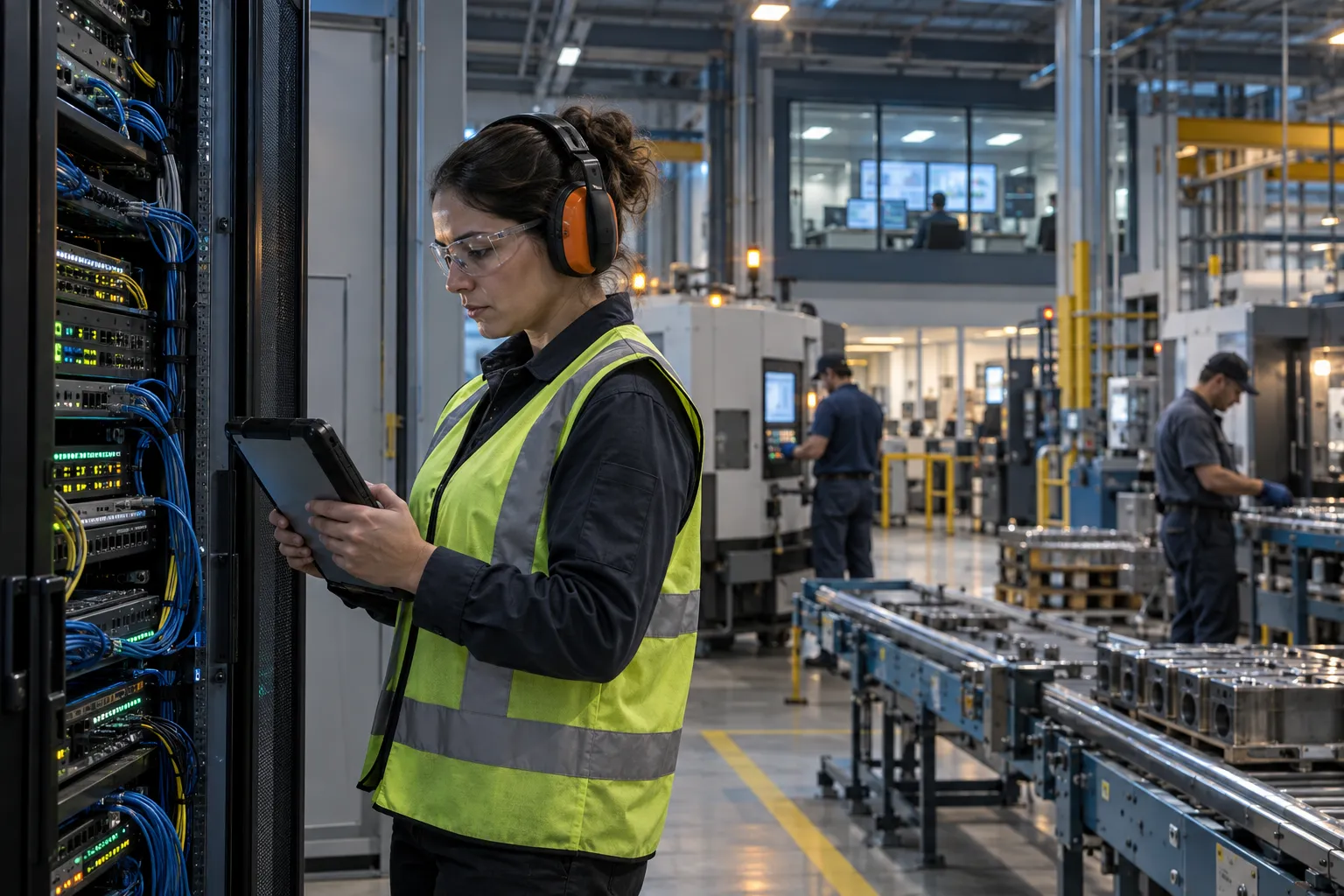
New tools can improve visibility and support production decisions, but they rely on dependable data, network access, and equipment coordination. Adoption works best when each project starts with a clear infrastructure requirement, not just a software decision.
AI and Predictive Maintenance: Only as Good as the Data Feed
Artificial intelligence (AI) tools and predictive maintenance depend on useful machine and maintenance data. Gaps, inconsistent timestamps, or unreliable connections can weaken analysis before it reaches a planner or maintenance technician. Your infrastructure needs dependable data collection, clear ownership of source records, and network paths that do not disrupt control traffic.
IIoT Sensors and Edge Computing: More Devices, More Attack Surface
The Industrial Internet of Things (IIoT) connects sensors and equipment to collect operating data. Edge computing processes some information near equipment, reducing dependence on a distant system. Your infrastructure needs documented devices, planned network capacity, and controlled access. Sensors without an inventory can create unmanaged connections.
Digital Twins: A Second Copy of Your Process to Protect
A digital twin is a digital representation of a physical asset or process, updated with operational data. It can support planning and analysis, but the information must be accurate and access controlled. Your infrastructure needs reliable data exchange, defined update responsibilities, and safeguards for design and process information.
Reshoring and the Workforce Shortage: Growth on Unstable Footing
Reshoring can bring new capacity, equipment, and production workflows into a plant. Experienced workers can be difficult to replace, while new systems add training and support needs. Your infrastructure needs a documented network, consistent access controls, and production procedures that do not depend on a single person’s memory.
Additive Manufacturing and Robotics: New Endpoints on Old Floors
Robots and additive manufacturing equipment may connect modern controls to older production networks. New endpoints can introduce vendor access, design-file transfers, and added support requirements. Map connections and plan integration around legacy equipment and maintenance windows.
Common warning signs can appear before a new initiative reaches production:
- Machine data arrives late or inconsistently.
- Teams rely on manual file transfers or shared logins.
- New devices appear without an assigned owner.
- Production changes depend on undocumented network knowledge.
These are infrastructure questions, not reasons to abandon useful technology. Andromeda Managed IT Services for Industrial/Manufacturing Clients addresses managed IT support for production environments. It is relevant when planning needs to account for equipment, production windows, and daily operations.
Before expanding a trend pilot, check whether your network and support model can sustain it. Andromeda Managed IT Services for Industrial/Manufacturing Clients is one option for manufacturers evaluating that foundation. Stable infrastructure lets new technology support throughput rather than add another interruption.
IT/OT Convergence and Ransomware: Why the Floor Is Now a Network Target
A ransomware incident can interrupt production, block work orders, and leave leaders deciding whether to stop a line while they assess risk. Exposure grows when office systems and operational technology (OT), the equipment and controls used to run production, share network paths. Protecting the floor starts with knowing which systems communicate and what production depends on them.
When the Office Network and the Plant Floor Share a Broadcast Domain
On a flat network, office laptops, servers, and plant devices may share a broadcast domain, where connected devices can communicate broadly without clear boundaries. A compromised office account could create a path toward systems supporting production. Legacy programmable logic controllers (PLCs) and machine workstations may be exposed even when nobody intended to connect them directly.
Common warning signs include:
- Unknown devices connected to production switches
- Shared accounts used for office and machine access
- Vendor connections that remain active after service work
- No documented map of traffic between business and plant systems
Why Downtime Pressure Makes Manufacturers Prime Ransomware Targets
When production stops, costs can include idle labor, delayed orders, overtime, and material that cannot be used as planned. That pressure can complicate response: teams may feel pushed to restore access before confirming which systems are safe. A cyber insurance questionnaire or customer security review may also expose gaps that have not been tested against plant operations.
Plan for isolation and recovery before an incident. Identify who can authorize a shutdown, which machines require a controlled stop, and how operations will verify systems before restarting. A backup is useful only when its recovery process has been tested against plant applications and production requirements.
Segmentation, Zero Trust, and the Machines That Cannot Be Patched
Network segmentation separates systems into controlled zones, limiting which devices can communicate. A legacy controller that cannot be patched may remain unchanged while access to it is restricted. Zero Trust verifies access rather than assuming a device or user is safe because of its location; it can narrow connections based on identity and need.
These controls require an accurate asset inventory, traffic review, and coordination with production and maintenance. Test and schedule changes around operating constraints. The goal is to reduce unnecessary paths without interrupting machine communication.
NIST, CMMC, and ISO: Which Frameworks Apply to Your Plant
The right framework depends on contracts, customer requirements, and regulatory obligations. The National Institute of Standards and Technology (NIST) publishes cybersecurity guidance; the Cybersecurity Maturity Model Certification (CMMC) applies to eligible defense contractors and subcontractors handling specified information. International Organization for Standardization (ISO) standards may also apply when customers or business requirements call for them.
Framework alignment is not a blanket compliance guarantee. Confirm requirements with qualified compliance advisors, then document scope, controls, evidence, and ownership. Andromeda Managed IT Services for Industrial/Manufacturing Clients includes Cybersecurity & Compliance (NIST 800-171 compliant). The service can support manufacturers assessing security needs alongside production constraints.
A Stabilization Walkthrough: Five Steps That Protect Production
A practical stabilization effort starts with visibility and moves toward controlled, documented change. Andromeda’s five-step operating model provides a sequence for that work:
- Assess and Align: Inventory systems, risks, network paths, and existing commitments.
- Take Command: Establish support ownership and address recurring operational issues.
- Secure and Comply: Prioritize controls and map evidence to applicable requirements.
- Report and Guide: Give leadership clear updates on risks, progress, and open decisions.
- Lead and Modernize: Plan improvements around production windows and business priorities.
Security work should reduce risk without treating production as a test environment.
Measuring the Problem: What IT Drag™ Really Costs Your Throughput
Recurring technology failures take time from production even when no single incident looks severe. IT Drag™ describes compounding inefficiencies such as repeated troubleshooting, manual workarounds, and throughput delays. Measuring them in shift time gives operations and finance a clearer view than ticket counts alone.
The Costs You Are Already Paying but Have Not Counted
An interruption may leave an operator waiting for instructions or force a supervisor to reconcile records after service returns. The operational cost shows up as lost production minutes, overtime to recover a schedule, scrap when process information is unavailable, and delayed shipments. Recurring tickets also consume maintenance and IT time that could go toward planned work.
How to Calculate Your IT Drag™ in Shift Hours and Overtime
Choose a period, such as a month, and record each incident that interrupted a production task. For each event, note the affected process, employees waiting, minutes lost, workaround used, overtime required, and any material or shipment impact. Separate confirmed costs from estimates so leaders can see where better records are needed.
Total lost labor and production time, and track repeat causes separately from one-time failures. Compare periods to see whether recurring interruptions are declining. The free IT Drag™ Calculator can help organize the assessment.
What Stability Looks Like: Published Metrics, Not Promises
Andromeda’s published site metrics, updated July 27, 2026, report a 12.0-minute median ticket response time and 97% of issues resolved within eight business hours, based on the trailing 30 days. A documented Chicagoland multi-site manufacturer case study reports roughly a 50% decrease in IT issues. Andromeda reports that typical clients see service desk tickets begin a steady decline within three to nine months, after an approximately three-month normalization period. That is the pattern in our data, not a promise.
Andromeda Managed IT Services for Industrial/Manufacturing Clients is a service option for manufacturers evaluating support and stability. Measure whether recurring interruptions fall and your team can plan production with fewer technology surprises.
Choosing Help: Generalist MSP vs. Manufacturing-Specialized IT/OT Partner
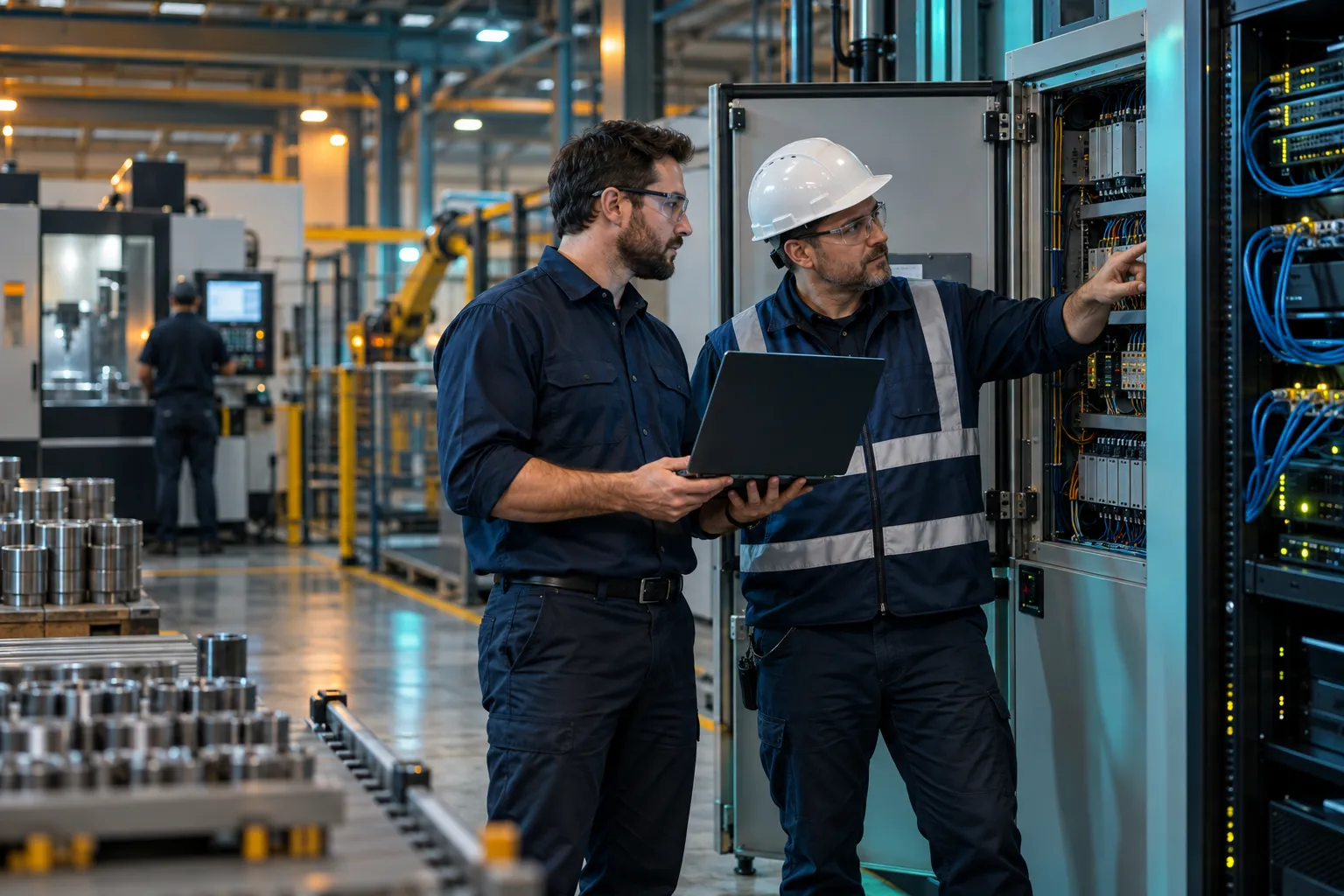
Your support model affects how quickly your team resolves issues without putting production at risk. The right fit depends on internal capacity, equipment, customer requirements, and downtime tolerance. Evaluate providers by how they handle production constraints, recurring problems, and ownership of open risks, not ticket volume alone.
Side-by-Side: Where a Generalist Breaks Down on a Plant Floor
Use these operating differences to guide a provider discussion. A generalist may handle routine office support well; the question is whether the model accounts for production equipment and schedules.
| Area to assess | General IT support model | Manufacturing-focused IT/OT support |
|---|---|---|
| Production changes | May schedule work around standard business hours. | Coordinates changes with operations and maintenance windows. |
| Legacy equipment | May treat unsupported controllers as ordinary endpoints. | Plans controls around patch limits, machine dependencies, and access paths. |
| Recurring incidents | Can close each ticket without documenting a shared root cause. | Tracks patterns and assigns follow-up ownership. |
| Leadership reporting | May emphasize ticket activity. | Connects open risks and changes to uptime, delivery, and compliance needs. |
In-House IT, Co-Managed, or Fully Managed: The Honest Trade-offs
In-house IT keeps knowledge close to your systems and production teams, but a small staff may be stretched across projects, support, and security. Co-managed support adds capacity or specialist skills while your internal team retains defined responsibilities. Fully managed support may suit a plant without enough internal IT capacity, though leadership still needs visibility and clear decision rights.
Assign owners for user support, network changes, backups, cybersecurity, vendor access, and production-system escalation. Confirm how on-site work is arranged; a hybrid model may handle routine support remotely and reserve site visits for planning or implementation. The trade-off worth naming is capacity versus control. Neither model removes the need for plant-level decisions.
Questions That Expose Whether a Provider Understands OT
Ask for specific examples of how the provider would work through your constraints:
- How do you schedule network changes around production windows?
- How do you document legacy controllers that cannot be patched?
- Who approves remote vendor access, and how is it removed afterward?
- How do you identify recurring incidents and report their root causes?
- How are backup recovery and system restart procedures tested?
- Can you map security work to applicable NIST, CMMC, or ISO requirements?
Look for clear answers about process, ownership, and coordination with operations. A provider should explain what requires a maintenance window and what evidence it will give your leadership team.
A sound support arrangement gives your team defined escalation, documented changes, and fewer surprises during a shift. To assess the fit, schedule a 30-minute discovery call with Andromeda, or use the IT Drag™ Calculator to organize operational costs before speaking with a provider.
Frequently Asked Questions
What does manufacturing mean in practical terms?
Manufacturing is the conversion of raw materials or components into finished goods on a production floor. In 2026, it splits into two main categories: discrete manufacturing, which builds countable items like machines and appliances, and process manufacturing, which transforms ingredients through mixing, heating, or refining. Your production type determines how much downtime your floor can absorb.
What is the difference between a producer and a manufacturer?
A producer creates goods or output broadly, while a manufacturer specifically transforms raw materials or components into finished physical products. In a plant setting, the distinction matters less than how you produce: a job shop pausing one custom order recovers quickly, while a continuous process may need careful coordination to reach a safe stop before anything pauses.
What is production in a manufacturing plant?
Production is the series of coordinated steps, equipment, and data exchanges that turn materials into shippable product. It depends on reliable connections among your ERP system, shop-floor applications, and equipment. When a shared system fails, production keeps running against stale schedules and someone spends days reconciling records by hand.
What is another word for production in manufacturing?
Common alternatives include output, throughput, and fabrication, depending on context. On the plant floor, throughput is the term most operations managers use because it measures what actually ships. Whatever word you use, the metric that matters is how much disruption your production method can absorb before quality, safety, or delivery dates suffer.
How does process manufacturing differ from discrete manufacturing?
Discrete manufacturing produces identifiable units, from single components to finished machines, while process manufacturing transforms materials measured by weight, volume, or formula. Discrete failures often affect specific work orders or stations. Process operations face different constraints: a batch may be held during an investigation, and a continuous line needs a planned, safe shutdown, not just a server restart.
What infrastructure do AI and IIoT sensors require on a plant floor?
AI tools and Industrial Internet of Things (IIoT) sensors require dependable data collection, documented devices, planned network capacity, and controlled access. Gaps in data or inconsistent timestamps weaken predictive maintenance analysis before it reaches your maintenance team. Sensors added without an inventory create unmanaged connections that expand your attack surface.
Why does uptime tolerance vary between plants?
Uptime tolerance depends on your production methods, equipment behavior, and available workarounds. A disconnected workstation may run on a local fallback, while a line that depends on shared production data may not. Mapping critical applications and equipment to the production steps they support shows which assets can pause safely and which need uninterrupted data exchange.