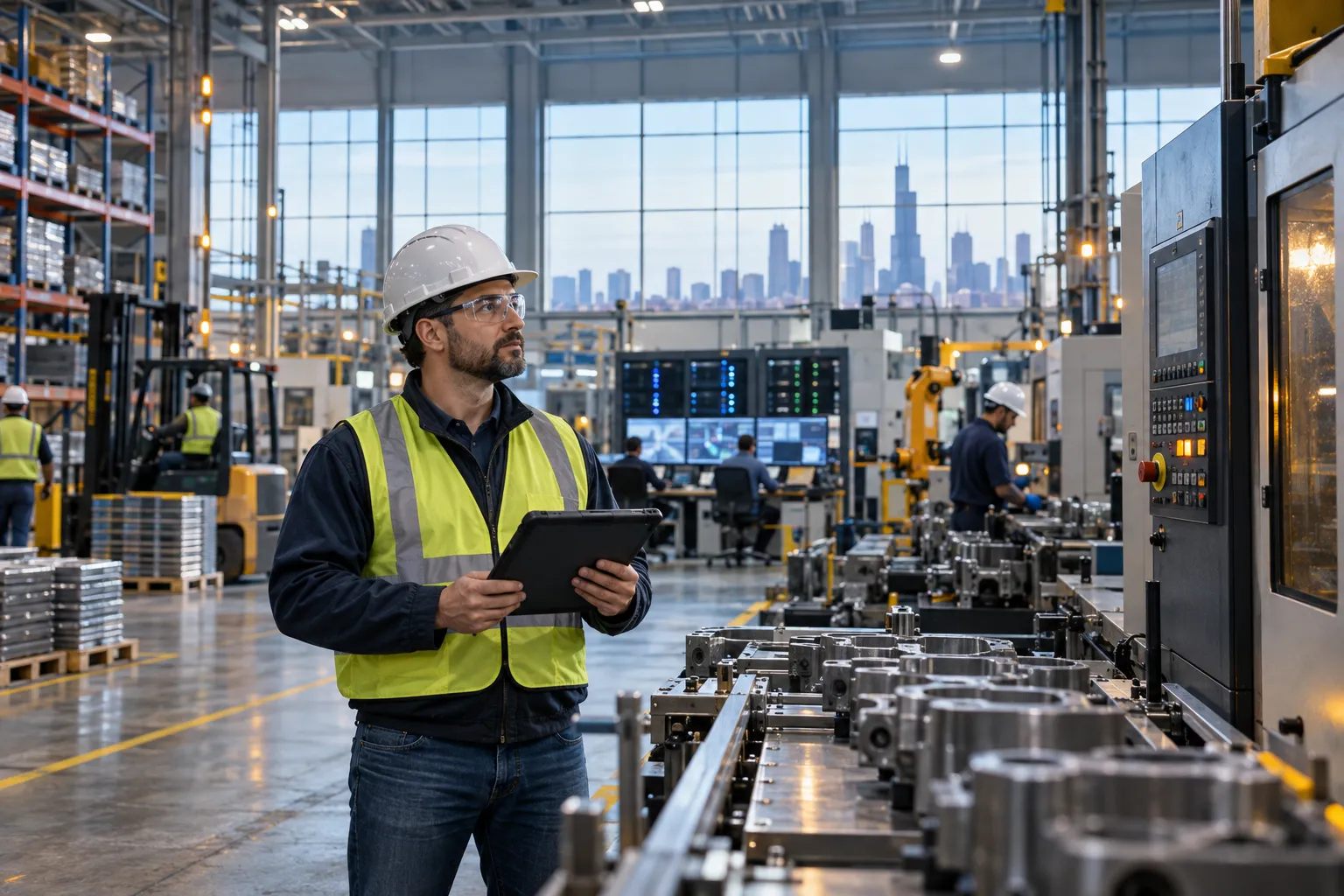
manufacturing in chicago il
When an order stalls because a production system cannot reach the floor, the lost time may look like an equipment problem until someone traces the network. Manufacturing in Chicago, IL spans food processing, machinery, chemicals, metal fabrication, and other sectors, each with its own production constraints.
Key Takeaways
- Chicago's manufacturing base spans food processing, machinery, chemicals, and metal fabrication, and each sector carries different tolerances for downtime on the production floor.
- Network problems often disguise themselves as equipment failures, so tracing connectivity should come before scheduling repairs or replacement parts.
- Plants running legacy controllers on flat networks face operational risk that generalist IT providers rarely account for.
- Operational leaders should judge IT decisions by uptime, throughput, and on-time delivery rather than by the technology deployed.
- Stability comes from having fewer recurring issues, not from fixing them faster after a shift is already lost.
This guide maps the sectors and plant-floor pressures that company rankings leave out. It identifies the operational questions to ask when IT problems interrupt schedules, machine data, or shipping.
Manufacturing in Chicago, IL: What the Sector Map Actually Looks Like Today
Chicago-area manufacturing includes industrial machinery, building materials, chemical production, food and beverage processing, textiles, plastics, electrical equipment, metal fabrication, warehousing, and wood and paper products. Read a company list by sector and operating conditions: food plant traceability requirements differ from a machinery maker’s production controls.
The Sectors That Drive Chicago and Illinois Manufacturing
Manufacturers in Illinois work across supply chains, from fabricated components and industrial equipment to packaged food and construction materials. Production schedules, sanitation requirements, equipment age, and customer audits vary by sector. A useful sector guide identifies those operating conditions, not just employers or company headquarters.
Major Manufacturers by Sector: An At-a-Glance Table
Company directories can help build a shortlist, but they do not establish a definitive ranking of the top 100 manufacturing companies in Illinois. Treat the examples below as sector markers, then verify each site’s current location, products, and operating scope before using it for supplier or workforce research.
| Sector | What plant leaders may encounter | Named example |
|---|---|---|
| Industrial machinery and equipment | Production equipment, machine controls, and service parts | John Crane, with a Chicago operation |
| Food and beverage processing | Sanitation schedules, traceability, and time-sensitive production | Sector represented across the Chicago region |
| Metal fabrication and electrical equipment | Machine uptime, job sequencing, and material flow | Sectors represented across Illinois |
| Chemicals, plastics, and building materials | Process controls, equipment availability, and safety requirements | Sectors represented across Illinois |
The Geography: Corridors, Suburban Clusters, and Collar Counties
Manufacturing activity extends beyond Chicago’s city limits. Plants and suppliers operate across suburban industrial corridors and the collar counties, where highways, rail, freight, and a regional labor pool shape daily operations. A company’s address is only a starting point: the specific plant location determines commute patterns, supplier routes, and which facilities share systems or support staff.
Why Chicago Is the Nation's Food and Beverage Capital
The region’s food and beverage presence reflects its role in processing, packaging, distribution, and transportation. Plants coordinate production with ingredient availability and shipment windows while maintaining sanitation records and product traceability. Schedule accuracy and reliable access to production data are practical operating needs.
What Those Sectors Face on the Floor: IT, OT, and the Downtime Nobody Prices Up Front
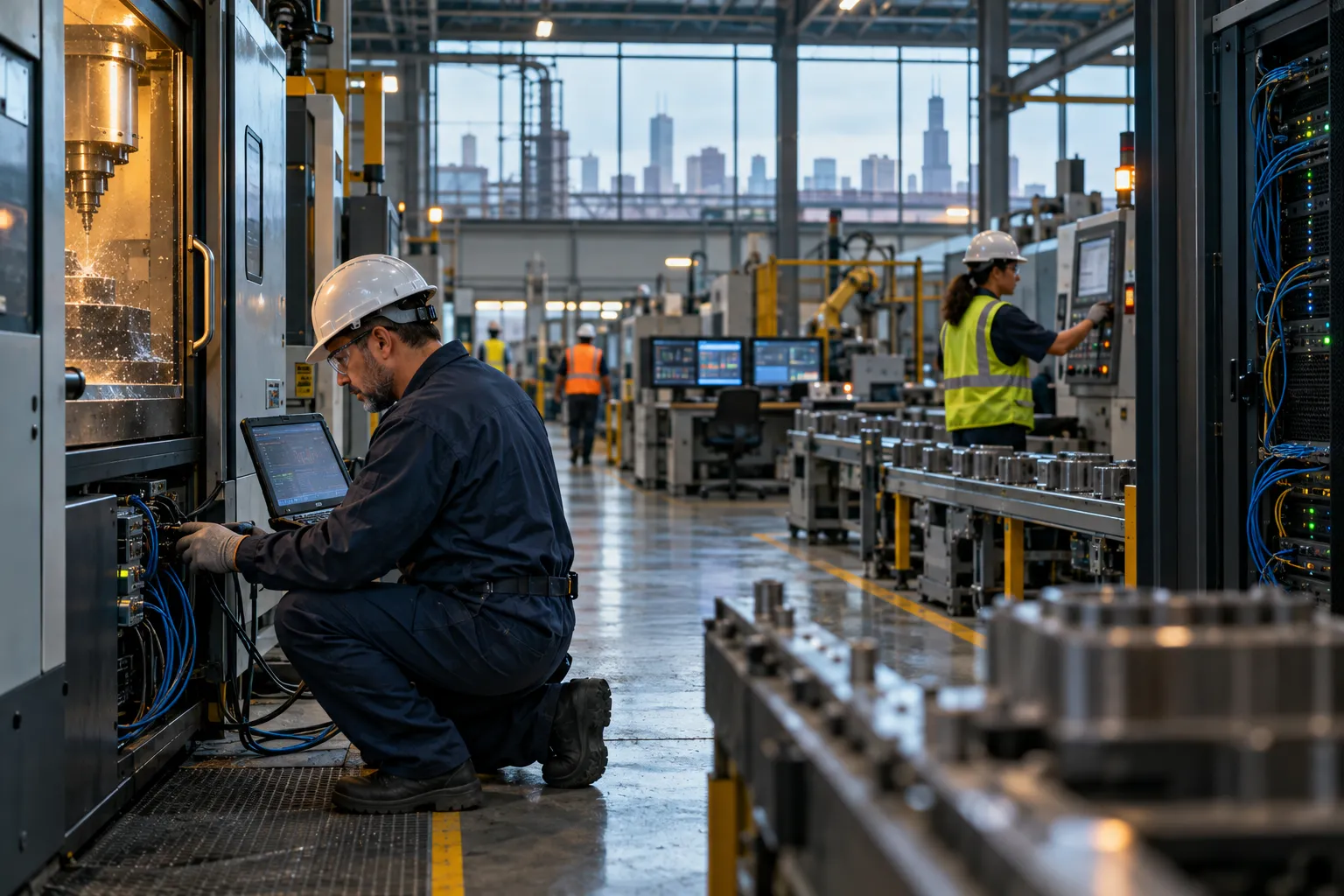
IT vs OT: Why Your Plant Network Is Not a Bigger Office Network
When a scanner stops updating orders or a machine loses its connection to a production system, your team needs to know whether the fault sits in office IT or operational technology (OT). IT handles business systems such as email and financial software. OT includes devices and networks that monitor or control physical processes, such as programmable logic controllers (PLCs) and machine interfaces. A plant network carries both kinds of traffic, but equipment and uptime requirements differ.
That distinction changes how teams plan access, updates, and troubleshooting. A maintenance window that works for office laptops may not work for a line running through the night. Network segmentation separates traffic so office devices do not automatically share access with controllers. The goal is to limit unnecessary paths without changing machine settings or interrupting production.
Legacy Equipment That Cannot Be Patched (and What to Do About It)
Some production equipment runs unsupported operating systems or controllers that cannot be patched without risking validation, compatibility, or uptime. Replacing a machine may not be realistic, and an untested update can create a different production problem. Start by documenting the device, its connections, vendor requirements, and the consequence of failure.
Controls can then be designed around the constraint. Restrict which systems can communicate with the equipment, limit remote access, and plan changes with operations and maintenance. The controller can remain unchanged while network paths around it become more controlled.
Sector-Specific Pressure: Food Safety, CMMC, and Cyber Insurance Questionnaires
Food processors may need dependable production records and traceability data to support food safety procedures. Manufacturers serving defense supply chains may face CMMC, the Cybersecurity Maturity Model Certification, with requirements tied to protecting controlled information. Cyber insurance questionnaires can ask about access controls, backups, endpoint protection, and incident response.
These demands are not interchangeable. Map each requirement to the systems and records it affects, then confirm who owns the evidence. A documented process is easier to explain during an audit or renewal than informal assurances.
The Operational Cost Shows Up As: Recurring Tickets, Stale Schedules, and Lost Shift Hours
A network fault can leave production planning disconnected from what the floor is building. Here is what that looks like on the floor:
- Scanners or terminals fail to update order status.
- Employees repeat data entry after systems reconnect.
- Supervisors work from a stale schedule while a ticket remains open.
- Maintenance and IT teams lose time determining which system caused the interruption.
Track incidents by affected system, production area, duration, and repeat frequency. That record helps distinguish a machine fault from a network or application issue and gives operations a basis for planning corrective work. When you need a provider familiar with plant constraints, Andromeda Managed IT Services for Industrial/Manufacturing Clients is a relevant service option. Assess its scope against your systems, access requirements, and production schedule.
IT Drag: The Cost Every Company List Leaves Out
What IT Drag Looks Like Week to Week in a Mid-Size Plant
A plant can keep shipping while small technology failures quietly consume time. IT Drag™ is Andromeda’s term for compounding daily inefficiencies caused by recurring IT problems, unclear ownership, and workflows that technology makes harder. A single ticket may appear minor; repeated across departments and shifts, the same fault can stall order updates, trigger manual work, and pull supervisors away from production.
Look for patterns rather than isolated incidents. Common signs include:
- Employees re-entering data after a system or network interruption
- Recurring service tickets with no documented root cause
- Production and office teams working from different schedule information
- Operations staff deciding whether a fault belongs to IT, maintenance, or a vendor
Logging affected systems, areas, repeat frequency, and workarounds helps make the cost visible. It shows up as lost attention and shift time, even when the line never fully stops.
Generalist MSP vs Manufacturing-Specialist MSP: An Honest Comparison
A support model built around office systems may not account for production windows, legacy controllers, or the consequences of changing a plant network. That mismatch is understandable when a provider has not been given a clear picture of plant operations. Evaluate how support handles manufacturing conditions, not just how quickly it closes a ticket.
| Area | Generalist support approach | Manufacturing-focused approach |
|---|---|---|
| Change planning | Schedules updates around standard office availability | Coordinates changes with production and maintenance windows |
| Incident handling | Closes the immediate ticket | Tracks repeat faults and investigates root cause |
| Plant equipment | May treat controllers like ordinary endpoints | Documents constraints and controls access around legacy equipment |
| Leadership reporting | Emphasizes ticket counts and response activity | Connects recurring issues to operational impact and planned work |
Andromeda Managed IT Services for Industrial/Manufacturing Clients is one service option for industrial and manufacturing environments. Assess its scope against your plant’s systems, escalation needs, and production schedule.
The Normalization Period: What Change Actually Requires
A new support relationship does not reveal every recurring issue in its first week. The incoming team needs time to document systems, access, vendors, open risks, and operating constraints. Andromeda describes roughly three months as a typical normalization period. Your staff may need to confirm equipment ownership, explain production dependencies, and help schedule changes that cannot happen during a run.
After the baseline is established, work shifts toward resolving repeat causes and planning improvements in a controlled order. Typical clients see service desk tickets begin to decline within three to nine months. Timing depends on the environment and work required; it is a pattern, not a promised timetable.
What Our Data Shows (and What It Does Not Promise)
Andromeda publishes service metrics updated weekly from trailing 30-day data. The published median ticket response time is 12.0 minutes, and 97% of issues are resolved within eight business hours. Those figures describe service performance across the measured period. They do not predict resolution time for a specific plant incident or replace agreement on escalation and coverage.
A documented Chicagoland multi-site manufacturer case study reported roughly a 50% decrease in IT issues. One case study cannot establish the same outcome for every operation. For a plant considering Andromeda Managed IT Services for Industrial/Manufacturing Clients, ask whether recurring faults become less frequent and production teams gain clearer ownership, documentation, and planning.
How to Evaluate an IT Partner for Your Chicago Plant
A support agreement should make ownership, production constraints, and planned work clear before the next outage. When reviewing a provider or renewing an MSP contract, ask how the team will learn your systems, coordinate with operations, and report on recurring problems. The Andromeda Managed IT Services for Industrial/Manufacturing Clients is one service option to assess against those requirements. Base your decision on documented scope and operating fit, not broad promises.
A Six-Step Evaluation Checklist for MSP Contracts
Use these questions to test whether a proposed agreement accounts for your plant’s operating conditions:
- Set boundaries: Which sites, users, servers, networks, and production systems are included?
- Define coverage: What hours, response targets, escalation paths, and on-site options apply?
- Map ownership: Who coordinates with maintenance, machine vendors, and your internal IT staff?
- Require root-cause tracking: How are repeat incidents documented and assigned for corrective work?
- Plan changes: Who approves updates, and how are maintenance windows agreed upon with operations?
- Review reporting: What will leadership see about open risks, recurring faults, and planned improvements?
Ask for sample reporting and a written transition plan. A clear answer identifies who does the work, what access is needed, and how changes are sequenced around production.
IT/OT Security Controls Worth Asking About
Security planning should protect business systems without treating a machine controller like an office laptop. Ask whether the proposed approach documents plant assets, separates network traffic, restricts remote access, and records who can reach sensitive systems. Confirm how backups are tested and how the provider would coordinate incident response with operations and maintenance leads.
For defense supply-chain work, ask how evidence is organized against applicable CMMC and NIST requirements. For all plants, clarify who reviews access, approves exceptions, and communicates security changes before implementation. Controls help when responsibilities and production constraints are understood.
How Manufacturing IT Support Is Scoped and Priced
Pricing depends on the agreed service boundary and the condition of the environment. Factors include supported locations, user and device counts, network complexity, security and compliance needs, coverage hours, and on-site work. Ask which items are included in the recurring fee and which require separate approval, such as major projects, hardware purchases, or after-hours implementation.
Also establish what happens during transition: discovery, documentation, access setup, open-ticket review, and coordination with existing vendors. A defined scope makes costs easier to compare with the work your plant needs. Evaluate the Andromeda Managed IT Services for Industrial/Manufacturing Clients against these same practical details.
Workforce Reality Check: Entry-Level Roles, Apprenticeships, and Hiring Pipelines
Technology support does not replace the need for skilled operators, maintenance technicians, or production supervisors. When evaluating a local hiring pipeline, ask employers, schools, and workforce organizations about entry-level roles, paid training, apprenticeships, and advancement from hands-on positions into technical work. In a high-cost region, clear pathways and realistic job requirements matter to candidates deciding whether to stay.
Identify which skills are difficult to hire and which can be developed internally. Cross-training staff on equipment documentation, safe escalation, and basic system procedures can improve continuity without shifting IT duties onto production employees.
Frequently Asked Questions About Manufacturing in Chicago, IL
What Industries Make Up Manufacturing in Chicago and Illinois?
Key sectors include industrial machinery, building materials, chemicals, food and beverage processing, textiles, plastics, electrical equipment, metal fabrication, warehousing, and wood and paper products. Each has distinct production schedules, equipment, and compliance needs.
Which Are the Top Manufacturing Companies in Chicago?
Company directories identify employers across machinery, food processing, materials, and other sectors, but rankings vary by source and criteria. A top 100 manufacturing companies in Illinois list is a starting point, not a definitive measure of plant scale or local operations. Verify each company’s current facilities and activities before relying on a listing.
What Is the Difference Between IT and OT?
Information technology (IT) supports business systems such as email and finance software. Operational technology (OT) monitors or controls physical processes, including production equipment. They connect in many plants, but changes to OT require careful planning around safety and uptime.
What Does John Crane Do in Chicago?
John Crane makes engineered products and provides services for rotating equipment, including mechanical seals. It is an example of the region’s industrial machinery sector. Confirm current site activities directly before making location-specific assumptions.
Frequently Asked Questions
What industries are prominent in Chicago manufacturing?
Chicago manufacturing spans industrial machinery and equipment, food and beverage processing, metal fabrication, chemical production, plastics, building materials, electrical equipment, and warehousing. Each sector carries different operating conditions, from food traceability requirements to machine uptime demands in fabrication shops.
What are some manufacturing businesses in Illinois?
Illinois manufacturing includes companies like John Crane, which produces engineered products for rotating equipment such as mechanical seals from its Chicago operation. Company directories can help build a shortlist, but verify each site's current location, products, and operating scope before relying on it for supplier or workforce research.
How did Chicago get so wealthy?
Chicago's wealth grew from its position as a processing, packaging, distribution, and transportation hub. That role built a deep manufacturing base in food and beverage, machinery, and materials, supported by highways, rail, and freight corridors that still shape plant operations across the region today.
What US state is #1 in manufacturing?
Rankings of manufacturing output shift year to year, and Illinois remains a major manufacturing state anchored by the Chicago region. Rather than chasing a ranking, plant leaders get more value from understanding the sectors and plant-floor conditions that apply to their own operations and supply chains.
What city has the most manufacturing in the US?
Chicago is consistently among the largest manufacturing cities in the US, with production extending well beyond city limits into suburban corridors and the collar counties. A company's address is only a starting point, since the specific plant location determines commute patterns, supplier routes, and shared systems.
Why does plant IT downtime stop production schedules?
Plant networks carry both IT and OT traffic, so a fault in office infrastructure can disconnect machines, scanners, and production systems. When a scanner stops updating orders or a machine loses its connection to the floor, schedules stall until someone traces whether the problem sits in IT or operational technology.
What should manufacturers do with legacy equipment that cannot be patched?
Document the device, its connections, vendor requirements, and the consequence of failure. Then restrict which systems can communicate with the equipment and limit remote access. The controller stays unchanged while the network paths around it become more controlled, protecting uptime without risking validation or compatibility.