
industrial plant services
A failed conveyor drive can stop packaging while the maintenance crew waits for a replacement part. A disconnected controller can interrupt production even when the equipment itself is sound. Industrial plant services covers physical work on equipment and digital support for the systems that keep production moving.
Key Takeaways
- Industrial plant services spans two distinct disciplines: hands-on physical maintenance of equipment and the digital support that keeps production systems running.
- Operational failures often stem from the systems around the equipment, not the machinery itself, so both sides of the service equation matter.
- When one conveyor drive stalls packaging, the cost shows up as lost shift hours, delayed orders, and overtime to catch back up.
- Choosing a provider means checking whether they understand production environments, not just whether they can fix a ticket.
- A strong partner should reduce recurring issues over time, because stability comes from having fewer problems rather than faster fixes.
The term is broad, so buyers should ask what work a provider performs, which systems it supports, and how it plans around production schedules. For manufacturing IT and operational technology (OT), Andromeda Managed IT Services for Industrial/Manufacturing Clients addresses the digital side, including plant networks, cybersecurity, and support for production environments.
What Industrial Plant Services Actually Cover (and What They Leave Out)
Industrial plant services are the contracted work, expertise, and support used to keep a facility’s equipment, infrastructure, and production systems operating. The scope can include mechanical maintenance and fabrication, as well as digital services for plant networks and OT. It does not automatically include every task at a facility. Buyers should confirm whether a proposal covers equipment, controls, information technology, or only a defined part of the operation.
The Physical Half: Maintenance, Fabrication, Installation, and Repair
Physical services address the machines and infrastructure that make or move product. Work may include inspections, preventive maintenance, equipment repair, parts fabrication, installation, and planned shutdown support. A fabrication shop may build or repair components, while a field crew may install equipment or perform maintenance at the plant.
Ask which assets are covered, what work is performed on-site, and how crews coordinate with operations. A scheduled repair still affects throughput if it takes a line out of service during a critical production window.
The Digital Half: Plant IT and OT Services
Digital services support the systems that move production and business information. Plant IT can include network infrastructure, cloud and Microsoft 365, backups, cybersecurity, and user support. OT includes connected equipment and control systems used to operate production. Manufacturing execution systems (MES) track production activity, while enterprise resource planning (ERP) systems connect functions such as orders, inventory, and scheduling.
These environments have practical constraints: legacy equipment may not support routine patching, and a plant may have no safe maintenance window during a production run. Andromeda Managed IT Services for Industrial/Manufacturing Clients focuses on manufacturing IT and OT support, with changes sequenced to protect production uptime.
Where the Two Halves Meet on the Production Floor
A repair can depend on digital systems, and a network change can affect a machine’s ability to report status. When maintenance, controls, and IT teams plan separately, a fix in one area can create an outage in another. Set clear ownership and coordination, including who approves changes, tests the result, and communicates with production.
| Service area | Typical scope | Production question |
|---|---|---|
| Physical plant work | Maintenance, repair, fabrication, installation | Which equipment and work windows are included? |
| Plant IT and OT | Networks, cybersecurity, backups, production-system support | How are changes tested and scheduled around operations? |
| Coordinated work | Planning across equipment and digital systems | Who owns escalation when both areas are involved? |
Industries Served and the Physical Service Categories Behind Them
Core Service Categories: Preventive, Predictive, Corrective, and Turnaround Work
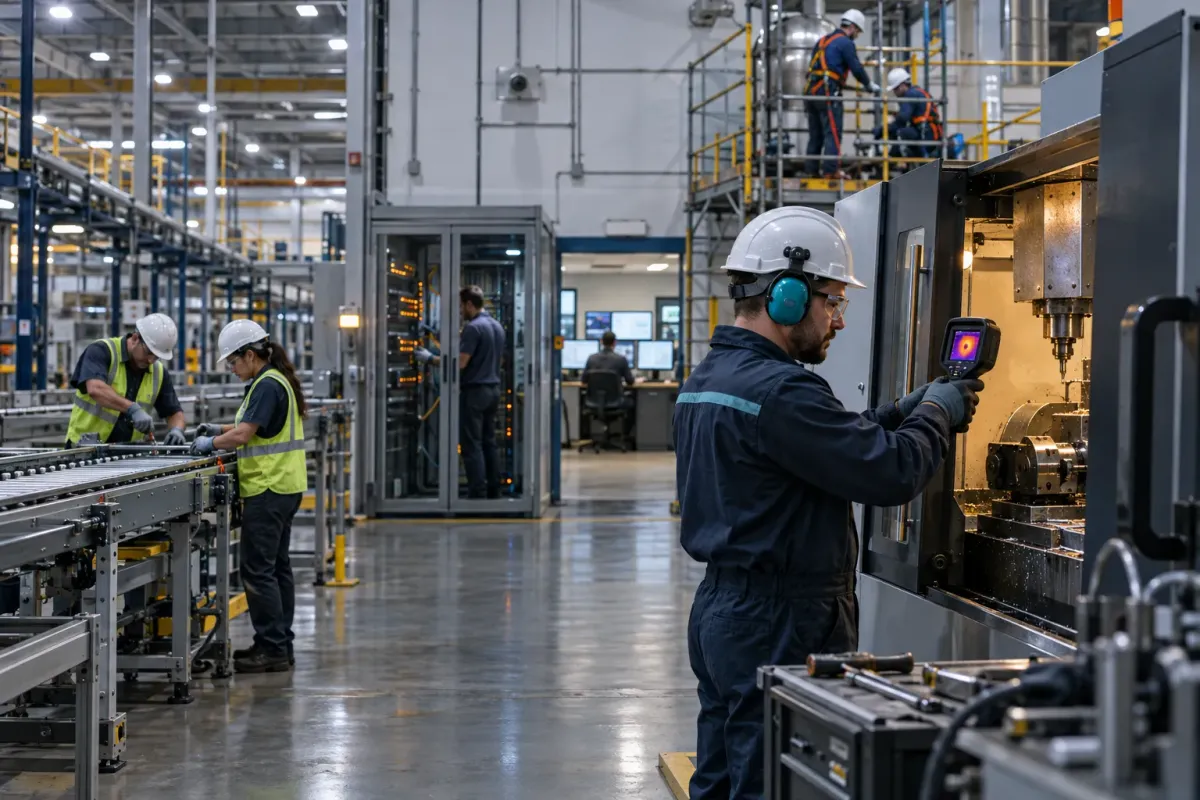
Physical maintenance work generally falls into four categories. Preventive work follows a schedule to inspect or service equipment before a known maintenance interval. Predictive work uses observed condition, such as vibration or temperature, to help identify when service may be needed. Corrective work repairs a fault after it occurs. Turnaround work groups inspections, repairs, and upgrades into a planned period when equipment is taken out of service.
Each category has a different planning requirement. Predictive programs need useful condition data; turnarounds require coordination across crews, parts, and operations. Neither approach removes the need to plan for faults or confirm responsibilities.
Which Industries Buy These Services and Why
Facilities with production equipment, process systems, or material-handling assets may need outside service capacity. Common manufacturing settings include:
- Industrial machinery and equipment
- Building materials, chemical production, and food and beverage processing
- Textiles, rubber, glass, and plastics
- Electrical equipment and metal fabrication
- Warehousing, wood products, and paper products
The work differs by site. A food processor may need tightly coordinated sanitation and maintenance windows; a metal fabricator may prioritize equipment availability and repair planning. Providers need to understand the facility’s operating conditions, not just its asset list.
Why Downtime Is the Metric Every Category Answers To
A maintenance task matters because of its effect on safe operation, throughput, and scheduled shipments. An unplanned stoppage can idle labor, disrupt upstream and downstream work, and force a team to recover lost production later. Planned service also makes equipment unavailable during the work, so timing and preparation matter.
Compare service plans by asking how they identify recurring faults, coordinate work windows, and document repairs. The relevant measure is whether the work helps your plant manage downtime and return equipment to service predictably.
Universal Plant Services: Locations, Capabilities, and Careers, Answered
Universal Plant Services Locations: Houston Headquarters and Corpus Christi Operations
Universal Plant Services is headquartered in the Houston metropolitan area, according to company and third-party profiles. Its footprint extends beyond Houston: the company’s Indeed profile describes roughly 14 full-service facilities across the Gulf Coast, West, and Midwest, while Craft.co lists 18 office locations. Those counts describe different location categories and should not be treated as interchangeable.
Searchers asking about Universal Plant Services locations or a Corpus Christi presence can use this reference as a starting point. The company’s job listings include Corpus Christi-area roles, but a listing does not establish a staffed service facility or its exact capabilities. Confirm the current site address, services, and coverage directly with Universal Plant Services before planning work.
| Location question | Available information | What to verify |
|---|---|---|
| Houston | Headquarters in the Houston metropolitan area | Dispatch point, service area, and current contact details |
| Corpus Christi | Corpus Christi-area job listings appear in Indeed results | Whether a local operation is active and which crews it supports |
| Wider footprint | Indeed profile reports roughly 14 full-service facilities; Craft.co lists 18 office locations | Which location provides the specific field or shop service needed |
What Services the Company Provides and Which Industries It Serves
Universal Plant Services describes industrial services that include equipment repair and fabrication, along with field work for industrial facilities, according to its company capabilities information. Scope can vary by service line and location. Confirm the equipment type, whether work takes place in a shop or at the facility, and what planning or outage support is included.
For Universal Plant Services industrial services, ask which industries and operating conditions match the proposed crew’s experience. Clarify work boundaries, required permits, parts responsibility, scheduling, and who coordinates with plant operations. A broad service list is a starting point, not confirmation that a provider can cover a specific asset or production window.
Careers in Corpus Christi and Houston: Roles, Skills, and Hiring Patterns
People searching for industrial plant services careers can find Universal Plant Services postings in both the Houston and Corpus Christi areas. Indeed search results show location-specific openings, though available roles change over time. Check current requirements, work location, and application instructions in the postings.
Industrial service employers may recruit for field and shop work, along with supervision and support roles. Read each posting for required trade experience, safety credentials, travel expectations, shift schedule, and whether the work is at a customer site or facility. These details matter as much as the job title when assessing fit.
What a Location Map Can and Cannot Tell You About Service Quality
A map can show geographic presence. It cannot tell you whether a crew has the right equipment experience, how quickly it can mobilize, or how work will be coordinated around production. Ask directly about scope, staffing, response process, and references for comparable work.
For digital support at a manufacturing site, Andromeda Managed IT Services for Industrial/Manufacturing Clients addresses plant IT and operational technology needs. Evaluate any proposed provider by its assigned responsibilities and its approach to recurring production issues, not by the number of pins on a map.
How to Evaluate an Industrial Plant Services Provider: A Checklist
A Numbered Evaluation Framework for Shortlisting Providers
Shortlisting should establish whether a provider can perform the required work safely, coordinate with your team, and document what happens. Apply the same criteria to every proposal so service descriptions, exclusions, and response expectations are visible side by side.
- Define the assets, systems, sites, and work windows in scope.
- Verify relevant experience with your equipment and production environment.
- Confirm staffing, escalation ownership, and scheduling assumptions.
- Review safety practices, compliance needs, and change controls.
- Set reporting expectations for work completed, repeat faults, and follow-up.
For manufacturing IT and OT, confirm that network changes account for legacy controllers and production schedules. Andromeda Managed IT Services for Industrial/Manufacturing Clients is designed for that digital operating context, with work sequenced around production requirements.
Compliance as a Selection Criterion: NIST, CMMC, and ISO Readiness
Compliance support should connect documented controls to the systems and processes your facility uses. NIST is the National Institute of Standards and Technology; CMMC is the Cybersecurity Maturity Model Certification; ISO refers to standards published by the International Organization for Standardization. Not every plant has the same obligations, so identify which contract, customer, or regulatory requirements apply.
Ask how the provider documents access, security controls, backups, incident handling, and remediation responsibilities. Andromeda provides alignment with CMMC, NIST, and ISO where applicable, and its Cybersecurity & Compliance service is NIST 800-171 compliant. Your team should confirm the specific scope and evidence needed for its assessment.
Nine Questions to Ask Before You Sign
Use these questions to surface gaps before work begins. Request clear, written answers tied to the proposed scope.
- Which equipment, sites, and systems are included?
- What work is excluded or billed separately?
- Who approves schedule changes and production-impacting work?
- How are urgent issues escalated, and who owns the response?
- What safety procedures and site credentials are required?
- How are parts, permits, and subcontractors handled?
- What records will you receive after service?
- How are repeat failures tracked and addressed?
- What conditions allow either party to revise the scope?
The Daily Friction Your Contract Probably Misses (IT Drag)
A contract can cover tickets and planned tasks while leaving daily inefficiency uncounted. Slow logins, unreliable plant connectivity, repeated access problems, and manual workarounds consume employee time even when no single incident triggers a major outage. Andromeda calls this compounding operational friction IT Drag™.
Ask providers how they identify repeat causes, assign ownership, and report whether those issues decline. The useful measure is the effect on work: interruptions avoided, time spent on manual recovery, and production systems kept available. A service scope should make those responsibilities explicit.
Choosing on Uptime, Not Catalogs: The Decision That Actually Matters

Why Recurring-Issue Elimination Beats Service Breadth
A long service list does not tell you whether the same fault will interrupt production next week. Choose a provider that can trace repeat problems to their root cause, assign an owner, and show whether the issue returns. Review incident patterns, documented fixes, and the production impact of unresolved work, not just covered systems.
For a plant evaluating industrial plant services, uptime is the useful test: does the work help your team keep production moving and recover predictably when something fails? Service breadth matters when it matches your actual needs. Root-cause follow-through matters every shift.
A Measured Example: Fewer IT Issues After a Normalization Period
Andromeda’s documented case study of a Chicagoland multi-site manufacturer reports roughly a 50% decrease in IT issues. That outcome followed a normalization period, rather than appearing immediately after service began. Andromeda reports that typical clients see service desk tickets begin to decline within three to nine months after about three months of normalization. That is a reported pattern, not a promised result for every plant.
Early work often involves documenting systems, stabilizing operations, and correcting inherited issues. Agree on what will be tracked and when the provider will review the trend with your team.
Your Next Step: Measure the Drag or Start With a Conversation
Andromeda Managed IT Services for Industrial/Manufacturing Clients supports manufacturing IT and operational technology, with changes planned around production requirements. If recurring tickets, workarounds, or connectivity interruptions are consuming staff time, the IT Drag™ Calculator can help you estimate that daily friction. If you are ready to discuss your plant’s needs, schedule a 30-minute discovery call with Andromeda.
Choose the provider that makes recurring problems visible, assigns responsibility, and works to reduce their effect on uptime.
Frequently Asked Questions
What are industrial plant services?
Industrial plant services are the contracted work, expertise, and support that keep a facility's equipment, infrastructure, and production systems operating. The scope spans two halves: physical work such as maintenance, fabrication, installation, and repair, and digital work such as plant IT, networks, cybersecurity, and operational technology (OT) support.
What falls outside the scope of industrial plant services?
Hiring a provider does not automatically cover every task at your facility. Some proposals cover only equipment, others only controls or IT, and some only a defined slice of the operation. Confirm in writing which assets are included, what work is performed on-site, and how service windows fit your production schedule.
What is the difference between plant IT and OT services?
Plant IT covers the business systems side: network infrastructure, cloud and Microsoft 365, backups, cybersecurity, and user support. OT (operational technology) covers the connected equipment and control systems that run production, including manufacturing execution systems (MES) that track activity and ERP (enterprise resource planning) systems that connect orders, inventory, and scheduling.
What are the four main categories of physical plant maintenance?
Physical maintenance generally falls into four categories: preventive work on a set schedule, predictive work guided by observed conditions like vibration or temperature, corrective work to repair faults after they occur, and turnaround work that groups inspections, repairs, and upgrades into a planned outage. Each category carries a different planning burden, from condition data to multi-crew coordination.
Why is downtime the key metric for evaluating plant service providers?
Every maintenance task matters because of its effect on safe operation, throughput, and scheduled shipments. An unplanned stoppage idles labor, disrupts upstream and downstream work, and forces recovery later. Compare providers by asking how they identify recurring faults, coordinate work windows, and document repairs so equipment returns to service predictably.
Which industries typically buy industrial plant services?
Common buyers include industrial machinery and equipment makers, building materials, chemical, and food and beverage processors, textiles, rubber, glass, and plastics producers, electrical equipment and metal fabrication shops, and warehousing, wood products, and paper products operations. Work priorities differ by site: a food processor needs coordinated sanitation windows, while a fabricator prioritizes equipment availability and repair planning.
Why should plant maintenance and IT teams coordinate on changes?
A repair can depend on digital systems, and a network change can affect a machine's ability to report status. When maintenance, controls, and IT plan separately, a fix in one area can create an outage in another. Set clear ownership for who approves changes, tests the result, and communicates with production before work begins.