managed it services for industrial
When a plant network fails, operators may lose machine data, planners may use an outdated schedule, and a shipping window can disappear before support arrives. Andromeda Managed IT Services helps manufacturers reduce that exposure through managed it services for industrial operations, with attention to uptime, IT/OT boundaries, cybersecurity, and accountable response.
Key Takeaways
- Downtime on the plant floor carries costs that reach well beyond IT, from stale production schedules to missed shipping commitments.
- Managed IT services shift manufacturers from reactive break-fix support toward proactive monitoring with defined response commitments.
- Securing the boundary between business networks and operational technology keeps a breach in one area from spreading to machines that run production.
- Industrial cybersecurity must account for legacy equipment and controllers that were never designed with modern connectivity threats in mind.
- Manufacturers should expect clear escalation paths, measurable service levels, and accountable response times from any IT provider they bring onto the plant floor.
This guide covers the limits of reactive support, production-network organization, security, IT/OT connectivity, compliance, and service models for machine shops, chemical processors, machinery builders, and plastics manufacturers.
Beyond Break-Fix: Why Industrial IT Demands a Disciplined Operating Model
The High Cost of Reactive IT: Unplanned Downtime and Lost Shifts
Break-fix support waits for failure. A failed domain controller can interrupt authentication, a switch outage can stop barcode scanning, and a lost ERP connection can disrupt order entry. Supervisors then reconcile transactions, reschedule labor, and explain delayed shipments. Plants need prevention, monitoring, documented recovery, and maintenance windows planned around production.
What “IT Drag™” Really Means for Your Production Floor
IT Drag™ is the friction caused by recurring tickets, unclear ownership, aging workstations, weak documentation, slow approvals, and systems that exchange information poorly. It may appear as an operator waiting for a login, a maintenance lead bypassing a security control, or an office team rekeying data from a manufacturing execution system. The steady loss of throughput, attention, and confidence often matters more than one dramatic outage.
The Gap Between Office IT and Plant Floor OT: Why Generalists Fall Short
Information technology supports users, applications, identity, and business data. Operational technology controls or monitors physical processes through PLCs, HMIs, sensors, historians, industrial switches, and supervisory control systems. A password reset and firmware change carry different production risks. OT equipment may run for years, use vendor-specific software, or require a controlled shutdown. Effective support understands machine dependencies, safety procedures, remote access, change control, and the difference between an office reboot and a line interruption.
Andromeda’s Approach: A Disciplined Operating Model, Not Just a Help Desk
Andromeda Managed IT Services treats support as an operating function tied to plant performance. Work begins with inventory and ownership, then covers monitoring, patch planning, vulnerability management, backup validation, network documentation, and recurring-issue analysis. Andromeda reports a 1 minute 34 second average live tech phone pickup and a 12.0 minute median ticket response, based on its verified service benchmarks. Documented customer outcomes show IT service tickets reduced by approximately 50% within three to nine months.
Navigating IT/OT Convergence: Securing Your Production Network
Understanding the Purdue Model: Segmenting for Security and Stability
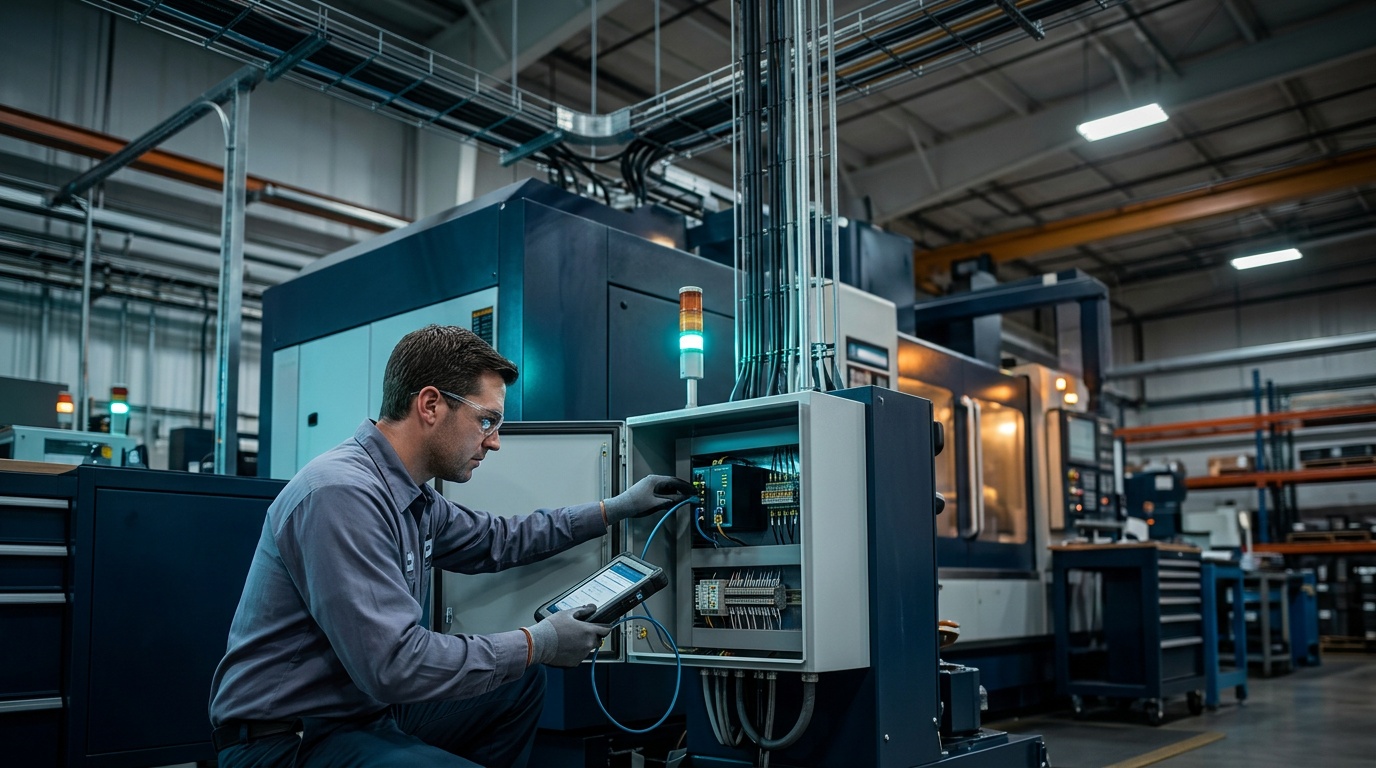
The Purdue Model maps separation between business systems and control systems. Enterprise applications sit above manufacturing operations, while supervisory systems, controllers, and field devices occupy lower levels. Firewalls, industrial DMZs, VLANs, access rules, and controlled conduits limit unnecessary traffic between zones. Segmentation also helps contain an issue in a user network so it does not automatically reach a cell, line, or process area. The design should reflect actual machine dependencies.
Bridging the IT/OT Divide: Connecting ERP, MES, and Legacy Equipment
Manufacturers need business and production systems to exchange scheduling, inventory, quality, and work-order information. ERP and MES integration becomes difficult when controllers use proprietary protocols, unsupported operating systems, or flat networks. A sound plan identifies required data, connection direction, record ownership, and the failure mode when a link is unavailable. Gateways, historians, read-only interfaces, and staged testing can connect legacy assets without directly exposing every machine to corporate or cloud traffic.
Industrial Cybersecurity Essentials: Beyond Antivirus for the Shop Floor
Endpoint protection is one layer. Managed cybersecurity services for manufacturers also require asset discovery, multifactor authentication, privileged access control, email filtering, vulnerability review, immutable backups, patch testing, logging, and an incident response plan that includes plant leadership. Remote vendor access needs special scrutiny because dormant accounts and broad permissions can create a path into production. Andromeda’s M*AR*S™ Security Stack uses layered controls across industrial endpoints and networks. Andromeda reports blocking more than 300,000 cyber attacks monthly across industrial endpoints through those layered stacks.
Key Compliance Frameworks: NIST, CMMC, and Manufacturing Readiness
Compliance depends on the information a plant handles and the contracts it supports. NIST 800-171 is commonly relevant when controlled unclassified information is present, while CMMC Level 2 may apply to defense contractors protecting that information. ISO standards can support security, quality, or continuity management. Readiness requires a system boundary, access records, risk assessments, backup and testing evidence, supplier controls, and owners for corrective actions.
Andromeda’s M*AR*S™ Security Stack: Layered Protection for Industrial Environments
The M*AR*S™ approach organizes security around prevention, detection, containment, and recovery. Controls are reviewed for effects on machines, maintenance access, production reporting, and emergency procedures. The practical test is whether the team can identify affected assets, isolate a threat, preserve evidence, restore clean systems, and explain its decision to an auditor or plant manager.
The Andromeda Five-Step Operating Model: Your Roadmap to Operational Maturity
Production improvement comes from a repeatable model connecting IT decisions to uptime, throughput, quality, and shipped orders. Andromeda Managed IT Services for Industrial/Manufacturing Clients uses five steps to move a plant toward managed it services for industrial operations with defined ownership, priorities, and measurable progress.
Step 1: Assess and Align, Understanding Your Current IT Environment
The assessment covers servers, switches, wireless access points, endpoints, cloud services, backups, accounts, production applications, remote access, and IT/OT dependencies. It records equipment age, warranty status, software versions, vendor contacts, recovery procedures, and single points of failure. Alignment then ranks issues such as a failing file server, unsupported operating system, or undocumented machine connection against production consequences, timing, risk, and budget.
Step 2: Take Command, Stabilizing Operations and Eliminating Recurring Issues
Monitoring identifies capacity problems, failed backups, unusual activity, device-health issues, and recurring patterns before shift-level disruption. Standard configurations, patch schedules, escalation paths, runbooks, testing, and rollback procedures create consistent responses around production requirements. Andromeda reports a 12.0-minute median ticket response and resolution of 97% of issues within eight business hours through its verified service benchmarks. Documented customer outcomes show tickets falling by approximately 50% within three to nine months after normalization.
Step 3: Secure and Comply, Fortifying Your Defenses and Meeting Standards
This step combines identity controls, multifactor authentication, endpoint protection, privileged access, vulnerability management, backup testing, email security, network monitoring, and incident response. Remote vendor connections receive particular attention because open access can expose controllers, historians, or engineering workstations. NIST 800-171 and CMMC Level 2 may apply when controlled unclassified information is involved, while ISO standards may support security, quality, or continuity programs. Evidence includes system boundaries, access reviews, risk treatment, recovery tests, and assigned responsibilities.
Step 4: Report and Guide, Transparent Leadership Dashboards and Proactive Updates
Plant leaders need reporting on open risks, aging assets, backup status, security events, recurring incidents, completed maintenance, upcoming changes, and decisions requiring attention. Dashboards should show which systems could affect shipping, which dependencies lack recovery coverage, and which improvements await budget or production access. Service reviews track trends, exceptions, roadmap progress, and next actions for the provider and plant.
Step 5: Lead and Modernize, Strategic IT for Future Growth and Efficiency
Once risks are understood, modernization may include replacing unsupported infrastructure, improving plant wireless coverage, refining ERP and MES integration, expanding cloud services, strengthening disaster recovery, or preparing a new facility for consistent network and security standards. Each initiative is evaluated against production schedules, staffing, capital plans, safety requirements, and maintenance capacity. A phased plan can isolate older assets and improve monitoring while preserving useful equipment.
The Andromeda Guarantee: Accountable Service Delivery with Clear SLAs
The Andromeda Guarantee defines scope, priorities, reporting, and escalation before an urgent event. Internal IT, operations, and finance can judge performance against agreed commitments, with managed it services for industrial support measured by operational dependability rather than vague availability.
Managed IT Services for Industrial vs. Generalist MSPs: What's Truly Different?
A plant needs support measured against production conditions, not office convenience. The provider must understand shifts, machine dependencies, maintenance windows, barcode workflows, engineering workstations, and the cost of stopping a line. IT network infrastructure management applies that standard through documented service levels, retained technical knowledge, and planning tied to uptime and shipped orders.
Operational Metrics That Matter: Response Times, Retention, and Resolution
Service reviews should show answer speed, ticket age, recurring incidents, and resolution level. Andromeda reports an average live tech phone pickup of 1 minute 34 seconds, a 12.0-minute median ticket response, and resolution of 97% of issues within eight business hours through verified service benchmarks. Ask for definitions covering priority rules, business-hour limits, escalation procedures, and exclusions.
Transparent Pricing vs. “Nickel-and-Dime” Billing: What to Expect
The agreement should identify covered users, devices, servers, network equipment, security controls, monitoring, backup oversight, onsite support, after-hours response, project work, and third-party charges. It should explain emergency billing, exclusions, rates, renewal terms, hardware responsibilities, written approval thresholds, and sample invoices.
The Value of Long-Term Technician Retention in Manufacturing IT
Technician changes create knowledge-transfer risk. A new engineer may not know which switch serves a cell, which workstation runs a legacy application, or which vendor requires advance notice for remote access. Andromeda reports average technician retention of more than eight years. That continuity supports documentation, diagnosis, and stable support while modernization is funded.
Co-Managed IT (CoMITS) vs. Fully Managed: Finding the Right Fit
Co-managed IT lets an internal team retain authority over architecture, applications, or plant engineering while assigning monitoring, security operations, endpoint administration, or overflow support externally. Fully managed service provides one accountable team for daily support, infrastructure, cybersecurity, vendors, and planning. The choice depends on internal coverage, shifts, specialized skills, and outage ownership. Define responsibilities in a service responsibility matrix.
Andromeda’s Premium Add-Ons: Maximizing Your Operational Advantage
Premium services should address a defined production risk. Options include disaster recovery design and testing, plant wireless assessments, advanced Microsoft cloud administration, compliance preparation, virtual CIO guidance, and security monitoring through the M*AR*S™ stack. Andromeda reports blocking more than 300,000 cyber attacks monthly across industrial endpoints through layered protection. Andromeda Managed IT Services for Manufacturing fits organizations needing those capabilities within a documented operating plan.
| Decision area | Industrial operating model | What to verify before purchase |
|---|---|---|
| Support | Priority-based response with plant-aware escalation | Pickup, response, resolution, and after-hours definitions |
| Knowledge | Documented systems and consistent technical ownership | Retention, runbooks, asset records, and transition procedures |
| Billing | Defined recurring scope with approved project work | Exclusions, rates, third-party charges, and approval controls |
Frequently Asked Questions for Industrial IT & Managed Services
What is the difference between standard commercial IT and managed IT services for industrial environments?
Industrial support accounts for OT equipment, production schedules, legacy systems, safety procedures, and line-interruption costs. Office support usually centers on users and business applications.
How do industrial MSPs bridge plant OT and back-office IT?
They map dependencies, segment networks, control remote access, and connect ERP, MES, historians, and legacy equipment through approved data paths without unrestricted machine access.
How does a provider prevent downtime during updates and maintenance?
Changes are tested, scheduled around production, communicated to affected teams, and supported by rollback plans. Backup validation and escalation reduce recovery uncertainty.
What security frameworks apply to mid-size manufacturing plants?
NIST 800-171 and CMMC Level 2 may apply when controlled unclassified information is handled. ISO standards may support security, quality, or continuity programs. Scope depends on contracts and data.
How can a company avoid hidden fees?
Require an itemized scope, exclusions, rate sheet, approval process, after-hours terms, and sample invoice before signing.
How quickly can Andromeda onboard a plant?
Timing depends on asset count, documentation, access, and production constraints. A controlled discovery phase avoids changing critical systems before dependencies are understood.
Frequently Asked Questions
What are managed IT services for industrial companies?
Managed IT services for industrial companies provide ongoing monitoring, maintenance, cybersecurity, help desk support, and recovery planning for business and production technology. Managed support covers servers, endpoints, cloud systems, industrial networks, scanners, controllers, and legacy equipment while accounting for production schedules, safety procedures, and IT/OT boundaries.
How much do managed IT services for industrial operations cost?
Managed IT services for industrial operations cost depends on the number of users, sites, devices, production systems, security requirements, support coverage, and compliance needs. A reliable assessment should also account for documentation, monitoring, backup validation, network work, planned maintenance, and response expectations instead of comparing providers by help desk price alone.
What is included in managed IT services for industrial environments?
Managed IT services for industrial environments typically include asset inventory, monitoring, ticket support, patch planning, vulnerability management, backups, network documentation, access controls, and incident response planning. Services may also cover IT/OT segmentation, vendor remote access, ERP and MES connectivity, recovery testing, and recurring-issue analysis.
How do managed IT services benefit manufacturing companies?
Managed IT services benefit manufacturing companies by reducing avoidable downtime, improving response time, and giving plant leaders clearer ownership of technology problems. Planned maintenance, validated backups, production-aware changes, and documented recovery can help protect machine data, scheduling, order entry, barcode scanning, and shipping commitments.
How do industrial managed IT providers protect production networks?
Industrial managed IT providers protect production networks through segmentation, monitored industrial DMZs, restricted remote access, multifactor authentication, privileged access controls, vulnerability reviews, and tested backups. A production-aware design limits unnecessary traffic between business systems and plant equipment while documenting approved connections and recovery boundaries.
Can managed IT services connect ERP, MES, and older factory equipment?
Managed IT services can connect ERP, MES, and older factory equipment by mapping data needs, ownership, connection direction, and failure handling before changes are made. Gateways, historians, read-only interfaces, staged testing, and controlled network paths can support data exchange without exposing every machine directly to corporate or cloud traffic.
How can a manufacturer choose the right managed IT services provider?
A manufacturer can choose the right managed IT services provider by checking industrial experience, IT/OT knowledge, response commitments, security practices, documentation methods, backup testing, and change control. Ask how the provider handles legacy equipment, vendor access, production outages, maintenance windows, and escalation to plant leadership before signing an agreement.