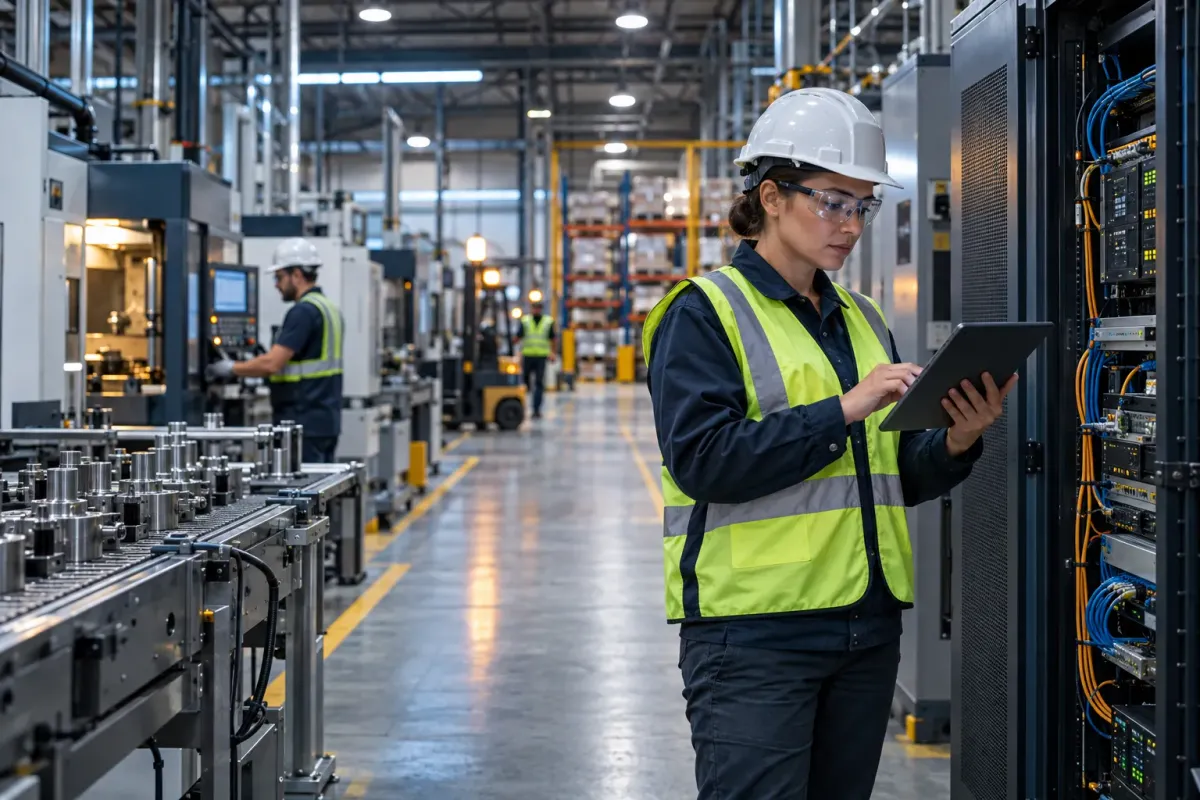
industrial technical services
A production line stops because a machine controller cannot communicate with the supervisory system, or a building system fails during a shift. The phrase industrial technical services can describe help for either problem, but the right provider depends on what failed and which systems are involved.
Key Takeaways
- Industrial technical services cover both information technology and operational technology, so buyers need to match the provider to the systems that actually failed.
- A generalist provider may fix an office network quickly, yet struggle with plant controllers, production software, and legacy equipment that cannot be patched.
- Manufacturers should evaluate providers on manufacturing and OT specialization, response accountability, and a documented approach to root cause rather than ticket volume.
- Recurring issues on the production floor usually point to a missing maintenance and monitoring model, not to isolated equipment failures.
- The right partner should reduce the daily inefficiencies that quietly slow production, and stability comes from having fewer problems, not faster repairs.
For plant leaders, the key distinction is whether the work involves machinery and facility systems, business technology, or the connection between them. Directing a service request to the right specialist can prevent delays caused by calling a provider without the required experience.
What Industrial Technical Services Actually Are (and What They Are Not)
Industrial technical services support the equipment, controls, infrastructure, and technology a plant depends on to operate. The term can include automation, electrical work, heating and cooling, mechanical maintenance, and industrial networking. It does not describe one trade or one standard package. Identify the affected system first, then look for a provider experienced with that system in an operating industrial facility.
A Plain Definition for Plant and Operations Leaders
When a conveyor stops, production staff may first suspect the motor, then discover that a sensor, programmable logic controller (PLC), or network connection is involved. Industrial technical work addresses the equipment and systems behind the failure, including diagnosis, installation, repair, integration, and planned maintenance. The work must account for safety, production schedules, and existing equipment.
The scope varies by provider. One team may focus on automation and machine controls; another may handle electrical systems, heating, ventilation, and air conditioning (HVAC), or industrial maintenance. For problems that cross into business technology or plant connectivity, Andromeda Managed IT Services for Industrial/Manufacturing Clients addresses the IT and operational technology (OT) side.
Industrial Technical Services vs. IT Services vs. General Contracting
A similar symptom can point to different systems. A line-side terminal that cannot retrieve production data may involve the plant network or a manufacturing execution system (MES), while a failed air handler calls for facility expertise. The comparison below helps separate the likely service category. Confirm the diagnosis with qualified personnel before authorizing work, especially where electrical hazards or machine safety are involved.
| Service category | Typical systems | Example issue |
|---|---|---|
| Industrial technical work | Controls, machinery, electrical and facility systems | A PLC fault stops a packaging line |
| IT services | Servers, endpoints, business applications, and networks | Staff cannot access the enterprise resource planning (ERP) system |
| General contracting | Building construction and broad facility renovations | A production area needs structural changes |
Why the Confusion Costs You Time When You Search for Help
Search terms can return companies with similar names or services that solve different problems. A search for industrial technical services might surface automation, HVAC, electrical, or technology support. Before you call, note the equipment involved, the symptoms, when the fault occurs, and any recent changes. That description helps a provider determine whether its team is equipped to respond.
If the issue involves access controls, network security, or business systems connected to plant operations, read Managed IT Services Security for Manufacturing for context on the technology side. To assess a managed provider, use Vet an MSP Before You Sign and Manufacturers Choose the Best MSP as guides to fit and accountability. Choose One That Fits Manufacturing and Evaluate Local MSPs Before You Sign can also help frame the provider questions that matter.
The Main Types of Industrial Technical Services, Mapped to the Problems They Solve
Automation and Controls: PLCs, SCADA, and Machine Integration
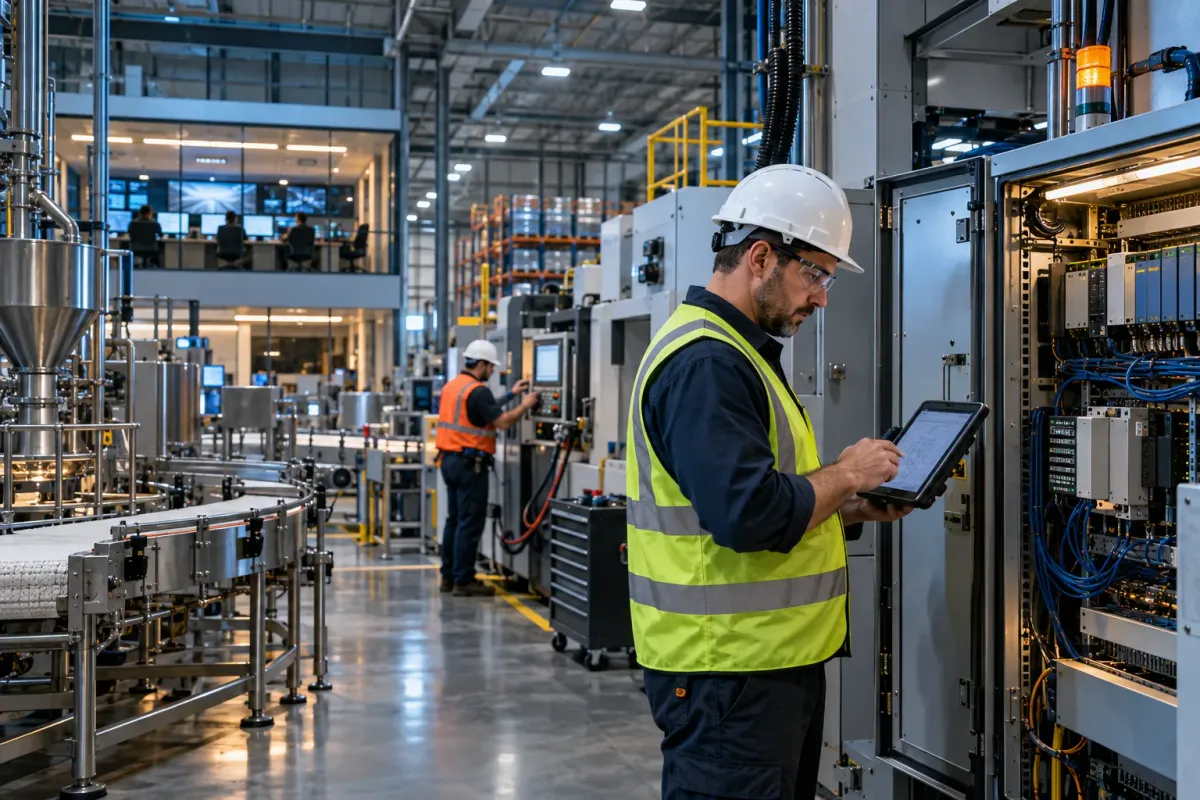
When a machine sequence stops or operators see inconsistent readings, the cause may sit in the control system rather than the mechanical equipment. Automation specialists work with PLCs, sensors, human-machine interfaces, and supervisory control and data acquisition (SCADA) systems. They can troubleshoot logic, replace components, connect equipment, or plan upgrades. Older controllers require care: a change to one device can affect an entire line, so testing and a defined production window matter.
Electrical, HVAC, and Mechanical Services in Industrial Settings
Facility and equipment problems have direct production consequences. Electrical service may address power distribution, motor circuits, or control panels. HVAC and mechanical teams maintain ventilation, process cooling, compressors, pumps, and other equipment that supports production conditions. A recurring temperature alarm, unusual vibration, or intermittent power issue deserves investigation at the source, not just a reset. Coordinate planned work with operations to account for access, lockout procedures, and any required downtime.
Fabrication, Maintenance, Fire Alarm, and Security Systems
Some needs fall outside controls and building utilities but remain important to plant operations. Fabrication can support custom guards, brackets, or equipment modifications. Maintenance services address wear and recurring faults; fire alarm and physical security specialists install or service detection, notification, access, and monitoring systems. Define which systems are affected, what documentation will be delivered, and how the crew will coordinate with plant staff before work begins.
The Growing IT/OT Overlap: Where Industrial Technical Services Meet Managed Technology
A production system can rely on both a machine controller and the network, server, or software that moves its data. Controls specialists understand machine behavior, while IT teams manage identity, endpoints, backups, and network access. A flat network or unsupported operating system can complicate security and troubleshooting, particularly when equipment cannot be patched without disrupting production.
Andromeda Managed IT Services for Industrial/Manufacturing Clients supports manufacturing IT and OT environments, including network management, cybersecurity, and compliance support. The service is distinct from repairing a PLC or replacing an HVAC unit. Its role is to help keep connected technology supportable and changes documented, with work sequenced around production needs. Define the boundary between controls and IT before a project starts so the right specialists are accountable for each system.
Who Uses These Services: Industries and Real-World Use Cases
Manufacturing, Food and Beverage, Chemical, and Energy Applications
Production environments differ, but they share a need to keep equipment, utilities, and supporting technology dependable. In metal fabrication, a control fault can interrupt a production cell. Food and beverage plants must coordinate equipment maintenance with sanitation schedules and product handling. Chemical facilities may need qualified work around process controls, ventilation, and site safety requirements. Energy operations depend on monitoring and equipment that support reliable delivery.
Other settings have their own constraints. Building materials, plastics, warehousing, and paper production may rely on conveyors, packaging lines, environmental controls, or older machines that cannot be taken offline casually. Before requesting service, identify the process affected, the equipment involved, and any safety or production restrictions. This information helps a provider plan access, testing, and work timing with your operations team.
Three Example Projects: Automation Upgrade, Plant Network Segmentation, and HVAC Replacement
Project scope should reflect production risk, not just the equipment list. These examples show how a technical change can affect operations and what to establish before work begins:
- Automation upgrade: Replacing a controller or connecting a machine to a supervisory system may require logic review, backups, testing, and a planned production window. Agree on acceptance criteria before the change.
- Plant network segmentation: Separating production devices from office systems can limit unnecessary network access. Map machine dependencies first, especially when legacy controllers cannot be patched or interrupted.
- HVAC replacement: Replacing equipment that supports a production area requires coordination around temperature, ventilation, access, and temporary operating conditions. Confirm how the crew will protect the process during the change.
IT and operational technology (OT) work can also affect production continuity. Andromeda’s documented case study reports that a Chicagoland multi-site manufacturer saw roughly a 50% decrease in IT issues after implementing managed services. That is a specific customer outcome, not a forecast for every plant. Track recurring incidents and their operational effects, then address their causes.
How to Choose an Industrial Technical Services Provider: A Buyer's Checklist
Industry Experience, Certifications, and Safety Record
A provider’s experience should match the equipment and operating conditions at your facility. Ask for examples of work in similar production environments, including how crews handled legacy machinery, maintenance windows, and coordination with plant personnel. Confirm that technicians hold the credentials required for the work. Ask how the provider documents safety procedures, site orientation, and incident reporting.
For connected production systems, check whether the team understands both operational technology and business IT. Depending on your contracts and customer requirements, ask about alignment with the National Institute of Standards and Technology (NIST), Cybersecurity Maturity Model Certification (CMMC), or International Organization for Standardization (ISO) standards. A certification or compliance claim should have a defined scope. It does not replace an explanation of how the provider will protect your equipment and production data.
Local Presence, Response Commitments, and Accountability
Response time matters, but the useful commitment explains what happens after your call. Ask how the provider classifies production-impacting incidents, who makes the escalation decision, and whether on-site support is available when remote diagnosis is not enough. Clarify service hours, travel arrangements, parts sourcing, and how planned work is scheduled around shifts.
Document the boundaries of responsibility before signing. A controls contractor, facilities team, and managed IT provider may each support systems connected to the same process. Agree on who owns initial triage, who coordinates with your staff, and who records the final change. A nearby address alone does not show whether a provider can meet your operating requirements.
Questions to Ask Before You Sign
Use the first call to test whether the provider can explain its method in terms your production team can verify. Ask questions such as:
- Which equipment and systems in our facility have you supported?
- How will you assess production risk before changing a live system?
- What information should our team collect before requesting emergency support?
- How are safety procedures, backups, testing, and change records handled?
- Who coordinates work when controls, facilities, and IT responsibilities overlap?
- What response commitment applies to a production-stopping issue?
Andromeda has supported manufacturers since 1994 and reports average employee retention of more than eight years. Continuity can help technicians learn a facility’s systems over time. Still, ask how the assigned team will document your plant’s equipment, escalation paths, and operating constraints.
Provider Fit: Benefits and Trade-Offs to Weigh
Pros
- Relevant plant experience can reduce delays during diagnosis and planning.
- Written response and escalation terms make accountability easier to verify.
- Documented procedures support safer changes and clearer handoffs.
Cons
- A specialist may cover a narrower set of trades, requiring coordination with other providers.
- Planned assessment and documentation take staff time before work starts.
- On-site availability and parts access depend on location and service terms.
Choose based on demonstrated fit, documented commitments, and a workable plan for protecting production. A careful first conversation should leave you with clear next steps, named responsibilities, and a realistic account of the work required.
Finding Industrial Technical Services Near You: Westfield, MA and Savannah, GA
Industrial Technical Services Providers in and Around Westfield, MA
In Westfield, start by matching the provider’s stated specialties to the system that needs attention. A company named Industrial Technical Services appears in Westfield search results, but a similar business name alone does not confirm its service scope. HVACService.io lists the Westfield business with a 4.8-star rating from 14 reviews. Treat that rating as one signal, then verify directly whether the team handles your equipment, industrial setting, and required service window.
Before scheduling a site visit, ask about experience with your facility systems, technician qualifications, safety procedures, and documentation. Confirm whether the provider performs the work itself or coordinates with another trade. For a production-impacting issue, establish how urgent calls are handled and what information the provider needs to plan access and minimize disruption.
Industrial Technical Services Providers in and Around Savannah, GA
Savannah search results include Industrial Technical Services, a business whose name can be confused with general information technology support. That history alone does not establish whether its current services match your project. Check the company’s service descriptions and ask whether it supports the particular controls, electrical, mechanical, or facility systems involved.
For work that crosses trades, ask who will coordinate the project and who is responsible for testing and closeout records. Identify the lead contact, expected site access, production restrictions, and how schedule changes will be communicated. Get the agreed scope in writing before authorizing work.
How to Search Effectively: Local Signals Worth Trusting
A “near me” result is a starting point, not proof of fit. Search with the city and the system or trade you need, such as industrial controls, plant HVAC, or electrical service. Then confirm the provider’s service area, industrial experience, licensing where required, insurance, safety practices, and availability for your operating hours. Reviews can describe customer experiences, but they cannot verify technical qualifications or response commitments.
When the issue involves connected production equipment, clarify whether the work concerns machine controls, plant networking, business systems, or more than one of these. Ask how specialists will coordinate, what changes require a maintenance window, and what records you will receive afterward. This check helps distinguish similarly named providers and directs the request to the right team before a service call disrupts production.
Frequently Asked Questions
What are industrial technical services?
Industrial technical services support the equipment, controls, infrastructure, and technology a plant depends on to operate. The term covers automation, electrical work, HVAC, mechanical maintenance, fabrication, and industrial networking. It does not describe one trade or one standard package, so the right provider depends on which system failed.
What types of industrial technical services exist?
The main types are automation and controls (PLCs, sensors, SCADA, and machine integration), electrical service, HVAC and mechanical work, fabrication and maintenance, and fire alarm and security systems. Each category addresses a different failure point on the production floor. Identifying the affected system first is the fastest way to find the right specialist.
How is industrial technical services different from IT services?
Industrial technical services address machinery, controls, and facility systems, while IT services cover servers, endpoints, business applications, and networks. A PLC fault stopping a packaging line calls for controls expertise; staff unable to access the ERP system calls for IT support. Some problems cross both worlds when production data depends on a machine controller and the network carrying its traffic.
How do I find industrial technical services near me?
Start by documenting the equipment involved, the symptoms, when the fault occurs, and any recent changes before you search. Those details help a provider determine whether its team can actually respond. Look for experience with your specific affected system inside an operating industrial facility, not just a similar company name in the results.
Why does calling the wrong service provider cost production time?
A search for industrial technical services often returns automation, HVAC, electrical, and technology companies that solve different problems. Sending a machine controls fault to an HVAC provider means a site visit that produces a referral instead of a diagnosis. Describing the failed system accurately before you call prevents that lost shift time.
Where does IT overlap with industrial technical services?
A production system often relies on both a machine controller and the network, server, or software moving its data. Controls specialists understand machine behavior, while IT teams manage identity, endpoints, backups, and network access. For issues involving plant connectivity, access controls, or business systems tied to operations, a managed provider with manufacturing experience fits the gap.
What should I confirm before authorizing industrial technical work?
Confirm the diagnosis with qualified personnel before any work begins, especially where electrical hazards or machine safety are involved. Define which systems are affected, what documentation will be delivered, and how the crew will coordinate with plant staff. Planned work should also account for lockout procedures and required downtime so production schedules stay protected.