manufacturing technology
A machine can hold its cycle time and still miss the production target if its data is late, the network drops connection, or the work order is wrong. Manufacturing technology includes the tools and systems that turn materials, instructions, and production data into finished goods. Whether those tools improve throughput depends on the information technology supporting them.
Key Takeaways
- Manufacturing technology only improves throughput when the IT behind it delivers accurate data at the moment the floor needs it.
- A machine running at full cycle time can still cost you a shift if the network, work orders, or production data fail silently.
- Treating shop floor equipment and supporting information systems as one connected operation is what separates working technology from expensive shelfware.
- Stability does not come from adding more tools. It comes from making sure the systems feeding your production schedule are reliable and current.
Buying a capable machine is not the same as making it work reliably across a plant. Production equipment, software, people, and processes all affect what happens during a shift.
What Manufacturing Technology Actually Means (Beyond the Vendor Pitch)
A Working Definition, Anchored to the Production Floor
Manufacturing technology combines equipment, software, controls, and data systems used to make, inspect, track, and move products. It can guide a machine tool, record a quality check, schedule a work order, or show a supervisor where production is falling behind.
On the floor, operators need accurate instructions, machines need usable data, and managers need to see production status. Systems must fit the process and remain available when a shift depends on them.
How Manufacturing Technology Differs From Manufacturing Equipment
Equipment performs a physical task. A press forms material, a robot moves parts, and a CNC machine cuts stock. Technology also includes computer-aided design files, machine controls, production software, and network connections that tell equipment what to do and record what it did.
A machine can be working while production stalls. A toolpath may be unavailable, a work order may not reach the operator, or a controller may be unable to communicate with the system tracking output. Equipment is one part of the production process.
Why the Technology Is Rarely What Fails: Introducing IT Drag
A plant can install a capable system and still lose time to slow logins, unreliable wireless coverage, inconsistent backups, or a server that cannot support the software. These everyday failures create IT Drag™, the accumulated inefficiency that gets in the way of work. The production tool may be sound while its supporting environment is not.
Andromeda supports manufacturers across Midwest production environments, where legacy controllers and limited maintenance windows make changes a sequencing problem, not just a purchase decision. Andromeda Managed IT Services for Industrial/Manufacturing Clients addresses the IT and operational technology (OT) support around plant systems. It is not a substitute for choosing equipment that fits the process.
The Measured Benefits (and the Normalization Period Nobody Mentions)
Well-supported systems can make production information easier to access, improve traceability, and reduce manual handoffs. These gains take coordination: operators need workable procedures, data must be accurate, and updates must be planned around production. New technology can add training and support demands before the process settles.
In Andromeda’s documented case study, a Chicagoland multi-site manufacturer saw roughly a 50% decrease in IT issues. Across typical clients, service desk tickets begin a steady decline within three to nine months, after about three months of normalization. Andromeda Managed IT Services for Industrial/Manufacturing Clients follows a managed IT and OT approach, but this timeline is a pattern, not a promise for every plant.
10 Examples of Manufacturing Technology in Use Today
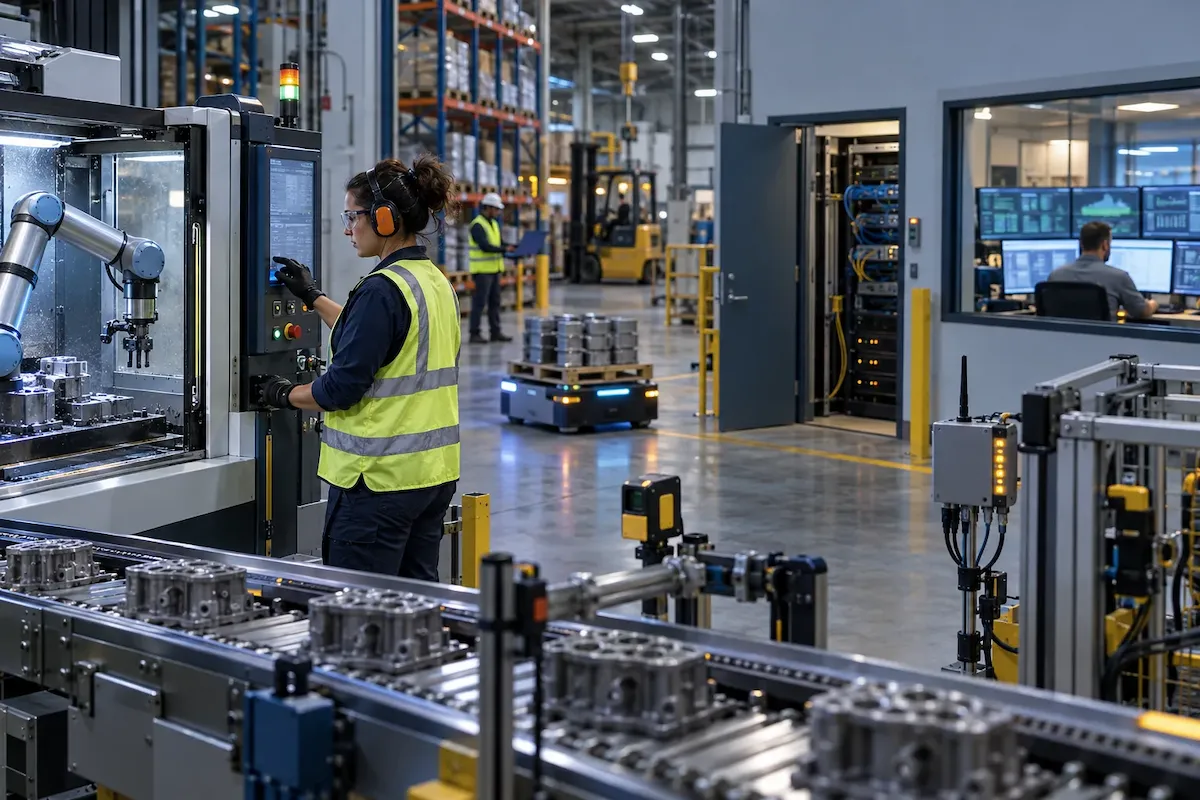
These examples range from equipment at a workcell to systems coordinating information across a facility. Each depends on dependable connections, accurate production data, and support that respects plant schedules. The right fit depends on your process, product, and integration needs.
- CNC machining and CAD/CAM software. Computer numerical control (CNC) machines follow programmed instructions; computer-aided design and manufacturing (CAD/CAM) software creates and prepares them. Correct files and reliable transfer help prevent setup delays and machining errors.
- Industrial robotics and automation. Robots perform repeatable tasks such as welding, palletizing, or material handling. They can support consistent cycle times, but require safe cell design, maintained controllers, and clear recovery procedures when a fault stops the line.
- Additive manufacturing (3D printing). Additive processes build parts layer by layer from a digital model. They can support prototypes, fixtures, and selected production parts; material choice and inspection requirements shape where the method fits.
- Industrial Internet of Things (IIoT) sensors and predictive maintenance analytics. Sensors collect operating data such as temperature or vibration; analytics can help maintenance teams spot changes worth investigating. Reliable network access and useful alert thresholds matter more than collecting data without an action plan.
- Manufacturing execution systems (MES). An MES tracks and coordinates production activity, including work orders, labor, and quality records. It helps teams see work in progress when it receives timely data from machines and operators.
- Enterprise resource planning (ERP) integration across the plant. ERP software connects business functions such as orders, inventory, and purchasing with production planning. Accurate exchanges with shop-floor systems help reduce duplicate entry and discrepancies between scheduled and actual work.
- Digital twins and simulation. A digital twin is a digital representation of a machine, process, or facility; simulation tests possible changes against a model. Its usefulness depends on current, trustworthy input data and a defined decision the model should inform.
- Computer-integrated manufacturing. This approach connects design, planning, production, and related systems so information can move between stages. Integration can reduce handoffs, but incompatible data formats or poorly managed access can interrupt workflows.
- Automated quality inspection and machine vision. Cameras and image-processing software inspect parts for visible defects or specified features. Teams need suitable lighting, consistent positioning, and a process for reviewing exceptions. Inspection data also needs a dependable route to quality records.
- OT networks and machine connectivity. OT networks connect controllers, sensors, and production equipment so systems can exchange operational data. Segmentation can limit unnecessary paths between machines and office devices. Planned changes help protect equipment that cannot be patched or taken offline.
All ten depend on power, network access, supported systems, backups, and controlled access. A tool can work as designed and still fall short if production data cannot reach it or operators cannot get support during a shift.
Manufacturing Technology Careers: Salaries, Degrees, and the Honest Version
A manufacturing career can lead from hands-on equipment work into programming, process improvement, quality, or safety. Pay depends on role, location, experience, and industry, so treat published averages as reference points, not a promise of your starting wage. A technician may troubleshoot a machine on the floor, while a technologist may focus on process improvements or coordinating technical changes.
Salary Ranges by Role (Technician to Technologist)
Salary data uses inconsistent job titles, and broad categories may combine distinct occupations. ZipRecruiter reports annual pay from $29,000 to $72,000 for manufacturing technology roles, with most reported salaries between $42,000 and $60,000. For a more specific benchmark, the U.S.
Use the table to compare roles, then check local job postings for current requirements and pay. The available research supports only some role-specific estimates.
| Role | Salary reference | Typical work focus |
|---|---|---|
| CAD technician | Role-specific figure not available in the supplied research | Prepare and revise technical drawings and design files |
| Industrial engineering technologist | Bureau of Labor Statistics data cited by UniShub | Help improve workflows, workstations, and production efficiency |
| Safety specialist | Role-specific figure not available in the supplied research | Support workplace safety procedures and compliance |
The Bureau of Labor Statistics figure cited by Goodwin University reports an average annual wage of $97,670 for workers in the field’s top percentile. That is not a typical entry-level salary; experience, specialization, and responsibility matter.
Manufacturing Technology Degrees: Associate, Bachelor's, and Certificates
An associate degree can prepare you for technician and applied technologist roles, especially with coursework in computer-aided design, machining, automation, quality, and hands-on lab work. A bachelor’s degree may support broader process, supervision, or industrial engineering technology roles. Certificates can build focused skills, such as computer numerical control programming or quality methods, though employers may still expect practical experience.
Compare course content with local job postings before enrolling. Look for lab time, internships, equipment access, and instruction that matches local manufacturing processes. Ask employers whether they recognize the credential for your target role instead of relying on general placement claims.
MET vs ME: The Stigma Question Answered Straight
Manufacturing engineering technology (MET) and mechanical engineering (ME) degrees prepare people for different kinds of work. MET programs tend to emphasize applied production, equipment, and implementation. ME programs generally include more theoretical engineering analysis and design. That distinction can affect eligibility for design engineering jobs that specify an engineering degree, even when an MET graduate has strong shop-floor experience.
MET can be a practical fit for applied work, but it may narrow access to some design roles. A credential alone does not solve every career barrier. Entry-level postings may ask for experience, and night-shift work can make accomplishments less visible. Keep a record of projects, quantify process improvements when you can, and discuss advancement paths with supervisors. For people supporting production systems, Andromeda Managed IT Services for Industrial/Manufacturing Clients works around the IT and operational technology that production teams depend on. Andromeda Managed IT Services for Industrial/Manufacturing Clients is relevant where system reliability affects daily work, not a substitute for choosing the right education or career path.
How to Actually Make Manufacturing Technology Work in a Mid-Size Plant
The Real Bottleneck: Legacy Controllers, Flat Networks, and Unsupported Systems
A new system can be ready to run while an older controller cannot safely connect to it. Many plants have machines that cannot be patched, unsupported operating systems, and flat networks where office devices and production equipment share paths. Replacing every controller is rarely practical, and a line may not be available for a broad network change.
Document which systems communicate, what production depends on them, and where a failure would stop work. Network segmentation can limit unnecessary traffic between office devices and machine systems without changing a controller. Reduce exposure and clarify dependencies while respecting equipment limits.
Modernization Without Disruption: What Sequencing Looks Like
Changes need to fit production schedules, maintenance windows, and recovery plans. Assess network paths, backups, software dependencies, and business priorities first. Test changes in a controlled area where possible, confirm rollback steps, and schedule higher-risk work with operations and maintenance leads.
Andromeda’s five-step operating model moves from Assess and Align to Take Command, Secure and Comply, Report and Guide, then Lead and Modernize. This sequence establishes current conditions before changes are made. Andromeda reports a 12.0-minute median ticket response time and says 97% of issues are resolved within eight business hours. Those measures do not remove the need to plan around your plant’s operating constraints.
Who Builds the Technology: Leading Companies and How to Evaluate Them
Siemens and Rockwell supply industrial automation and control systems; FANUC makes industrial robots; Honeywell serves industrial automation markets; and Dassault develops design and simulation software. The right provider depends on your process, existing equipment, support requirements, and integration needs. A familiar name alone cannot establish that a system will work with your plant’s network, controls, or production software.
Ask how the system exchanges data with existing equipment, who supports it during a shift, what happens when connectivity fails, and how upgrades will be tested. Andromeda Managed IT Services for Industrial/Manufacturing Clients supports the IT and operational technology environment around production systems. It cannot replace process fit or vendor-specific engineering support.
An Implementation Checklist Grounded in IT/OT Reality
Before approving a project, align operations, maintenance, internal IT, and the system provider on the following:
- Document equipment, controllers, software versions, and system connections.
- Identify production dependencies, safety requirements, and acceptable maintenance windows.
- Confirm backup coverage, recovery steps, access controls, and escalation ownership.
- Test data flow and failure handling before expanding beyond the initial area.
- Set operational measures, such as stopped production time, manual re-entry, or delayed work orders.
Manufacturing Technology FAQ and Where to Start
What Is the Simplest Definition of Manufacturing Technology?
It is the equipment, software, controls, and connected systems a manufacturer uses to make, inspect, track, and move products. Its practical value depends on how well it fits the work and the systems supporting it.
Is a Manufacturing Technology Degree Worth It?
It can be a good route into applied production, equipment, quality, and process roles. Compare course content and hands-on training with local job requirements. Some design positions require an engineering degree, so check eligibility for your intended career before enrolling.
Which Companies Lead in Manufacturing Technology?
Companies such as Siemens, Rockwell, FANUC, Honeywell, and Dassault serve different parts of industrial automation, robotics, and design software. There is no single best fit for every plant. Match capabilities, support, and integration requirements to your operation.
Measure Your IT Drag Before You Buy Another System
Before adding another platform, note where slow logins, dropped connections, repeated data entry, or unresolved tickets interrupt work. Andromeda’s documented Chicagoland multi-site manufacturer case showed roughly a 50% decrease in IT issues after a managed IT and OT engagement. That result is specific to the case, not a forecast for every plant.
Use the IT Drag™ Calculator to identify everyday inefficiencies before your next purchase. If you would rather talk through your plant’s situation, schedule a 30-minute discovery call with Andromeda. The aim is a production environment where systems are supported, responsibilities are clear, and planned changes fit the work.
Frequently Asked Questions
What are some examples of technologies used in manufacturing?
Common manufacturing technologies include CNC machining with CAD/CAM software, industrial robotics, additive manufacturing (3D printing), Industrial Internet of Things (IIoT) sensors, manufacturing execution systems (MES), and ERP integration across the plant. Each one depends on reliable connections, accurate production data, and IT support that respects plant schedules. The right fit depends on your process, product, and integration needs.
What are the types of manufacturing technology?
Manufacturing technology falls into two broad groups: equipment that performs physical work, and the systems that inform and record that work. Equipment includes presses, robots, and CNC machines. The technology around them includes design files, machine controls, production software, and networks that deliver instructions and capture what happened during a shift.
What is ICT in manufacturing?
ICT (information and communications technology) in manufacturing refers to the systems that move production data: networks, servers, software, and connections between machines and business systems. When ICT is slow or unreliable, capable equipment still misses targets because work orders arrive late, machines lose connectivity, or output cannot be tracked. We call this accumulated inefficiency IT Drag™.
What skills are needed in manufacturing?
Manufacturing requires both hands-on production skills and the ability to work with connected systems. Operators need accurate instructions and workable procedures, while maintenance and IT staff need to support machine controllers, networks, and production software. As plants add MES, ERP, and sensor data, coordination between operations and IT skills matters more.
Why does new manufacturing technology sometimes fail to improve production?
New technology fails to improve production when the supporting IT and operational technology (OT) environment cannot sustain it. A machine can hold its cycle time and still miss the target if data arrives late, the network drops, or the work order is wrong. Equipment is only one part of the production process.
How long does it take to see results from new manufacturing IT systems?
Plan for a normalization period of about three months, then expect improvement over the following months. In our documented case study, a Chicagoland multi-site manufacturer saw roughly a 50% decrease in IT issues, and typical clients see service desk tickets decline steadily within three to nine months. That is the pattern in our data, not a promise for every plant.
What is the difference between manufacturing equipment and manufacturing technology?
Manufacturing equipment performs a physical task: a press forms material, a robot moves parts, a CNC machine cuts stock. Manufacturing technology also includes the CAD files, machine controls, production software, and networks that tell equipment what to do and record what it did. A machine can be running while production stalls because a toolpath is unavailable or a work order never reached the operator.