
automotive industrial solutions
A line-side scanner stops communicating during a shift, and the production team starts tracking parts by hand. The issue may involve equipment, plant networking, or business software, so automotive industrial solutions need to account for the full production environment.
Key Takeaways
- Automotive industrial solutions work best when they treat the production floor as one connected environment rather than a set of separate equipment, network, and software problems.
- A single line-side failure can cost hours of manual tracking and overtime labor, so response time and root-cause resolution matter more than quick fixes.
- Managed IT and OT support helps you find the underlying cause of recurring issues instead of reacting to each symptom after it stops a shift.
- Partners who understand manufacturing, including legacy equipment that cannot be patched and flat plant networks, reduce downtime risk that generalist providers often miss.
- Stability comes from fewer problems over time, which is why proactive monitoring and planned maintenance windows protect your throughput and delivery dates.
In a mid-size plant, the goal is not to add technology for its own sake. It is to connect production systems, maintenance work, and business operations in ways that fit the equipment and available maintenance windows.
What Automotive Industrial Solutions Include in a Mid-Size Plant
Automotive industrial solutions cover technology and services that support manufacturing, from equipment controls and plant networks to production software and maintenance coordination. They differ from auto repair shop equipment, which services individual vehicles rather than coordinating factory production.
Define the scope: production technology, plant IT, and maintenance
A plant’s scope can include operational technology (OT), systems that monitor or control physical processes; office information technology (IT); production equipment; and maintenance planning. A manufacturing execution system (MES) tracks work through production, while enterprise resource planning (ERP) software coordinates orders, inventory, and purchasing. Maintenance teams need usable equipment records and a clear way to communicate faults, work orders, and repair status across these systems.
How manufacturing solutions differ from auto repair shop equipment
Vehicle lifts, diagnostic scanners, and alignment systems help technicians service cars. Factory systems coordinate production lines, material movement, quality checks, and information between departments. IT Solutions for Building Materials Manufacturers refers to a service for another manufacturing setting, not equipment for an automotive repair bay. The distinction is the operating environment and production need.
Where automation, sensors, artificial intelligence, and production software fit
Automation controls repeatable machine tasks. Sensors report conditions such as temperature, vibration, or position, and the Industrial Internet of Things (IIoT) connects equipment data with systems that can use it. Artificial intelligence (AI) may analyze inspection images or identify patterns in machine readings, but it depends on reliable data and a defined use. The second mention of IT Solutions for Building Materials Manufacturers is a reminder to select plant technology for a specific operating environment, not as a generic package.
Paint-shop quality, material changes, and brownfield versus greenfield projects
Paint-shop process control can monitor conditions that affect coating consistency, while inspection tools measure surface or material characteristics. Terahertz measurement is used for certain noncontact inspection tasks and needs evaluation against the material, process, and quality requirement. Changing material mixes, including increased aluminum use, may affect handling, inspection, and process settings.
A brownfield project upgrades an operating facility, where legacy controls, production schedules, and limited maintenance windows shape the work. A greenfield project starts with a new facility, allowing networks, controls, and data collection to be planned before production. Either way, the change should support the process without creating an unmanaged burden for operators and maintenance staff.
Connect Plant IT, Equipment, and Maintenance Without Disrupting Production
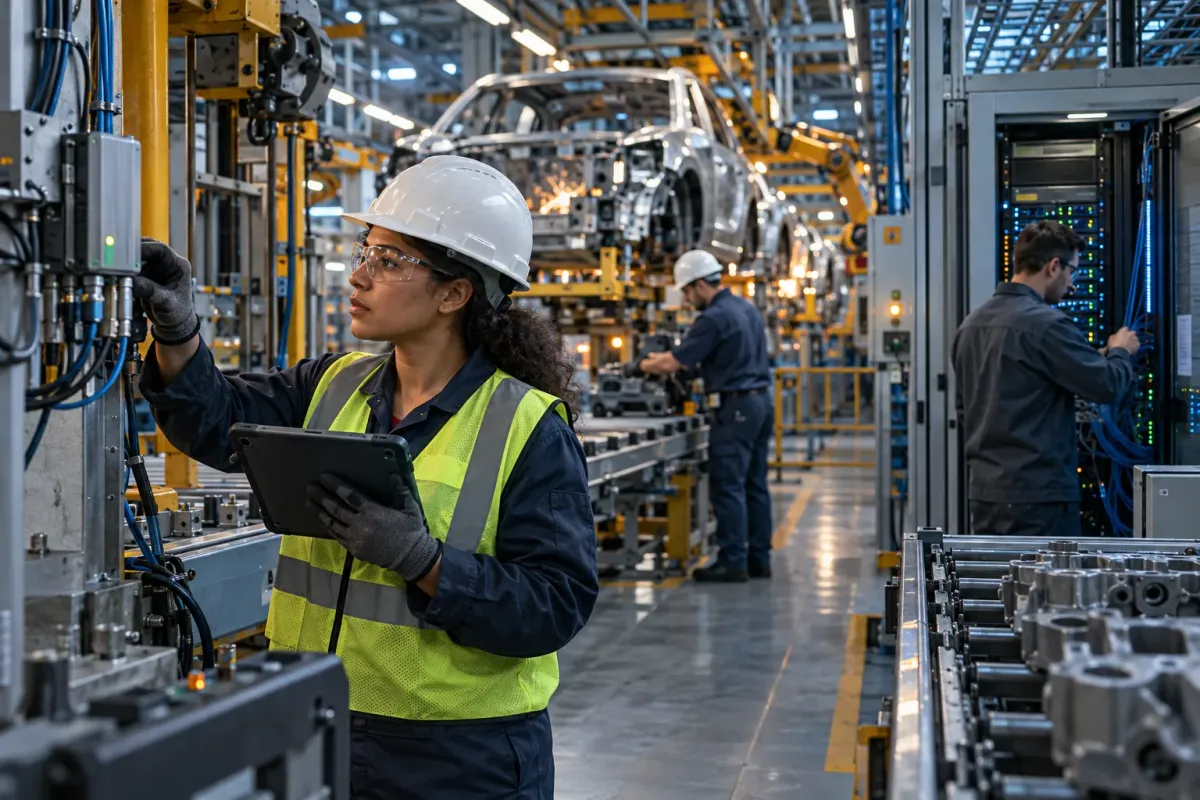
What advanced technology services look like on an automotive production floor
Useful services connect equipment data with the people responsible for production, maintenance, and business systems. A line stoppage should give the team enough information to identify the affected asset, check for similar faults, and coordinate a repair. Design around existing controls and work practices, rather than assuming machines can be replaced or taken offline on demand.
Secure IT/OT data flows around legacy controllers and flat networks
Many plants have programmable logic controllers (PLCs) that cannot be patched or replaced during normal production. Network segmentation separates device groups and restricts communication, limiting unnecessary access to controllers without changing them. The work requires an accurate network map, testing, and a change window planned with operations. Safe to Outsource OT Support addresses questions about outside support; Securing Industrial Systems Without Disrupting Production focuses on protecting production systems during security work. Readers assessing provider access can also review Secure Are Managed IT Service Providers.
Preventive versus predictive maintenance: choosing the right starting point
Preventive maintenance follows a schedule, such as inspecting a component after a set period of use. Predictive maintenance uses equipment condition or sensor data to help identify when attention may be needed. It requires reliable readings, staff who can interpret them, and a process for turning alerts into approved tasks. A calendar-based program may be more practical when asset data is incomplete.
| Approach | How it works | What the plant needs |
|---|---|---|
| Preventive | Schedules inspections or service at planned intervals. | Asset records, agreed intervals, and maintenance windows. |
| Predictive | Uses condition or sensor data to inform maintenance timing. | Useful data, staff to review it, and a documented response process. |
Use AI and machine data in stages, with people and training in the plan
Start with a specific operating question, such as which recurring faults deserve investigation or which inspection step consumes the most operator time. Check that the necessary data is available, decide who will review it, and define how findings become authorized actions. Operators and maintenance technicians often know the practical conditions behind data patterns. Co-managed support can add technical capacity while keeping plant knowledge and decisions with the internal team.
Before expanding a pilot, verify that staff can maintain the process and alerts do not bypass safety or work-approval procedures. Manufacturers handling contract requirements may find the NIST 800-171 Compliance MSP Guide useful when considering documented security controls. For broader partner selection criteria, see Choose a Managed IT Services Company.
Choose Partners That Find Root Causes, Not Just Close Tickets
What an industrial maintenance company owns, and where a general contractor stops
A recurring line fault can involve a machine, its controls, plant networking, or a maintenance procedure. Industrial maintenance companies typically handle equipment inspection, repair, parts replacement, and scheduled service. General contractors coordinate broader construction or facility work, but may not own ongoing equipment maintenance or information systems.
A managed service provider (MSP) supports business technology and, when qualified, operational technology (OT), which monitors or controls production equipment. Responsibilities can overlap during a controls upgrade or network change. Agree in writing who diagnoses each failure, authorizes work, and returns equipment to service.
Compare provider scope, production knowledge, and reporting
The right partner depends on the problem you need owned. Use these distinctions to identify gaps and decide where teams must coordinate.
| Provider | Typical scope | Production knowledge | Root-cause practice and reporting |
|---|---|---|---|
| Generalist MSP | Office devices, business applications, and user support | May have limited familiarity with production controls and shift constraints | Ask whether recurring incidents are tracked by cause and reported to operations |
| Manufacturing-specialized MSP | Business IT, plant networks, security, and agreed OT support | Should understand production schedules, legacy equipment, and planned change windows | Can document incident trends, escalations, and corrective actions within its agreed scope |
| Industrial maintenance company | Equipment inspection, mechanical or electrical repair, and maintenance planning | Should understand the equipment and safe work practices in its trade | Can report service work, parts used, and equipment condition within its maintenance scope |
Evaluate response, escalation, documentation, and accountability
Ask how a provider handles an incident that crosses boundaries, such as a machine fault paired with a network communication failure. You need a named escalation path, a clear handoff between trades, and records showing what was tested and changed. A ticket marked closed does not prove the underlying cause was addressed.
Technician continuity matters because people who know the plant can recognize repeat faults and the consequences of poorly timed work. Andromeda reports average employee retention of more than eight years. Treat that as useful context, then ask how your account will document plant-specific knowledge and maintain coverage when assigned technicians are unavailable.
Ask about technician continuity, parts traceability, and safe control-panel work
Before approving work, ask who is qualified, how work will be authorized, and what records you will receive. Skilled-trades compensation and staffing affect continuity, so ask how a provider supports experienced technicians and plans for turnover. For replacement parts, request the manufacturer, part number, condition, and sourcing record. These checks help evaluate provenance without assuming a supplier mishandled parts.
For control-panel work, confirm applicable safety procedures, interlocks, isolation steps, and responsibility for testing before restart. Ask how repairability limits or unavailable documentation will be handled, and who can stop unsafe work. IT Solutions for Building Materials Manufacturers shows a separate industry-specific offering; it does not replace confirmation of automotive plant requirements.
Ask each prospective partner: Who owns recurring faults? Which work requires plant approval? How are parts identified and recorded? Who verifies interlocks and documents a safe return to service? A useful answer names people, records, and decision points.
Use a Staged Framework to Secure Systems and Measure Progress
Assess and Align: map assets, contracts, risks, and production constraints
Inventory servers, endpoints, plant networks, programmable logic controllers (PLCs), production software, and support contracts. Record unsupported assets, systems that cannot be patched during production, and those affecting order flow or quality records. Include maintenance windows, safety procedures, customer requirements, and current escalation responsibilities.
Andromeda’s five-step operating model moves from Assess and Align through Take Command, Secure and Comply, Report and Guide, and Lead and Modernize. The sequence gives leadership and plant staff a shared way to set priorities and keeps automotive industrial solutions tied to operating needs rather than a list of technology purchases.
Take Command and Secure and Comply: stabilize support and plan protections
Clarify who answers, escalates, and coordinates IT and maintenance during an incident. Then plan protections around actual plant risks. Endpoint detection and response (EDR) helps identify and investigate suspicious activity on covered devices; access controls limit who can reach systems; network segmentation restricts communication between device groups.
Patching needs an asset-specific plan, especially for controllers that cannot be updated without validation or a maintenance window. Document exceptions, safeguards, approval, and review dates. Security changes should follow operations and safety authorization, with a controlled plan that fits the equipment and shift schedule.
Report and Guide, then Lead and Modernize: track trends and sequence improvements
Leadership reporting should connect technical activity to production concerns. Track recurring incidents, affected assets, open risks, approved changes, and next-step owners. Once trends can be assessed, sequence improvements by operational impact, compliance obligations, and the plant’s ability to support each change.
Evaluate technology by fit, support requirements, and compatibility with existing systems. Dell, Microsoft, ThreatLocker, Datto, Ruckus, and Lenovo are examples of technology providers, not endorsements or proof that a product suits your plant. Ask who will configure and support each component, what data it collects, and how it will be maintained.
Match NIST, ISO, and CMMC controls to actual customer and contract requirements
The National Institute of Standards and Technology (NIST), International Organization for Standardization (ISO), and Cybersecurity Maturity Model Certification (CMMC) are not interchangeable checklists. Applicable controls depend on contracts, customers, and other obligations. CMMC may apply to manufacturers supporting defense work; confirm the required level and scope before selecting controls or making compliance claims.
Retain asset records, access reviews, patch decisions, incident records, approved changes, and security policies as work is completed. This evidence helps show what is in place and where exceptions remain. The NIST 800-171 Compliance MSP Guide can help frame questions about contract-related security responsibilities.
Check the technology ecosystem and verify partner claims
Use a consistent checklist: confirm IT and OT support scope, request references from plants with comparable equipment, and ask how changes are scheduled around production. Verify who owns recurring issues, produces leadership reports, and supplies documentation. Ask providers to distinguish included work from separately scoped projects.
Manufacturers considering Andromeda’s IT Solutions for Building Materials Manufacturers should confirm that its stated scope matches their needs; automotive requirements should be assessed on their own terms. A capable partner explains its limits, identifies necessary plant participation, and documents a sequence for approved work. That is more useful than a broad promise about technology.
Look for Bounded Evidence of Fewer Recurring Problems
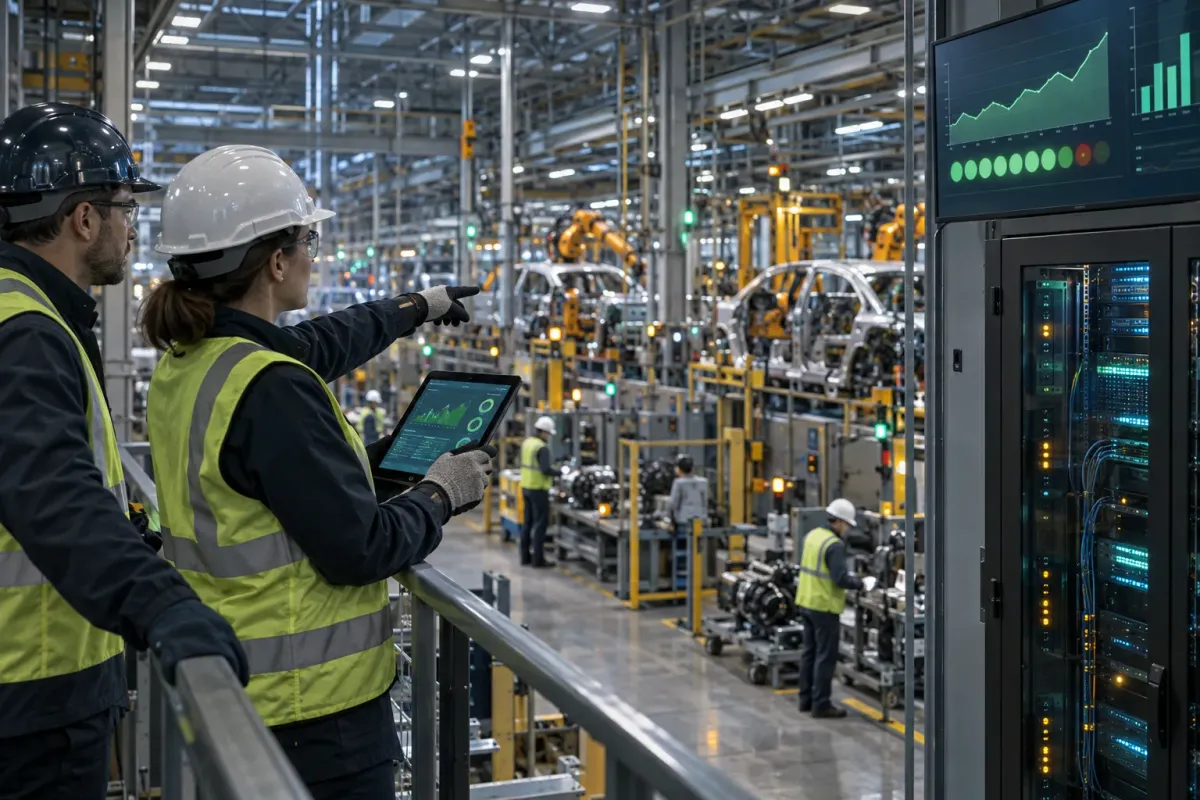
Case study: a Chicagoland manufacturer reduced IT issues by roughly 50%
A documented Andromeda case study reports that a multi-site Chicagoland manufacturer saw roughly a 50% decrease in IT issues. This supports that specific result, not a typical-outcome claim or a guarantee for another plant. Ask what counted as an issue, what period was measured, and whether the result covered all sites or a defined part of the environment.
Use the case study as evidence of a measured outcome, not a forecast. Your plant’s baseline, equipment, support scope, and incident definitions will shape its own results.
Allow for normalization before judging the trend
After a support transition, early work often involves documenting assets, clarifying ownership, and resolving accumulated issues. Andromeda reports an approximately three-month normalization period, with service desk ticket trends typically showing a steady decline within the first three to nine months. Review the trend across that period, not just early ticket volume, which may rise as previously untracked problems enter the record or reporting improves.
Set baseline measures for downtime, repeat incidents, and maintenance response
Before work begins, agree on measures that connect support activity to production. Use consistent definitions and record whether each measure comes from maintenance logs, shift reports, or ticket records.
- Recurring incidents by asset, cause, and repeat frequency
- Production interruptions, duration, and affected shifts
- Time from maintenance request to response and repair
- Overtime used to recover production or complete delayed work
- Shipment effects, including orders delayed by system or equipment issues
A documented, coordinated partner strategy gives your team a clearer view of what is improving and what still needs attention. Estimate hidden inefficiencies with Andromeda’s IT Drag™ Calculator, or schedule a 30-minute discovery call with Andromeda to discuss your plant’s priorities.
Frequently Asked Questions
What do automotive industrial solutions include in a mid-size manufacturing plant?
Automotive industrial solutions cover production technology, plant IT, and maintenance coordination, from equipment controls and plant networks to MES and ERP software. They differ from auto repair shop equipment, which services individual vehicles rather than coordinating factory production lines.
How do manufacturing solutions differ from auto repair shop equipment?
Auto repair shop equipment like lifts and diagnostic scanners helps technicians service finished cars. Factory systems coordinate production lines, material movement, quality checks, and information flow between departments, which means the operating environment and production need are entirely different.
Where do automation, sensors, and AI fit in automotive production?
Automation controls repeatable machine tasks, and sensors report conditions such as temperature, vibration, or position. The Industrial Internet of Things (IIoT) connects that equipment data with systems that can use it, while AI may analyze inspection images or machine readings, but only reliably when the underlying data and use case are well defined.
What is the difference between a brownfield and a greenfield project in automotive manufacturing?
A brownfield project upgrades an operating facility, where legacy controls, production schedules, and limited maintenance windows shape the work. A greenfield project starts with a new facility, so networks, controls, and data collection can be planned before production begins.
Should a plant start with preventive or predictive maintenance?
Preventive maintenance follows a calendar, scheduling inspections at planned intervals, and it may be more practical when asset data is incomplete. Predictive maintenance uses equipment condition or sensor data to time the work, but it requires reliable readings, staff who can interpret them, and a process for turning alerts into approved tasks.
How can a plant secure IT and OT systems around legacy PLCs that cannot be patched?
Network segmentation separates device groups and restricts communication, limiting unnecessary access to programmable logic controllers (PLCs) without changing them. The controller stays exactly as it is; what changes is what can reach it. This work requires an accurate network map, testing, and a change window planned with operations.
How should a manufacturer approach using AI and machine data without disrupting production?
Start with a specific operating question, such as which recurring faults deserve investigation or which inspection step consumes the most operator time. Confirm the necessary data exists, decide who will review it, and define how findings become authorized actions so operators and maintenance staff are not left with an unmanaged burden.