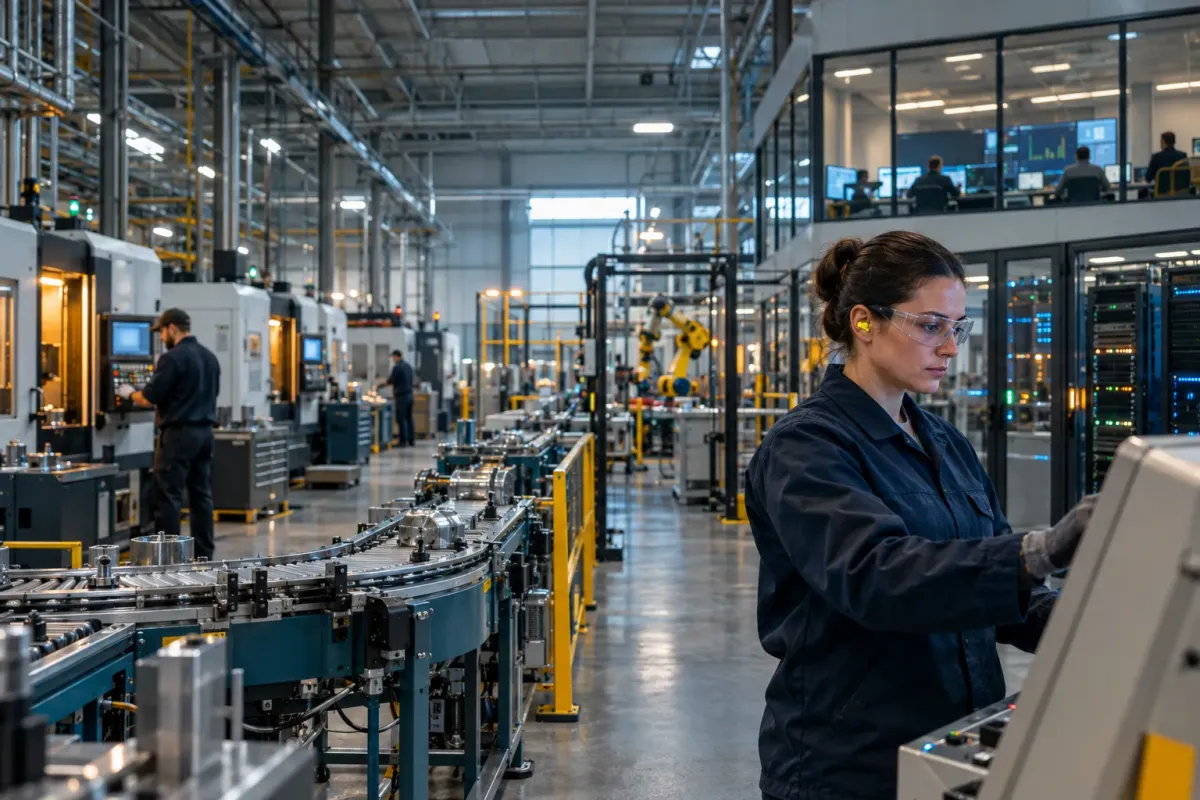
continuous manufacturing
A line that stops between batches can often wait for the next planned changeover. A line designed for continuous manufacturing cannot. Feed, processing, quality checks, and finished output must stay coordinated, or a data interruption can mean lost production and material that needs review.
Key Takeaways
- Continuous manufacturing runs nonstop, so every part of the line must stay synchronized to avoid lost production and scrapped material.
- A stoppage on a continuous line is far more costly than a changeover delay on a batch line, because restart takes significant time and review.
- Keeping feed rates, quality checks, and output aligned requires monitoring and planning rather than reacting after something breaks.
- Plants running continuous processes need IT and OT systems that protect uptime, since even short interruptions ripple into the shipping schedule.
The practical question is how operators know the process remains in control from the first feed to the finished product.
What Continuous Manufacturing Actually Means on the Floor
The Plain-Language Definition: Steady-State Flow, Not Stopped-Start Batches
In continuous manufacturing, raw materials enter a connected process at a controlled rate, move through successive operations, and emerge as finished or intermediate product. The line aims to hold a stable operating condition, called steady state, while material flows through it. Operators monitor conditions and adjust the process rather than waiting for an entire batch to finish before reviewing it.
“Continuous” describes the intended flow, not a promise that equipment never stops. Planned cleaning, maintenance, a quality concern, or an equipment fault can interrupt production. The difference is how the process is organized around that flow.
Batch vs Continuous: A Side-by-Side Comparison
Both approaches can produce consistent product. They differ in how material moves, when checks occur, and how work is scheduled. The right fit depends on the product, process control requirements, and the plant’s ability to maintain equipment and capture production data.
| Operating factor | Batch production | Continuous production |
|---|---|---|
| Material flow | Measured quantities move through defined steps as a batch. | Feed moves through connected stages at a controlled rate. |
| Quality checks | Checks often occur at set points, including after a batch step. | In-line measurements can monitor process conditions during flow. |
| Scheduling | Production can pause between batches for changeovers or cleaning. | Operations depend on coordinating feed, processing, and output. |
| Interruption response | A pause may affect the current batch and its schedule. | A pause can affect material across connected stages and require disposition review. |
Why the Difference Changes Your Downtime Math
On a batch line, an interruption may occur between runs, when equipment is already scheduled for a changeover. During an active run, a fault can delay completion or put the batch on hold. On a flowing line, a stop can affect feed rates, material in process, downstream equipment, and the ability to establish steady state again.
There is no universal cost per minute. Exposure depends on line rate, product value, recovery time, and whether material can be retained. Track lost output, labor waiting time, restart and inspection work, and delivery impact. That is a better basis for planning than assuming either method makes interruptions inexpensive.
How a Continuous Line Runs, Step by Step
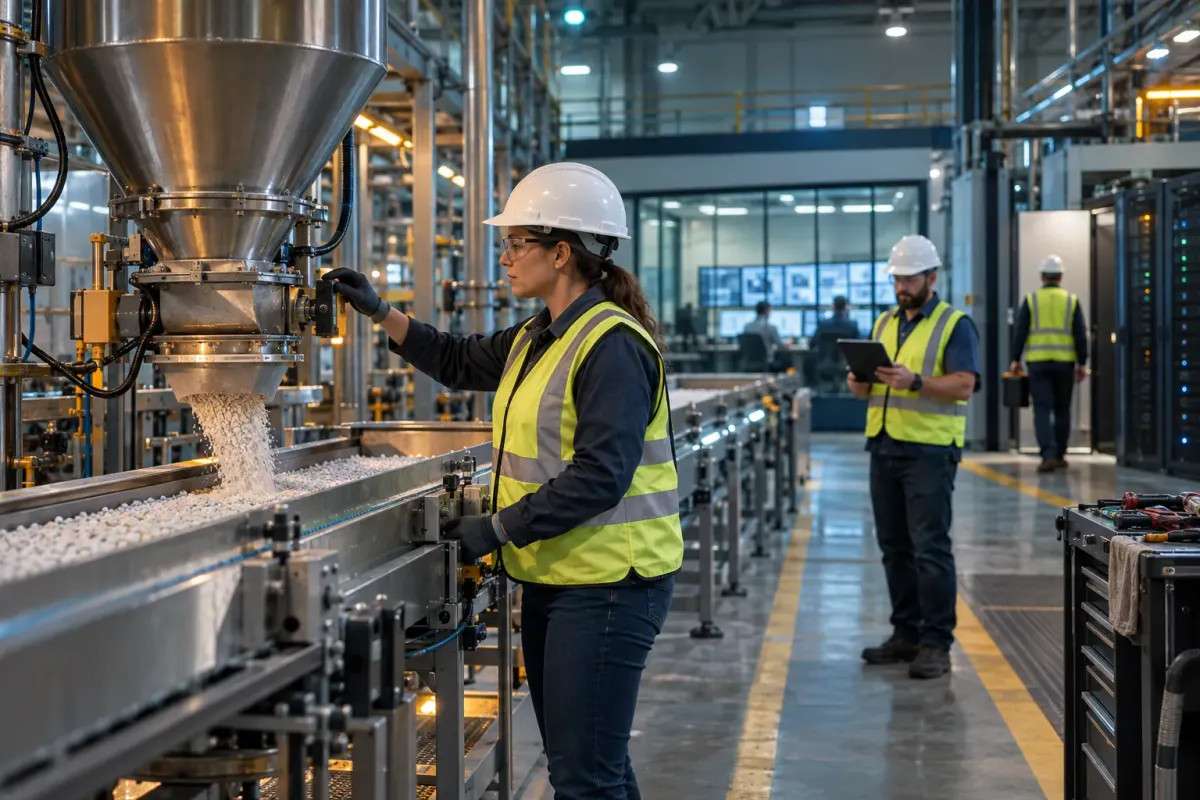
Step 1: Continuous Raw Material Feeding
Operators or automated feed systems meter ingredients or raw materials into the line at specified rates. Feeders, pumps, and scales must deliver a consistent supply, because a change in quantity can alter conditions in later stages. Material identity, lot information, and feed measurements also need recording so the production record reflects what entered the process.
Step 2: Steady-State Processing and In-Line Quality Monitoring
Material moves through operations such as mixing, heating, reaction, or forming. Process analytical technology (PAT) uses measurements taken during production to help operators assess whether conditions remain within set limits. Sensors may measure temperature, pressure, flow, or product properties. Readings matter only when available, time-aligned, and connected to the correct material in process.
Step 3: Real-Time Release Testing and Finished Output
At the output stage, finished product is collected, packaged, or sent to another operation. Real-time measurements can support timely quality decisions, but they do not automatically replace every required test or approval. Before process data supports release decisions, the quality team needs a validated method, defined acceptance criteria, and reliable records.
What Happens When Steady State Breaks
Consider a sensor that continues reporting locally while its data connection to the control system fails. The operator loses the live view needed to confirm a critical process condition. Depending on approved procedures and system design, the line may need to slow or stop while staff assess affected material and restore trustworthy readings.
Equipment may still be running, but missing or delayed data can leave the team unable to verify what happened. For a plant assessing Andromeda Managed IT Services for Industrial/Manufacturing Clients, support for connected production systems must account for the effect of a data gap, not just whether a device is powered on. Planning for Network Convergence Without Downtime can help frame how plant and business systems connect while production requirements remain in view.
Manufacturers reviewing Network Infrastructure Services for Industrial Manufacturers can ask what happens to feed control, monitoring, and records when a connection is unavailable. For food and beverage operations, Network Infrastructure for Food and Beverage Companies Needing Cloud Migration and what Analysts Recommend for IT Infrastructure in Food and Beverage Manufacturing may inform separate infrastructure planning conversations.
For teams evaluating Managed IT Services for Industrial Control System Security, the practical lesson is that continuous processes depend on dependable measurements as well as machinery. The Andromeda Managed IT Services for Industrial/Manufacturing Clients name is relevant when assessing support for systems carrying production data.
Real Continuous Manufacturing Examples Across Industries and Pharma
Industrial Examples: Refining, Chemicals, Food and Beverage, Plastics, and Paper
Continuous production is established in petroleum refining and commodity chemicals, where connected process stages transform a steady feed into products such as fuels and chemical intermediates. Similar operations appear in food and beverage processing, plastics production, and paper manufacturing. Equipment differs, but each operation depends on coordinated material flow, process controls, and monitoring.
Examples are not limited to a specific machine. A food line may combine ingredients, heat or process the mixture, and move it to packaging without organizing work around separate batches. A plastics or paper operation may run connected stages for long periods. Fit depends on the product, process requirements, and the ability to manage cleaning, changeovers, and quality checks.
Continuous Manufacturing in Pharma: Continuous Granulation, APIs, and Drug Product
In pharmaceuticals, continuous granulation can feed blended powders through connected operations that produce granules for later tablet manufacturing. Continuous processes can also make active pharmaceutical ingredients (APIs), the components responsible for a medicine’s intended effect, and finished drug products. The sequence and controls vary by product and process design.
Pharmaceutical manufacturing this way requires validated controls and traceable records. The team must connect process measurements to the material they describe, document how deviations are handled, and establish which testing supports each quality decision. The technology does not remove those responsibilities.
Named Adopters: Pfizer's PCMM and the Novartis-MIT Pilot Plant
That comparison concerns facility footprint, not a guarantee of lower total operating cost or a fit for every medicine.
The Novartis-MIT Center for Continuous Manufacturing developed a pilot plant that converted raw materials into tablets in about two days, as described in the published research on the pilot. The demonstration shows how connected stages can shorten the path from input to finished product. It does not establish that every commercial product can follow the same schedule.
ICH Q13 and Real-Time Release: The Regulatory Callout
ICH Q13 is guidance from the International Council for Harmonisation on the development, implementation, and lifecycle management of continuous manufacturing for drug substances and drug products. The U.S. Food and Drug Administration supports adoption through its guidance and regulatory engagement. More than 15 pharmaceutical products made through continuous processes have received U.S. regulatory approval, according to the research cited for this guide.
Real-time release is a quality strategy, not an automatic exemption from testing. A manufacturer must validate the process and analytical methods, define acceptance criteria, and show how production data supports release decisions. The World Health Organization’s draft working document on continuous manufacturing also reflects ongoing attention to regulatory expectations. Confirm the current status of guidance before relying on it for a submission.
The Part Nobody Covers: The Data, Controls, and OT Network Behind an Uninterrupted Line
Why Continuity Is an Operating-System Problem, Not Just an Equipment Upgrade
A line can have capable processing equipment and still lose production when control data becomes unavailable. Operational technology (OT), the systems that monitor and control industrial equipment, must carry timely measurements between sensors, controllers, operator stations, and production software. If a connection fails, operators may not be able to confirm that the process remains within approved limits.
The gap between planned use and actual use matters too. If the system does not capture production conditions and operator actions as they happen, supervisors may have to reconstruct events after a shift. Improvement work can stall when teams cannot see whether a change was followed or what the line did afterward.
What the Control Layer Must Do: PLCs, MES, and Real-Time Data Capture
Programmable logic controllers (PLCs) read inputs and run programmed equipment actions. A manufacturing execution system (MES) can track work orders, material genealogy, production status, and quality records. With sensors and operator interfaces, these systems help staff connect process conditions to the relevant product and time.
Reliable capture requires consistent timestamps, usable alarm histories, and clear procedures for missing or delayed readings. A dashboard cannot correct a sensor that reports bad data or a process record that cannot be matched to a lot. The control layer must support safe equipment operation and a production record the quality team can review.
Segmentation, Monitoring, and Legacy Controllers on a 24/7 Line
Many plants still have controllers that cannot be patched without vendor review or a planned shutdown. Network segmentation separates production devices from office systems, limiting which connections can reach a controller without changing its function. Monitoring can help identify unexpected communication or equipment behavior.
A flat network makes it harder to contain a problem or distinguish normal machine traffic from an unusual connection. Redesign needs a device inventory, documented communication paths, and testing that respects production schedules. The controller may remain unchanged; access around it can be managed more deliberately.
The Maintenance and Customization Trade-Offs Worth Naming
Maintenance can be harder to schedule when a process is designed to keep flowing. Cleaning, inspection, calibration, and repairs may require a planned stop, a validated restart, or a defined disposition for material in process. Customization may also be less flexible when the line is tuned for a narrow range of recipes or operating conditions.
Those constraints should shape the design and operating plan, not appear as surprises after installation. Changes to controls, production software, or network paths need testing and accountable approval. The goal is dependable production with known maintenance windows, not an assumption that the line can run without interruption.
What It Takes to Run One: A Starting Roadmap for Mid-Size Manufacturers
Justifying the Business Case and NPV Without Overstated ROI Claims
A credible business case starts with your plant’s operating data, not a promised percentage improvement. Compare current and proposed processes using expected throughput, labor, yield, energy, quality testing, maintenance, and facility costs. Include transition expenses such as equipment, controls, validation, training, and planned production interruptions.
Build a net present value (NPV) model with assumptions your finance and operations teams can inspect. Test what happens if demand is lower than forecast, startup takes longer, or maintenance requires more downtime than planned. Proceed only when process fit, operating constraints, and measured cost assumptions support the investment.
An Adoption Readiness Checklist
Before selecting a pilot, confirm that the team can measure current performance and maintain the records needed to assess a new process. Use this checklist to identify gaps early:
- Document the product’s demand pattern, process requirements, and acceptable variation.
- Identify equipment, control, data-capture, and quality-system changes.
- Assign owners for process validation, operator training, and production records.
- Confirm how material will be handled during a fault, planned stop, or restart.
- Set review dates and measures for throughput, yield, quality, and downtime.
Continuous improvement needs scheduled follow-through, not a launch meeting followed by silence. Regular reviews help operators and managers catch missing production data, unresolved issues, and differences between planned and actual use.
From Pilot Line to Production: Sequencing Changes to Protect Uptime
Start with a defined pilot scope and a baseline from the existing process. Test data capture, control behavior, quality procedures, maintenance tasks, and restart steps before expanding the line. Keep changes traceable, and agree on who can authorize a stop or return to the prior operating method.
Pros
- A bounded pilot helps expose process and staffing gaps before wider deployment.
- Recorded operating data supports a more defensible investment decision.
Cons
- Validation, training, and planned maintenance take production time.
- Customization may narrow when equipment is configured for a specific process.
For a plant that needs support planning IT and OT work around a pilot, Andromeda Managed IT Services for Industrial/Manufacturing Clients can be part of the discussion. Your next step can be a 30-minute discovery call, or the IT Drag™ Calculator if you want to assess operational friction before speaking with anyone.
Frequently Asked Questions
What is continuous manufacturing, in plain terms?
Continuous manufacturing is a production method where raw materials enter a connected line at a controlled rate, move through successive operations, and exit as finished product while the line holds a stable operating condition called steady state. Operators monitor and adjust conditions during flow rather than waiting for a batch to finish. The word describes the intended flow, not a promise that equipment never stops.
How does continuous manufacturing differ from batch manufacturing?
Continuous manufacturing moves material through connected stages at a controlled rate, while batch manufacturing moves measured quantities through defined steps and can pause between runs for changeovers. Quality checks happen in-line during flow in continuous production, and a stop can affect material across every connected stage. In batch production, a pause between runs often has little effect on the schedule.
What are the steps in the continuous manufacturing process?
The continuous manufacturing process has three main steps: controlled raw material feeding, steady-state processing with in-line quality monitoring, and real-time release testing at the output stage. Feeders, pumps, and scales meter ingredients at specified rates so downstream conditions stay stable. Process analytical technology (PAT) sensors track temperature, pressure, flow, and product properties, but release decisions still require validated methods and defined acceptance criteria.
What are real examples of continuous manufacturing in pharma and other industries?
Continuous manufacturing appears in oil refining, chemical production, plastics, paper, food and beverage processing, and increasingly in pharmaceutical production. In pharma, it means connected mixing, reaction, and formulation stages monitored in line rather than batch-by-batch. The common thread is steady-state flow, which makes dependable measurements and production records as important as the machinery itself.
What happens when steady state breaks in a continuous line?
When steady state breaks, material across connected stages can be affected, and the line may need to slow or stop while staff assess the product and restore trustworthy conditions. A sensor that keeps reporting locally but loses its connection to the control system leaves operators without the live view needed to confirm critical process conditions. The equipment may still run, but missing data means the team cannot verify what happened.
Why does downtime cost more in continuous manufacturing than batch production?
Downtime in continuous manufacturing affects feed rates, material in process, downstream equipment, and the ability to re-establish steady state, so a stop touches more than one stage. Batch lines can often absorb interruptions between runs when equipment is already scheduled for changeover. There is no universal cost per minute: exposure depends on line rate, product value, recovery time, and whether material can be retained.
What is ICH Q13 and what does it require?
ICH Q13 is the international guideline for continuous manufacturing of drug substances and drug products, and it requires manufacturers to demonstrate control of the process from first feed to finished output. In practice, that means reliable, time-aligned process data connected to the correct material, validated measurement methods, and defined acceptance criteria before real-time data supports release decisions. Your production record must show what entered the process and how conditions stayed within limits.