
managed it services companies
When recurring IT failures interrupt a production shift, the cost shows up in idle labor, delayed shipments, and overtime to recover the schedule. When evaluating managed it services companies, manufacturers need to look beyond help desk response and ask whether a provider can prevent technology problems from repeatedly reaching the floor.
For industrial facilities, the right support model accounts for business systems and the operational technology connected to production. Andromeda Managed IT & OT Services is designed around that IT and OT responsibility. Assessing any provider starts with understanding how ordinary technical friction becomes lost production capacity.
IT Drag™ is the accumulated time and capacity lost when recurring technology problems slow employees, disrupt workflows, or delay production. A generalist support model may resolve individual tickets without correcting the underlying cause. Manufacturers should seek a provider that understands plant systems, traces repeat incidents to their source, and measures service by operational impact as well as ticket activity.
The Real Cost of Generalist IT: Unpacking 'IT Drag™' and Its Impact on Production Floor Uptime
What 'IT Drag™' Looks Like on the Manufacturing Floor
A scanner that drops its connection, a workstation that takes too long to load a production order, or a network interruption between shifts can each look like a small support issue. The operational cost grows when the same fault returns, employees invent workarounds, and supervisors spend time chasing updates instead of managing output. That accumulated friction is IT Drag™: technology problems that consume labor and production capacity even when no single incident appears severe.
Why Generalist MSPs Miss the Mark in Industrial Environments
Office support practices do not always fit a plant floor. Industrial environments may depend on machine-connected workstations, barcode scanners, manufacturing execution systems, and carefully managed network segments. A technician unfamiliar with those dependencies can treat a production interruption as an isolated computer problem, without checking whether a change could affect equipment communication or order flow. Remote support and ticket closure matter, but so does knowing when a fix needs coordination with operations, maintenance, or an equipment vendor.
Closing another ticket is not the same as restoring stability when the same issue returns. A useful service review asks whether the provider identified a root cause, documented the dependency, and reduced the chance of another interruption. Without that discipline, employees keep compensating for unreliable systems, and IT Drag™ becomes part of the daily schedule.
The True Financial Impact: Beyond Break-Fix Costs to Lost Throughput
The invoice for emergency support rarely captures the full cost of an incident. Consider production time lost while an order cannot be released, labor waiting for a system to recover, overtime needed to catch up, and a delivery that misses its planned departure. These effects vary by facility, so buyers should track their own downtime and recovery data rather than rely on a generic savings estimate. A documented multi-site manufacturer case study found recurring IT issues decreased by 50% within three to nine months following operational stabilization. That measure connects technical improvement to fewer repeat disruptions.
Beyond the Help Desk: Identifying True Operational IT Partners for Manufacturing
The Shift from Reactive Break-Fix to a Disciplined Operating Model
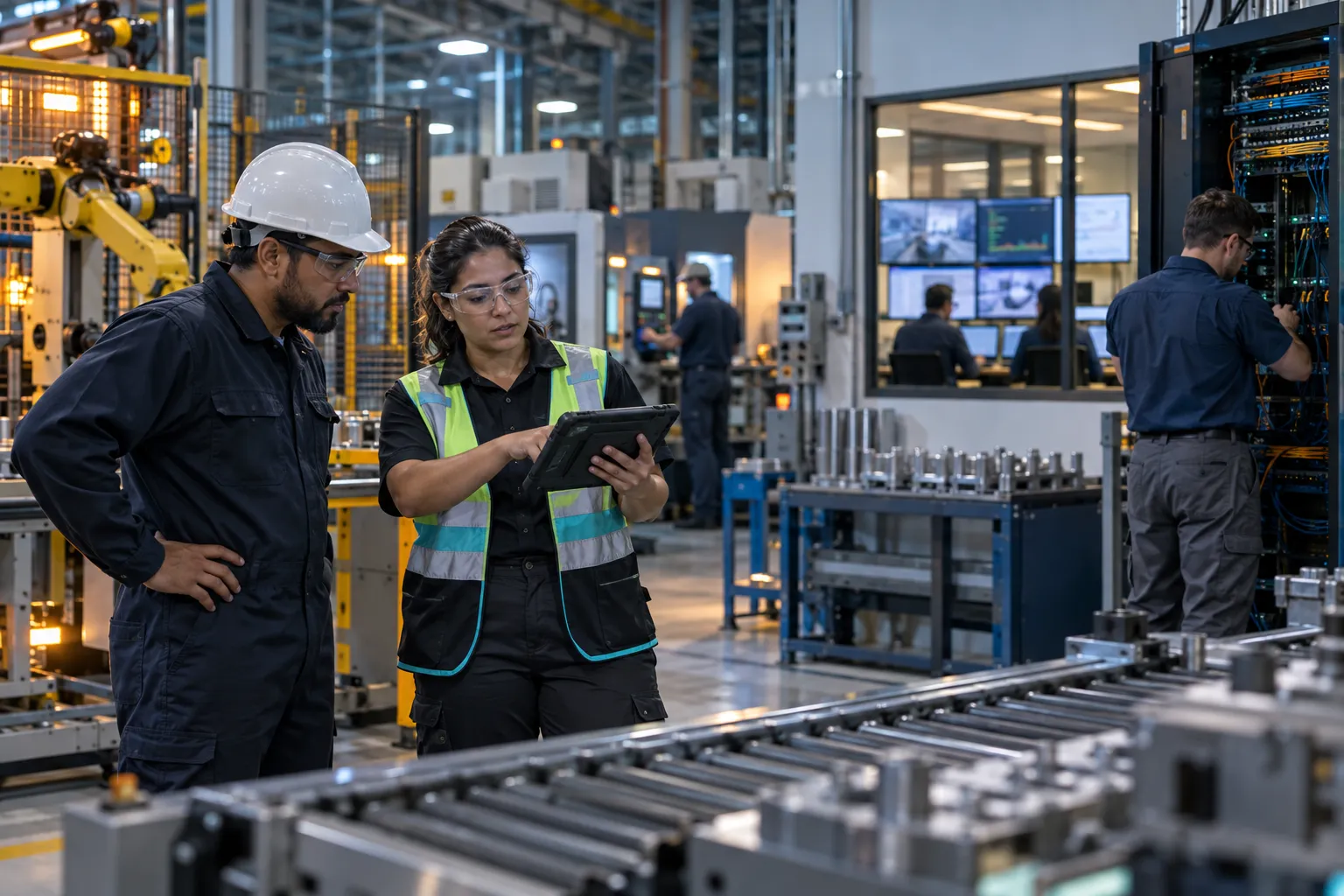
When a support provider only becomes active after a failure, the plant carries the risk until someone reports the problem and a technician responds. A disciplined operating model adds routine monitoring, patch planning, asset records, backup checks, incident review, and assigned ownership for repeat faults. These services should support production requirements, not create surprise maintenance windows. Ask how the provider identifies patterns across tickets, prioritizes systems tied to shipping, and coordinates planned changes with plant leadership.
Key Differentiators: Specialization, Root-Cause Resolution, and Low Turnover
Evaluate whether the people supporting your facility can explain its network, business applications, and operational dependencies in practical terms. Specialist knowledge is useful only when it stays available: frequent technician turnover can mean repeated explanations, lost context, and delays while new staff learn the environment. Andromeda reports average employee retention of more than eight years at high-tier specialist providers, a useful indicator to discuss when assessing continuity. Ask for examples of how recurring incidents are documented, assigned, and checked after a fix.
Evaluating IT/OT Convergence: Why Your Provider Needs to Understand Plant Floor Systems (MES, ERP, SCADA)
Production depends on information moving between systems. ERP handles business transactions and order information; MES supports shop-floor execution; SCADA can monitor and control industrial processes. A provider does not need to replace your controls engineer, but it should understand that a network, identity, backup, or security change can affect system availability and data flow. Ask how IT staff coordinate with operations before maintenance, troubleshoot connectivity across IT and OT boundaries, and respect segmentation and equipment support requirements.
Andromeda Managed IT & OT Services addresses support across those connected environments. Compare operating practices, not broad service labels, to assess whether a provider’s model fits your plant:
| Evaluation area | Reactive general support | Operationally aligned support |
|---|---|---|
| Recurring incidents | Closes tickets individually | Tracks patterns and documents root causes |
| Plant changes | Schedules work around IT availability | Coordinates maintenance with production needs |
| System context | Focuses on office endpoints and applications | Considers ERP, MES, SCADA, and network dependencies |
| Service reporting | Emphasizes ticket counts | Connects support activity to repeat faults and operational impact |
For manufacturers reviewing managed it services companies for manufacturing, the practical test is whether the provider can explain how its work protects production continuity. Look for clear ownership, technical context, and follow-through after the immediate ticket is closed.
The Andromeda Five-Step Operating Model: A Framework for Uptime and Operational Maturity
For manufacturers evaluating managed it services companies, a service model should show how support moves from understanding the facility to guiding measured change. Andromeda Managed IT & OT Services uses a five-step operating model to connect day-to-day support with production priorities, system risk, and longer-term planning. The sequence matters: changes made before teams understand the environment can create new interruptions, while unresolved recurring issues leave employees working around preventable problems.
Step 1: Assess and Align, Understanding Your Current State and Risks
Before changing systems, the provider needs a practical picture of how the facility operates. Document users, devices, servers, network segments, backups, business applications, and connections to production equipment. The assessment should also identify who owns each system, which processes depend on it, and when maintenance can happen without disrupting a shift. Andromeda Managed IT & OT Services begins by aligning support priorities with facility requirements, so the plan reflects order flow, staffing, and recovery needs rather than a generic technology checklist.
Step 2: Take Command, Stabilizing Operations and Eliminating Recurring Issues
Once the current state is visible, the next task is to establish ownership and reduce avoidable disruption. That includes organizing asset records, confirming monitoring and backup coverage, reviewing open incidents, and assigning responsibility for repeat problems. A ticket should not be considered resolved if the same fault returns without a documented explanation or follow-up. Andromeda reports a median ticket response time of 12 minutes, with 97% of issues resolved within eight business hours. Consider those measures alongside operational checks, such as whether recurring faults decline and employees can complete work without improvised workarounds.
Step 3: Secure and Comply, Building a Defense for Industrial Data
Security work must protect business information without overlooking the systems that keep production moving. The provider should understand account access, endpoint protection, network segmentation, backup recovery, and risks created by remote access to industrial systems. For organizations with contractual or regulatory requirements, map controls to the applicable framework, such as CMMC or NIST 800-171, and identify evidence needed for audits. Andromeda reports that its dedicated security stacks block more than 100 attacks per month per endpoint and over 300,000 attempted attacks monthly across client bases. Buyers should ask how alerts are reviewed, escalated, and tied to response procedures.
Step 4: Report and Guide, Leadership-Level Visibility and Proactive Strategy
Useful reporting helps leaders decide what needs attention before it becomes a production interruption. A monthly review should explain service trends, unresolved risks, backup status, security events, recurring incidents, and planned changes in terms operations and finance can use. Ticket totals alone do not show whether a facility is becoming more stable. The provider should identify business impact, name the owner for each action, and set a review date. This gives plant leadership a basis for prioritizing work against production calendars, staffing constraints, and capital plans.
Step 5: Lead and Modernize, Driving Efficiency Through Strategic IT/OT Integration
Modernization should follow operational readiness, not a technology sales calendar. Once core systems are documented, supported, and secure, the provider can work with operations and internal IT to assess improvements to system connectivity, data access, and application workflows. Any proposed change should include dependencies, a test plan, rollback steps, and a production-aware maintenance window. Andromeda Managed IT & OT Services supports this progression by connecting IT planning with plant requirements, helping leaders decide which changes can improve coordination without putting uptime at unnecessary risk.
Vetting Your Next Managed IT Services Provider: A Manufacturing Buyer's Checklist
When evaluating managed it services companies, a contract should make clear who owns a problem, how quickly the provider responds, and what happens when service falls short. For a plant, a missed commitment can mean a stalled production order or delayed shipment, not just an open ticket. Review the provider’s operating terms against your facility’s shift schedule, critical systems, security obligations, and internal staffing. Andromeda Managed IT & OT Services is one example of a service model that addresses both IT and OT. Use the criteria below to test whether the contract supports your operating needs.
Service Level Agreement (SLA) Benchmarks That Matter: Response, Resolution, and Uptime
An SLA should distinguish acknowledgment from meaningful progress. A fast automated ticket receipt does not help a supervisor whose production workstation remains unavailable. Ask how the provider defines response, resolution, escalation, and service availability, and whether urgent plant-impacting incidents receive different handling from routine requests. Confirm hours of coverage, the process for after-hours escalation, and who contacts operations when a fix could affect production systems.
Check whether reporting shows performance by priority and identifies unresolved incidents, repeat tickets, and exceptions to commitments. Ask how service levels are measured and what remedy applies when the provider misses them. A useful agreement connects technical response to operational priorities, with named responsibilities and a clear path for raising a concern.
The Accountability Factor: Guarantees Beyond Promises (Andromeda Guarantee Example)
Service claims matter only when the provider accepts accountability for delivery. Ask what evidence the provider supplies during regular reviews, how it documents missed commitments, and who owns corrective action. Andromeda describes a formal Andromeda Guarantee as financial backing for service delivery. Buyers should request the written terms and confirm which services, conditions, and remedies it covers before treating any guarantee as meaningful.
Andromeda Managed IT & OT Services can serve as a reference point when assessing whether a provider makes its commitments specific and reviewable. Look for documented escalation paths, assigned service owners, and reporting that explains the operational effect of missed targets, rather than a general promise to provide support.
Assessing Security Posture: Beyond Buzzwords to Real Industrial Protection (CMMC, NIST, Zero Trust)
Security requirements should be translated into controls your team can verify. If customer contracts or federal work require CMMC or NIST 800-171 alignment, ask how the provider maps controls, maintains evidence, and supports remediation. Discuss identity management, endpoint monitoring, backup testing, network segmentation, remote access, and incident escalation. If ISO requirements apply to your organization, confirm how security responsibilities fit with existing policies and audit processes.
Zero Trust is not a substitute for a documented design. Ask how access is approved, limited, monitored, and removed, including access to production-connected systems. Clarify who investigates alerts and how operations is involved before containment actions could affect equipment or system availability.
Understanding Co-Managed IT (CoMITS) vs. Full Outsourcing for Your Facility
Co-managed IT can support an internal IT leader without taking over every responsibility. The provider may handle monitoring, security operations, infrastructure maintenance, or escalation coverage while plant staff retain control of priorities, vendors, and business decisions. Full outsourcing may fit a facility without internal IT capacity, provided the agreement clearly assigns ownership for applications, users, plant technology coordination, and change approvals.
Before choosing, write down which tasks stay internal, which transfer to the provider, and how both teams share documentation and incident updates. Confirm that the arrangement can adapt as staffing, production hours, or compliance needs change. The right model has clear decision rights and dependable coverage, not just a broad service label.
Frequently Asked Questions
What are managed IT services?
Managed IT services are ongoing technology support and maintenance provided by an outside company for a recurring fee. For manufacturers, managed IT services can include monitoring, help desk support, patch planning, backup checks, and incident reviews. The right provider also tracks repeat problems and considers how technology issues affect production.
How much do managed IT services cost?
Managed IT services costs vary based on the number of users and sites, the systems covered, and the level of support needed. Manufacturers should compare what each proposal includes, such as monitoring, backup checks, and IT and OT coordination. They should also weigh recurring fees against downtime, lost labor, and recovery costs.
What is included in managed IT services?
Managed IT services commonly include help desk support, system monitoring, patch planning, asset records, backup checks, and incident reviews. For manufacturing facilities, the service scope may also cover coordination around production schedules and support for connected IT and OT systems. Confirm which systems, locations, and response responsibilities are included.
How do managed IT services benefit manufacturing companies?
Managed IT services can help manufacturing companies reduce repeat technology disruptions and limit lost production capacity. Routine monitoring and root-cause reviews can address recurring faults before they keep interrupting workflows. A provider familiar with plant systems can also coordinate changes with operations and account for dependencies between business systems and production.
How should manufacturers choose a managed IT services company?
Manufacturers should choose a managed IT services company that can explain its experience with plant systems, recurring incidents, and production-aware maintenance. Ask how it documents root causes, coordinates changes with operations, and maintains knowledge of your environment. Review service measures beyond ticket closure, including whether repeat disruptions decline.
How can a manufacturer measure the value of managed IT services?
Manufacturers can measure managed IT services by tracking repeat incidents, downtime, recovery time, and production delays. Record the labor and overtime tied to technology interruptions to understand their operational cost. Comparing these measures over time can show whether support is reducing disruptions, not just closing tickets.