
Best managed IT services with OT cybersecurity for industrial control systems
When an office network problem reaches a production system, the result can be a stalled line, missed shipment, or manual workaround lasting through the shift. Choosing the Best managed IT services with OT cybersecurity for industrial control systems means comparing how providers protect uptime, not just which security tools they sell.
Key Takeaways
- Flat plant networks let an office-side incident reach machines that cannot be patched, so segmentation should be a first requirement of any provider you evaluate.
- Operational technology, or OT, security means protecting uptime and production schedules, not just installing tools on servers.
- Ask each provider how they sequence network changes around maintenance windows, because a security project that stalls a line costs more than it protects.
- Root-cause elimination beats ticket churn: fewer recurring issues on the floor is the metric that matters.
- Most plants see service desk tickets decline within 3 to 9 months, and honest providers will name that normalization period up front.
For a mid-size manufacturer, the right provider understands business IT and operational technology, and plans changes around production equipment and staff. Andromeda’s Andromeda Managed IT Services for Industrial/Manufacturing Clients is built for that combined operating environment.
Why Choosing an OT Cybersecurity Provider Is Really an Uptime Decision
What OT Security Actually Protects That IT Security Does Not
A compromised office laptop can expose email and business files. A security event affecting operational technology (OT), the systems that monitor or control physical processes, can also interfere with machine availability, process control, and safety procedures. Information technology (IT) security often prioritizes data protection. In a plant, security decisions must account for whether equipment can keep operating safely.
That distinction matters when a legacy programmable logic controller (PLC) cannot be patched during a production run. A provider should understand the controller’s role, its dependencies, and which controls can reduce exposure without changing its operation. Security must fit the process.
How a Compromised Office Network Reaches Your Plant Floor
A threat does not need to start at a machine to affect production. A compromised office account or endpoint may provide entry to shared servers, remote access tools, or poorly separated plant networks. If office and production devices communicate freely, an incident can move closer to industrial control systems.
Network segmentation separates systems by function and controls communication between them. It does not require replacing every legacy machine. The provider should map assets and connections, then propose boundaries and access rules your team can test and approve.
The Cost of Downtime Most Buyers Have Not Counted
Check Point also reported an average of 1,585 cyberattacks per week against manufacturing organizations in 2025, a 30% year-over-year increase. For your plant, ask how a provider helps prevent an IT incident from becoming lost production time.
The operational cost shows up as idle labor, overtime to recover the schedule, delayed orders, and manual reconciliation when production systems lose reliable data. Compare providers by their ability to identify dependencies, coordinate incident response, and make changes with production priorities in view.
How We Evaluated: Five Criteria a Mid-Size Manufacturer Should Demand in Writing
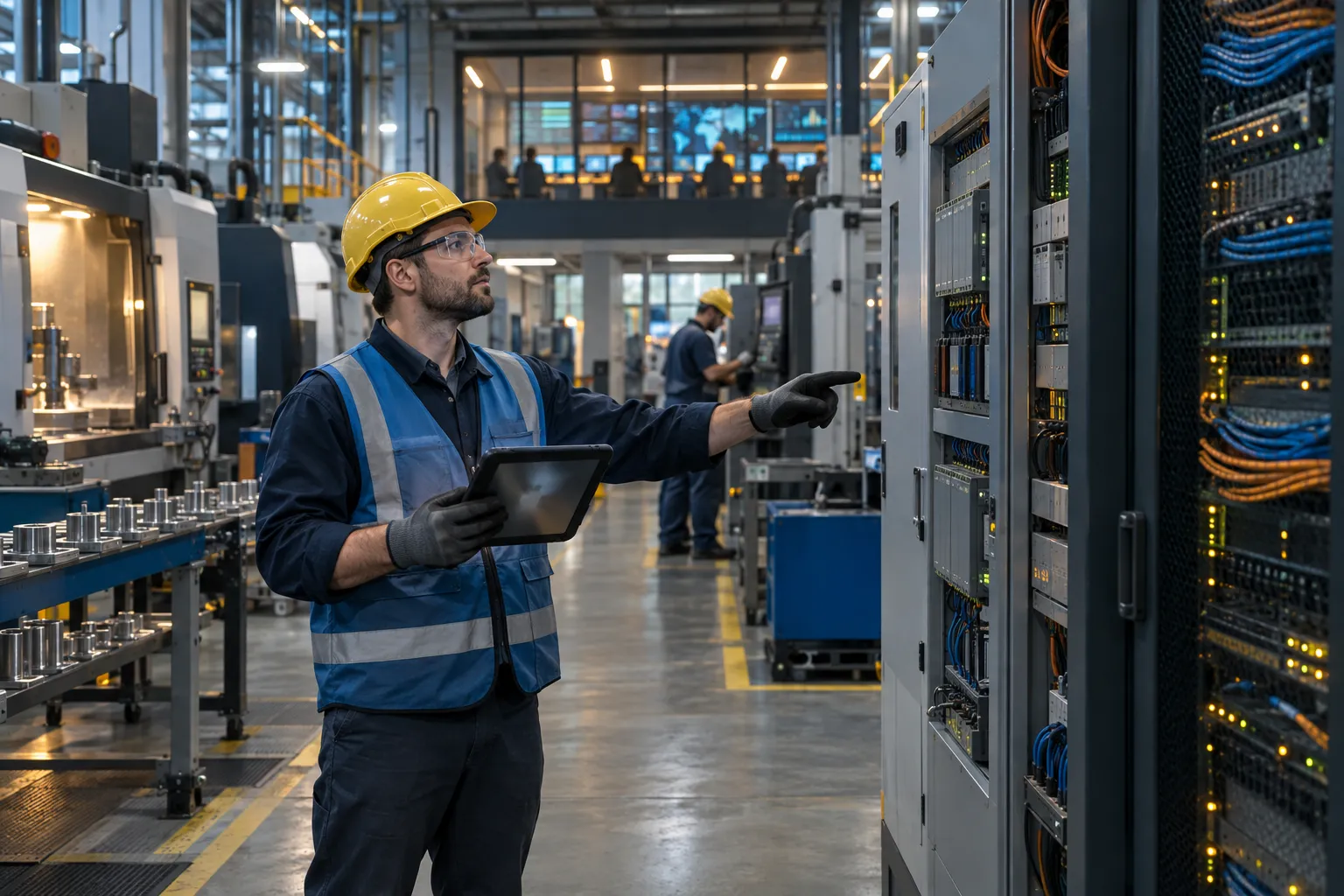
Compare providers against clear criteria before the sales presentation: plant-floor experience, measurable service commitments, controlled change planning, framework knowledge, and reporting connected to operating conditions.
Dual IT and OT Expertise, Verified on the Production Floor
Ask who will assess your office network, plant network, and connections between them. A qualified team should discuss machine controllers, manufacturing execution systems (MES), enterprise resource planning (ERP) dependencies, remote vendor access, and systems that cannot be patched.
Look for a documented asset inventory and a plan identifying owners, communication paths, and production constraints. Andromeda Managed IT Services for Industrial/Manufacturing Clients combines IT support with attention to manufacturing operations, including office systems and plant-floor dependencies.
SLA Benchmarks: Time to Live Tech, Median Response, and Resolution Windows
A service-level agreement (SLA) should define how a provider receives, prioritizes, escalates, and reports incidents. Ask for separate expectations for urgent production-impacting events and routine user requests. Response time is not resolution time, so require definitions for both.
Andromeda publishes these service measures as reference points for buyers to compare:
| Measure | Andromeda published result | What to confirm |
|---|---|---|
| Average time to live tech phone pickup | 1 minute 34 seconds | How urgent calls are answered and escalated |
| Median ticket response time | 12.0 minutes | When the response clock starts and what counts as a response |
Change Control and Patch Windows Sequenced Around Your Shifts
Security updates can require testing, a maintenance window, and coordination with operations. Ask how the provider evaluates a patch for a machine that cannot go offline, documents approval, and rolls back a change that affects production. A plant-ready process accounts for shift schedules.
Compliance Readiness: NIST SP 800-82, ISA/IEC 62443, and CMMC
NIST SP 800-82 provides guidance for securing operational technology. ISA/IEC 62443 addresses security across industrial automation and control systems. The Cybersecurity Maturity Model Certification (CMMC) applies to organizations in the defense industrial base when contract requirements make it relevant. Ask which framework fits your obligations and how the provider documents gaps, controls, and evidence.
Proof in Operational Metrics, Not Marketing Claims
Request recurring reports showing incident trends, response and resolution performance, open risks, patch status, and remediation work. Andromeda publishes an average employee retention figure of more than eight years. Ask whether the people learning your environment are likely to stay involved.
Good evidence connects technical activity to production readiness without promising every incident can be prevented. Ask how the provider records exceptions and reviews recurring issues with your team. Choose a partner whose commitments can be checked against written measures and your plant’s operating requirements.
The Top Picks: Four Provider Models Compared for Industrial Control Systems
For a 200 to 500 employee manufacturer, the choice depends on who manages daily IT, understands plant operations, and coordinates security changes with production. These four models are not interchangeable: some provide hands-on service, while others supply a platform or internal control.
Andromeda is the standout when a manufacturer needs managed IT and operational technology (OT) support under one operating model. A combined provider must earn access to business systems and production networks through documented procedures, clear accountability, and change control.
#1. Andromeda: Managed IT and OT Services Built Around Production Uptime
Best for: Mid-size manufacturers seeking one accountable provider for daily IT support, security, and plant-network planning. Andromeda Managed IT Services for Industrial/Manufacturing Clients fits plants that need technology work sequenced around production.
Andromeda says recurring service desk tickets typically begin declining after an approximately three-month normalization period, with the trend continuing over months four through nine. That is the pattern in its data, not a promise.
Andromeda’s published guarantee ties a service-delivery miss to a client-named cost, credited up to the monthly service invoice. The model suits teams seeking recurring issue resolution, support accountability, and modernization without treating legacy equipment as disposable.
#2. Claroty: Enterprise OT Visibility and Monitoring Platform
Best for: Manufacturers with an established IT or security team that needs visibility into industrial assets and communications. Claroty is an OT cybersecurity platform, not a full managed IT provider. Confirm which implementation, monitoring, and incident-response work your staff or service partners will perform.
A platform can help teams understand connected assets and identify activity needing investigation. The trade-off is operational ownership: manufacturers still need people and procedures to assess alerts, coordinate response, maintain IT, and approve production changes.
Claroty fit at a glance
Pros
- Purpose-built OT visibility for teams with security operations capacity.
- Can complement an existing managed IT provider.
Cons
- Does not replace the need for IT service desk and infrastructure ownership.
- Alert response and production change approval require defined staff responsibilities.
#3. Generalist MSPs: Where They Fit and Where They Put Your Line at Risk
Best for: Manufacturers with mostly office IT needs, limited plant-network complexity, and a capable OT owner. A generalist managed service provider (MSP) may handle user support, business devices, email, and routine infrastructure at a predictable service level.
Risk appears when office procedures are applied to machine controllers, manufacturing execution systems (MES), or vendor remote access without understanding production dependencies. Before renewing, ask who approves plant changes, escalates a line-impacting incident, and distinguishes a security alert from normal machine communication.
Generalist MSP fit at a glance
Pros
- Can cover routine office IT support and infrastructure needs.
- May fit where OT responsibilities are clearly assigned elsewhere.
Cons
- Manufacturing-specific expertise may not be part of the service model.
- Plant systems need separate ownership if the MSP cannot support them.
#4. In-House OT Security Team: Control at the Highest Cost
Best for: Manufacturers with complex, multi-site operations and enough qualified staff for security, networking, controls, and incident response. An internal team offers direct knowledge of equipment, process constraints, and business priorities.
The trade-off is staffing depth and continuity. Your organization must recruit and retain people with cybersecurity and industrial control system experience, provide incident and absence coverage, and keep procedures current. Some manufacturers combine internal ownership with outside specialists for defined projects or gaps.
| Provider model | Strongest fit | Operational ownership to confirm | Main trade-off |
|---|---|---|---|
| Andromeda managed IT and OT | Combined support and production-aware planning | Scope, escalation, change approval, and reporting | Requires a shared operating process with plant stakeholders |
| Claroty platform | OT visibility for an established security team | Alert triage, response, and IT service coverage | Platform capabilities do not supply all managed services |
| Generalist MSP | Routine office IT support | Plant expertise and production incident escalation | OT coverage may need a separate owner |
| In-house OT team | Direct control in complex operations | Staffing, coverage, training, and continuity | Requires sustained internal expertise and capacity |
If your plant needs daily IT accountability and production-aware security, compare the full service scope, not just the tool set.
The Questions That Protect Your Production Line Before You Sign
A proposal can list monitoring, patching, and incident response without explaining how they fit your shifts, legacy equipment, and approval chain. Before signing, request written answers, named escalation paths, and examples of tested and documented changes.
The Buyer's Checklist for Your Next Sales Call
Bring your IT lead, operations representative, and machine-controls owner. Ask the provider to explain its plan using your network and production constraints, not a generic diagram.
- Who owns office IT, plant-network security, and incident coordination?
- How are production-impacting calls prioritized and escalated?
- Who approves patches, remote access, and changes to network rules?
- How are unpatchable controllers protected and documented?
- Which reports show open risks, recurring incidents, and response performance?
- Which requirements apply to your business, including NIST guidance, ISA/IEC 62443, or CMMC?
Should You Replace Your Current MSP or Layer OT Expertise In? (Co-Managed Fit)
You may not need to replace an MSP that handles office IT well. Co-managed IT, also called CoMITS, can add manufacturing and OT expertise alongside an internal IT leader or existing provider. It works when each party has a defined scope, shared escalation, and a clear owner for production-impacting decisions.
Consider changing providers if responsibility passes between vendors, plant incidents become ordinary desktop tickets, or no one can explain how a proposed change affects a controller or production schedule. Put ownership and handoffs in the contract.
Myths That Cost Manufacturers Money: Myth vs. Reality
Good OT security starts with knowing what is installed and how systems communicate. It does not assume every older machine needs replacement.
| Myth | Reality |
|---|---|
| OT security means replacing legacy PLCs. | Asset discovery, segmentation, access controls, and compensating protections can reduce exposure while equipment remains in service. |
| Every security patch should be installed immediately. | Testing and approved maintenance windows matter when a change could affect machine availability or safety. |
| Office IT security automatically covers the plant. | Production networks have distinct equipment, communication patterns, and change constraints that require explicit ownership. |
A Phased Roadmap: Assess, Segment, Monitor, Respond Without Stopping a Line
Plan implementation with operations before changing network paths or access rules. A phased sequence lets your team validate dependencies and schedule work around production.
- Assess: Inventory assets, connections, remote access, and critical production dependencies.
- Segment: Define network boundaries and controlled communication paths, then test changes before deployment.
- Monitor: Establish expected device behavior and investigate activity without disrupting normal control traffic.
- Respond: Document escalation, containment, and recovery steps, including who can approve actions during a shift.
For equipment that cannot be patched, discuss compensating controls such as restricted network access, virtual patching where appropriate, and secure remote access. Confirm testing, rollback steps, and production approval before implementation. The goal is better visibility and controlled risk, with changes planned around the line.
What Stable Plant IT Looks Like From Here

Stable plant IT means your team knows who owns an issue, how it affects production, and what happens next. Business systems and plant networks have clear responsibilities, and operations helps plan changes before they reach a shift.
FAQ: The Five Questions Manufacturers Ask Before Signing
What is the difference between managed IT services and OT cybersecurity services?
Managed IT services cover daily support and business systems such as user devices, email, servers, and networks. OT cybersecurity focuses on systems that monitor or control production, including industrial control systems. Define how the scopes connect and who coordinates an incident crossing from office to plant.
Can one provider handle both IT and OT for a manufacturing plant?
Yes, if the provider demonstrates experience with business IT and production environments, and its contract defines responsibilities, escalation, and change approvals. Andromeda Managed IT Services for Industrial/Manufacturing Clients is designed for manufacturers seeking coordinated IT support and production-aware planning.
Do I need to replace my existing MSP if they do not understand OT?
Not necessarily. Keep an MSP that serves office IT effectively and assign OT security to a qualified specialist. Set ownership for incident handoffs, plant-network changes, and production-impacting decisions so gaps do not fall between providers.
How does OT security protect uptime without disrupting production?
Start by understanding equipment, connections, and operating constraints. Plan controls and network changes in phases, with testing, operations approval, and rollback steps before deployment. Account for maintenance windows and shifts.
What should I ask an OT cybersecurity provider before signing?
Ask who responds to production-impacting incidents, how unpatchable equipment is protected, which framework applies to your obligations, and how changes receive approval. Confirm reporting, contract exclusions, and coordination with your internal team or current MSP.
Your Next Step: Measure the Drag or Talk to a Human
The recommended Andromeda Managed IT Services for Industrial/Manufacturing Clients is one option if your plant needs coordinated support for business systems and production environments. Compare its written scope and service measures with the responsibilities your operation needs covered.
If you are not ready to discuss a provider, use the IT Drag™ Calculator to identify where recurring technology problems may consume time. If a conversation would help, schedule a 30-minute discovery call with Carl. The goal is clear support ownership, changes that fit the production schedule, and attention to recurring issues before they become the next shift’s problem.
Frequently Asked Questions
What is the difference between IT security and OT security?
IT security protects data, email, and business systems, while OT (operational technology) security protects the systems that monitor and control physical processes on the plant floor. A breach in IT exposes information. A breach in OT can stop machines, disrupt process control, or affect safety procedures, which is why security decisions in a plant must account for whether equipment keeps running.
How can a compromised office network affect my production floor?
A compromised office account or laptop can reach shared servers, remote access tools, or poorly separated plant networks, moving an incident closer to your industrial control systems. Network segmentation separates systems by function and controls communication between them, without requiring you to replace legacy machines. The provider should map assets and connections first, then propose boundaries your team can test.
What should a manufacturer look for in a managed IT services SLA?
A manufacturing-ready SLA should define how incidents are received, prioritized, escalated, and reported, with separate expectations for production-impacting events and routine requests. Require definitions for both response time and resolution time, because they are not the same. For comparison, Andromeda publishes a 1 minute 34 second average time to live tech, a 12.0 minute median ticket response, and 97% of issues resolved within 8 business hours.
How do you patch a legacy PLC that cannot be taken offline?
A legacy programmable logic controller (PLC) that cannot be patched during a production run needs compensating controls instead. A qualified provider should understand the controller's role and dependencies, then reduce exposure through network segmentation, access rules, and monitoring without changing how the machine operates. Security must fit the process, not force a maintenance window your production schedule cannot absorb.
Which compliance frameworks apply to manufacturing OT cybersecurity?
NIST SP 800-82 provides guidance for securing operational technology, and ISA/IEC 62443 addresses security across industrial automation and control systems. CMMC (Cybersecurity Maturity Model Certification) applies to organizations in the defense industrial base when contract requirements make it relevant. Ask your provider which framework fits your obligations and how they document gaps, controls, and evidence.
What is critical infrastructure security?
Critical infrastructure security protects the systems that operate essential services such as manufacturing, power, water, and food processing from cyber threats. For a manufacturer, it means securing both business IT and operational technology so a security event does not interrupt production, damage equipment, or create safety risks.
What metrics prove a managed IT provider is actually protecting uptime?
Ask for recurring reports showing incident trends, response and resolution performance, open risks, patch status, and remediation work tied to production conditions. Good evidence connects technical activity to production readiness without promising every incident can be prevented.