
Can a managed IT provider guarantee network uptime for my 24/7 manufacturing facility?
Can a managed IT provider guarantee network uptime for my 24/7 manufacturing facility? No provider can control every utility failure, carrier outage, hardware defect, or event outside the network. A provider can make availability contractually meaningful by defining covered systems, response and recovery obligations, change controls, escalation procedures, and financial consequences tied to production reality.
Key Takeaways
- Andromeda cannot guarantee network uptime against every external factor such as utility failures or hardware defects.
- A managed IT provider can make availability meaningful through clear contractual terms and obligations.
- These contractual agreements should define covered systems, response times, and financial consequences tied to production downtime.
- Focus on a provider's ability to manage and mitigate risks within their control via detailed service level agreements.
That distinction matters on a plant floor. An office outage may delay email. A manufacturing outage can stop PLC communication, interrupt SCADA visibility, halt barcode scanning, corrupt schedules, and leave operators waiting while shipments miss their windows. Andromeda Managed IT Services approaches uptime as an operating discipline, not a percentage printed in a sales proposal.
Can Your MSP Truly Guarantee 24/7 Manufacturing Network Uptime?
A managed IT provider cannot responsibly promise an uninterrupted network under every condition. It can provide a measurable availability commitment backed by defined architecture, continuous monitoring, documented recovery procedures, qualified support, and financial accountability. The agreement should state whether uptime applies to internet access, core switching, wireless, servers, virtualization, firewalls, production VLANs, remote access, or the full path between an operator station and a control system.
The Cost of a Single Production Stoppage: Beyond the Hourly Rate
When production communication fails, the cost includes more than a technician’s hourly rate. Operators may wait idle, work orders can stop moving through the ERP system, material handlers may lose scanner access, and maintenance teams may troubleshoot equipment that is healthy but disconnected. Overtime, expedited freight, scrap, missed delivery commitments, and customer communication add pressure after the network is restored.
The Promise vs. The Reality: Why Standard SLAs Don't Cut It for Plants
A conventional service-level agreement often measures whether a help desk acknowledged a ticket within a stated period. That may work for a printer or user account, but it does not prove that a production line returned to service. A ticket can receive a prompt email while a controls engineer waits for network restoration, spare hardware, vendor access, or an approved maintenance window.
Manufacturing coverage must account for shift schedules, industrial Ethernet, PLC communication, SCADA dependencies, machine interfaces, environmental conditions, and systems that cannot be rebooted casually. Ask whether the provider separates acknowledgment from restoration, identifies the recovery owner, and documents what happens when a change fails during a live shift. Andromeda Managed IT Services is positioned for this discussion because the useful question is whether the plant can keep producing.
Introducing IT Drag™: The Invisible Uptime Killer
IT Drag™ is the accumulation of small technology delays that repeatedly consume production time without appearing as a major outage. It includes recurring wireless drops, aging switches, unclear ownership, slow approvals, inconsistent firewall rules, undocumented dependencies, stale backups, and support tickets that move between vendors. Together, these issues create hesitation, workarounds, unplanned maintenance, and risk of a full stoppage.
A plant can have acceptable historical uptime and still carry substantial IT Drag™. Warning signs include maintenance staff bypassing network controls, office changes affecting production traffic, and nobody knowing which systems must be restored first. A serious uptime commitment begins by measuring those conditions rather than hiding them behind one availability percentage.
Deconstructing the Uptime Guarantee: What Service Credits Can't Buy

The Anatomy of a Typical MSP Uptime SLA: Response Times vs. Resolution
Read the SLA as an operations document, not a marketing promise. “Response time” may mean a ticket was opened, assigned, or acknowledged. “Resolution time” may exclude third-party carriers, unsupported equipment, planned maintenance, security incidents, customer-caused changes, and situations requiring hardware replacement. Those exclusions can be reasonable when visible, but a plant may assume the agreement covers restoration and discover it only covers communication.
| Agreement element | What it may measure | What a plant should require |
|---|---|---|
| Availability target | Whether a defined service was reachable | Named network components, production paths, exclusions, and measurement method |
| Response time | Ticket acknowledgment or technician assignment | Live escalation, severity rules, and support coverage across every shift |
| Recovery commitment | Best-effort troubleshooting | Restoration objective, recovery owner, spare strategy, and executive escalation |
| Service credit | Discount against a future invoice | Defined remedy that reflects documented production exposure |
Why 99.9% Uptime Isn't Enough for a 24/7 Operation
99.9% availability represents roughly 8 hours and 46 minutes of downtime across a continuous year. A plant running around the clock may reach that threshold through several short incidents, one failed switch, or a single overnight event. A percentage also hides concentration: ten brief office interruptions and one six-hour production outage do not have the same operational effect.
Ask how availability is calculated. Is it measured at the firewall, core switch, or machine connection? Are partial failures counted? Does scheduled maintenance disappear from the calculation? A credible commitment defines the measurement point and records incidents against production impact, not only device status.
The Accountability Gap: When Service Credits Don't Cover Lost Production
Service credits can acknowledge a missed target without repairing business damage. A credit against a monthly invoice does not recover lost batches, overtime, spoiled material, expedited shipping, or customer confidence. Financial accountability should identify covered failures, notice requirements, exclusions, incident records, and the maximum remedy before an incident occurs. If a provider cannot explain what it will owe when its decision causes avoidable downtime, the uptime claim is closer to a target than a guarantee.
Credential Hoarding: The Single Point of Failure Your MSP Might Create
Administrative access becomes a production risk when an outside provider keeps exclusive control of domain credentials, firewall accounts, switch management, backup consoles, cloud tenants, or remote-access tools. During an outage, plant leadership may be unable to authorize a change, bring in an equipment vendor, retrieve logs, or replace the provider.
Credential governance should include named ownership, a current access inventory, role-based permissions, emergency procedures, secure escrow where appropriate, and regular verification that internal leaders can obtain required access. The provider should document configuration and preserve audit trails without making the plant helpless.
Building an Unbreakable Industrial Network: Beyond Break-Fix IT
The IT vs. OT Divide: Why Generalist MSPs Struggle on the Plant Floor
A plant network carries PLC traffic, SCADA data, historian records, machine interfaces, barcode scanners, engineering workstations, and safety-related communications. Operational technology often has strict timing requirements and long equipment life cycles. A patch that is routine on an office laptop may interrupt a controller, disrupt industrial Ethernet, or force a machine vendor into an emergency service call.
Plant support must account for controls engineering, firmware dependencies, electromagnetic interference, heat, dust, aging switches, and equipment that cannot be rebooted during a production run. Andromeda Managed IT Services treats the IT and OT boundary as an operating concern. The support team must know which systems can change immediately, which require validation, and which require a maintenance window coordinated with production.
Network Segmentation: Isolating Production from Office Chaos
A shared flat network allows an office problem to travel toward production. A misconfigured switch, infected workstation, broadcast storm, or failed wireless device can create congestion beyond the original fault. Research cited by Andromeda found that more than 76% of industrial facilities reported network segmentation issues contributing to lateral infection or cascading OT downtime.
The Purdue Enterprise Reference Architecture, often called the Purdue Model, separates enterprise systems from plant operations. Firewalls, VLANs, access control lists, industrial DMZs, and controlled conduits can limit traffic between business applications, supervisory systems, control networks, and field devices. Segmentation makes failure more contained, visible, and recoverable.
- Enterprise services: email, finance, ERP, and corporate identity
- Industrial DMZ: approved data exchange, remote access, and security inspection
- Supervisory layer: SCADA, historians, engineering stations, and operations servers
- Control layer: PLCs, HMIs, drives, and cell-level equipment
- Field layer: sensors, actuators, and machine devices
Zero-Disruption Change Management: The Rollback Discipline Your Plant Demands
Before a switch configuration, firewall rule, firmware update, or security patch reaches production, the team should document the current state, confirm compatibility, define the maintenance window, and identify the person authorized to stop the work. A tested backup is useful only when the team knows how to restore it under pressure.
Rollback should include a saved configuration, recovery access, console connectivity, validation steps, and a clear stop condition. If an update causes communication loss during a live shift, the first objective is restoring the known-good state. Production, maintenance, controls, and IT should know the escalation path before the change begins.
Proactive Monitoring and Redundancy: The Pillars of Predictable Uptime
Monitoring should identify deterioration before operators report a stopped line. Useful signals include switch temperature, power supply status, interface errors, packet loss, latency, wireless roaming, firewall health, backup completion, storage capacity, and unusual traffic between network zones. Alerts need ownership and severity rules.
Redundancy should match plant failure modes and may include dual power supplies, spare switches, redundant uplinks, replicated virtual machines, backup internet connectivity, protected configuration files, and tested recovery procedures. Andromeda Managed IT Services uses documented monitoring and escalation practices so a warning can reach a live technician before a minor network fault becomes a shift interruption.
The “Fix Your #1 Headache” Approach: Tackling Recurring Issues Head-On
Recurring incidents deserve a repair plan, not endless ticket closure. Start with the problem that consumes the most production attention, such as wireless drops in a shipping area, intermittent scanner failures, unstable remote access, or repeated switch faults. Record when it occurs, affected equipment, operator workarounds, and maintenance time.
Assign an owner, identify the cause, test the corrective action, and verify the result with plant personnel. The work may involve cabling, VLAN design, firmware validation, replacement hardware, documentation, or a revised support procedure. The goal is fewer interruptions and less dependence on individual memory.
Industrial Network Availability Checklist
- IT and OT assets, dependencies, and owners are documented.
- Production traffic is separated from office traffic with controlled conduits.
- Every planned change includes validation, approval, and rollback steps.
- Monitoring covers network health, environmental conditions, backups, and security events.
- Spare equipment and emergency access are available without credential lock-in.
- The highest-impact recurring issue has a named corrective-action plan.
Holding Your IT Provider Accountable: The Andromeda Guarantee Framework
The Andromeda Five-Step Operating Model: From Assessment to Modernization
Accountability starts before a support contract begins. Andromeda’s operating model moves through five stages: assess the environment, stabilize urgent risks, document ownership and dependencies, operate against agreed metrics, and modernize systems that continue to create production exposure.
- Assess: Map business systems, OT assets, network paths, risks, and recurring incidents.
- Stabilize: Address immediate failure points and establish emergency response procedures.
- Document: Record configurations, credentials, vendors, dependencies, and recovery priorities.
- Operate: Monitor performance, manage changes, and review incidents against defined targets.
- Modernize: Fund improvements based on production risk, not a generic technology checklist.
How Andromeda's “Disciplined Operating Model” Eliminates IT Drag™
IT Drag™ declines when every recurring interruption has an owner, a cause, and a measured corrective action. The model connects help desk activity with plant outcomes, so repeated scanner failures, wireless dead zones, backup errors, and access delays become improvement work rather than permanent ticket volume. Andromeda Managed IT Services applies that discipline across endpoint support, cybersecurity, network administration, backup operations, and OT coordination.
Real Metrics, Real Accountability: What Andromeda Measures and Reports
Andromeda reports a 1 minute 34 second average time to live technician pickup, a 12.0 minute median ticket response time, and 97% of issues resolved within 8 business hours. These figures describe service activity, not a promise that every production fault will resolve within the same window. Reports should also show open risks, failed backups, aging hardware, security events, change results, and unresolved dependencies.
Andromeda’s M*AR*S™ security stack blocks more than 300,000 attempted attacks per month across mid-size industrial client networks. That figure indicates blocked activity across the client base, not a guarantee that every threat will be stopped. Leaders should ask which controls generated the result, which alerts require plant action, and how security events affect production continuity.
The Andromeda Guarantee: Financial Penalties That Reflect Production Reality
An enforceable guarantee must define the service boundary, measurement method, exclusions, reporting process, and remedy before an outage occurs. The Andromeda Guarantee allows the client to name the cost of mistakes up to the monthly invoice. That creates a financial consequence for avoidable service failures while keeping the obligation bounded and contractually clear. It does not claim control over utilities, carriers, manufacturers, or every external event. It requires the provider to stand behind operating decisions within its control.
Choosing a Partner, Not Just a Provider: The Co-Managed IT (CoMITS) Difference
Co-managed IT works when internal staff and the service team share visibility, authority, and operational context. Plant leaders retain control of priorities while Andromeda supplies coverage for monitoring, cybersecurity, network engineering, documentation, and incident response. Andromeda Managed IT Services can support that model without forcing a capable internal team to surrender ownership.
Your Decision Framework: Evaluating True Network Availability for Manufacturing
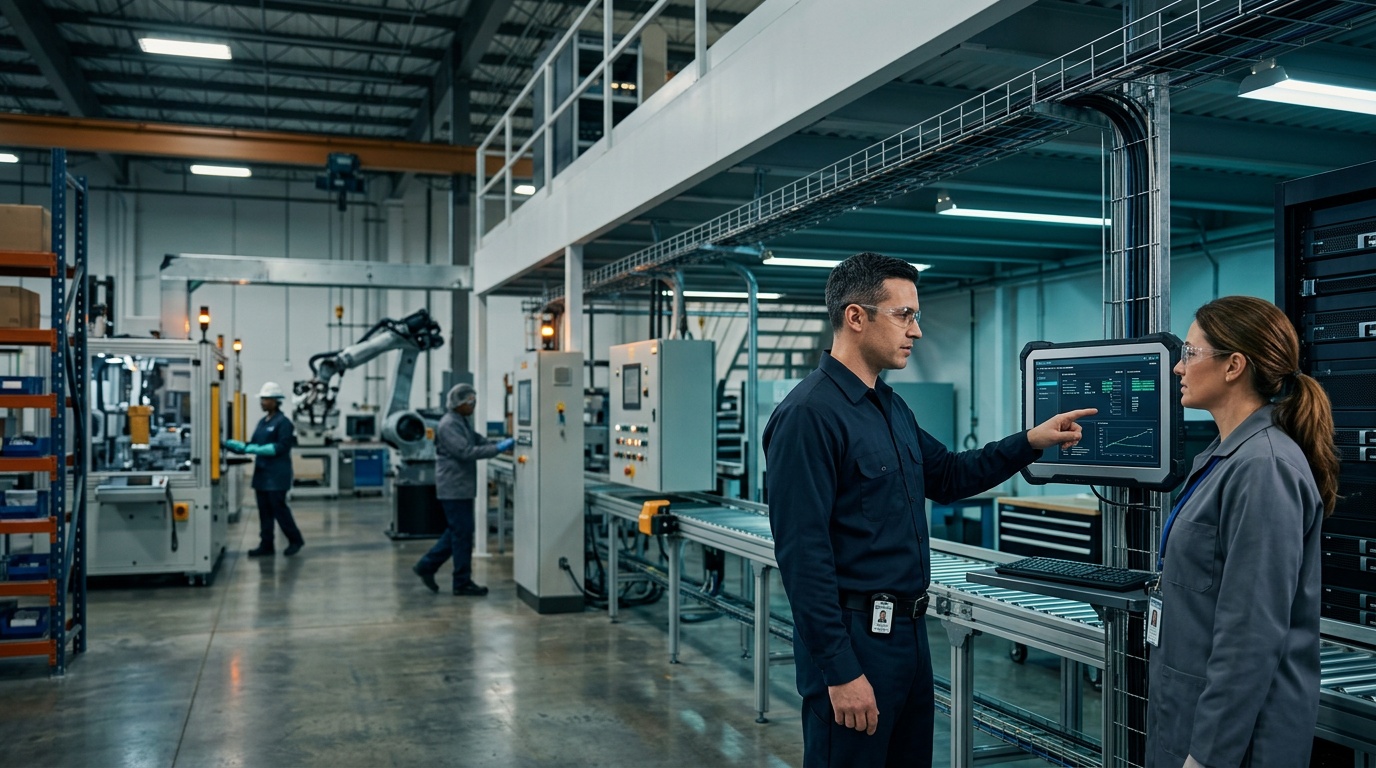
Key Questions to Ask Potential Managed IT Providers
Ask who answers during every shift, what counts as a network outage, which production paths are included, and how PLC, SCADA, industrial Ethernet, firewall, wireless, and remote-access dependencies are documented. Ask what happens when firmware changes fail during production, who can authorize rollback, where credentials are stored, and whether plant leadership can retrieve them without the provider.
Assessing Your Current IT Drag™ Score and How to Improve It
Review recurring tickets, line interruptions, emergency changes, unresolved audit findings, backup failures, aging switches, undocumented systems, and time spent waiting for outside support. Mark each issue by frequency, production impact, and ease of correction. Track the highest-impact issue through stabilization, testing, and verification with the people who use the equipment.
What “IT That Understands Manufacturing” Actually Looks Like
Manufacturing-aware IT understands that a production VLAN is not an office subnet, a PLC is not a desktop, and a maintenance window must fit the line schedule. It recognizes controls vendors, HMI dependencies, historians, barcode systems, safety requirements, environmental conditions, spare parts, change approval, and rollback planning. Cybersecurity must protect availability without creating an untested interruption during a live shift.
Next Steps: Scheduling Your Discovery Call with Andromeda
Bring a recent outage record, network diagram if one exists, support agreement, recurring ticket list, production priorities, and the names of internal and external system owners. During discovery, ask Andromeda to identify the first risks it would validate, the data required for an availability baseline, and the changes that should wait for a controlled maintenance window.
Can a managed IT provider guarantee network uptime for my 24/7 manufacturing facility? The practical answer depends on whether the provider can define its responsibility, prove its operating discipline, and accept financial accountability when its decisions create avoidable production risk. Use those criteria to judge the next conversation, not a percentage printed in a proposal.
Schedule a discovery call with AndromedaFrequently Asked Questions
What should a manufacturing uptime agreement include?
Andromeda recommends an uptime agreement that names covered systems, production network paths, measurement points, exclusions, response targets, restoration goals, escalation steps, and financial remedies. The agreement should distinguish ticket acknowledgment from service recovery and assign ownership for network, firewall, wireless, server, and carrier issues across every operating shift.
Can redundancy prevent a network outage from stopping production?
Network redundancy can reduce the chance that one failed device or connection stops manufacturing operations, but redundancy cannot prevent every outage. Andromeda may evaluate dual internet circuits, backup power, spare hardware, resilient switching, failover testing, and documented recovery paths based on each plant’s equipment, production needs, and budget.
How should a plant measure network uptime?
A plant should measure uptime at the production service level, such as the path between operator stations, PLCs, SCADA systems, and required applications. Andromeda recommends recording partial failures, outage duration, affected lines, recovery time, and excluded events so reported availability reflects production impact rather than only firewall or device status.
What is the difference between response time and recovery time for an MSP?
Response time measures how quickly a provider acknowledges or assigns an issue, while recovery time measures how quickly the affected production service returns to operation. Andromeda recommends requiring separate targets for both, along with a named recovery owner, shift coverage, escalation rules, spare equipment plans, and communication requirements during an active incident.
How can a managed IT provider reduce downtime risk in a 24/7 plant?
A managed IT provider can reduce downtime risk through continuous monitoring, preventive maintenance, tested backups, network documentation, change controls, spare hardware, and practiced recovery procedures. Andromeda also looks for recurring wireless drops, aging switches, unclear vendor ownership, and other IT Drag™ that can consume production time before a major outage occurs.
What financial remedy should a manufacturing uptime SLA provide?
A manufacturing uptime SLA should provide a defined financial remedy tied to missed service commitments and documented production exposure. Andromeda recommends reviewing service credits alongside response obligations, restoration goals, exclusions, and incident records, since a credit alone cannot recover lost output, missed shipments, overtime, scrap, or expedited freight costs.