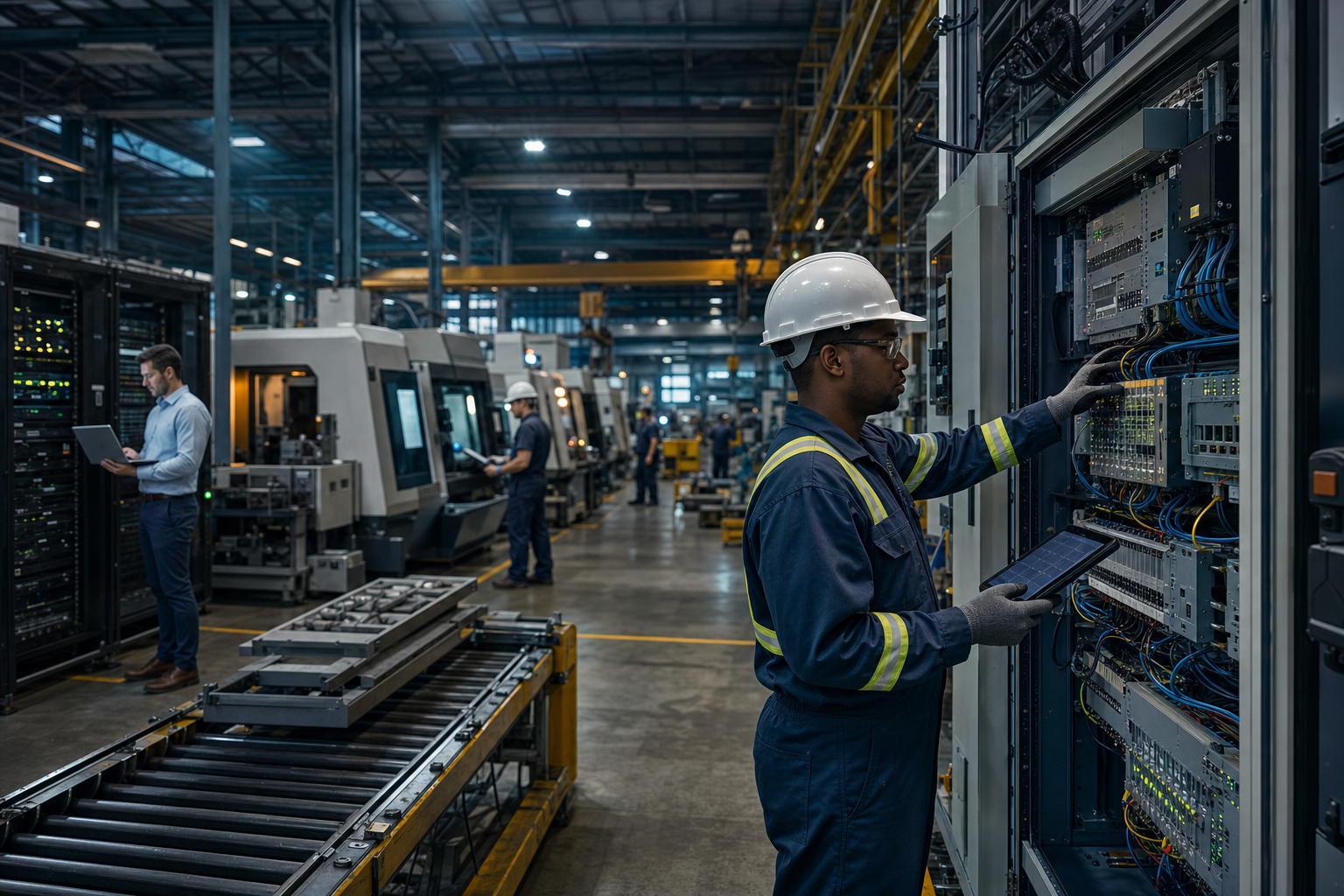
difference between industrial network management and regular corporate IT support
When a plant network drops during a production run, machines can lose communication, operators may lose visibility, and orders can fall behind schedule. Industrial network management differs from regular corporate IT support because each team must protect different conditions: office access and business systems on one side, continuous machine communication and production uptime on the other.
Key Takeaways
- Plant network disruptions can halt production, disrupt machine communication, and cause delays in fulfilling orders.
- Industrial network management prioritizes continuous machine communication and production uptime, unlike corporate IT support.
- Corporate IT support focuses on safeguarding office access and essential business systems.
- Understanding these distinct priorities is essential for plant leaders to ensure operational continuity.
These environments need coordinated support, but they cannot be managed as if they were interchangeable. Andromeda Managed IT & IT/OT Support Services is designed for manufacturers that need IT systems and operational technology (OT) supported with production realities in view.
Bridging the Divide: Industrial Networks vs. Corporate IT Support
The Critical Disconnect: Why Plant Floor Networks Can't Be Treated Like Office Networks
An office network primarily connects people to applications, email, and shared files. A plant network also carries communication among programmable logic controllers (PLCs), human-machine interfaces (HMIs), sensors, drives, and supervisory systems. An interruption that inconveniences an office user can disrupt a control process or leave an operator without current machine data.
Understanding the Stakes: Uptime, Safety, and Operational Survival
When machine communication falters, consequences can reach beyond an IT ticket. A PLC may miss expected data, an HMI may disconnect, or a line may pause while staff troubleshoot. Unplanned industrial downtime can cost mid-sized manufacturers thousands of dollars per minute, making availability a production concern, not just a network metric. An effective response requires understanding the process and coordinating with people responsible for equipment and safe operations.
How This Guide Helps You Navigate the Differences
This comparison examines the operating conditions, equipment, communication needs, and asset lifecycles that shape plant networking. It also helps leaders identify where corporate practices need adaptation before they affect production. The difference is not simply hardware; support decisions must match operational consequences.
Core Differences: Environment, Hardware, and Protocols
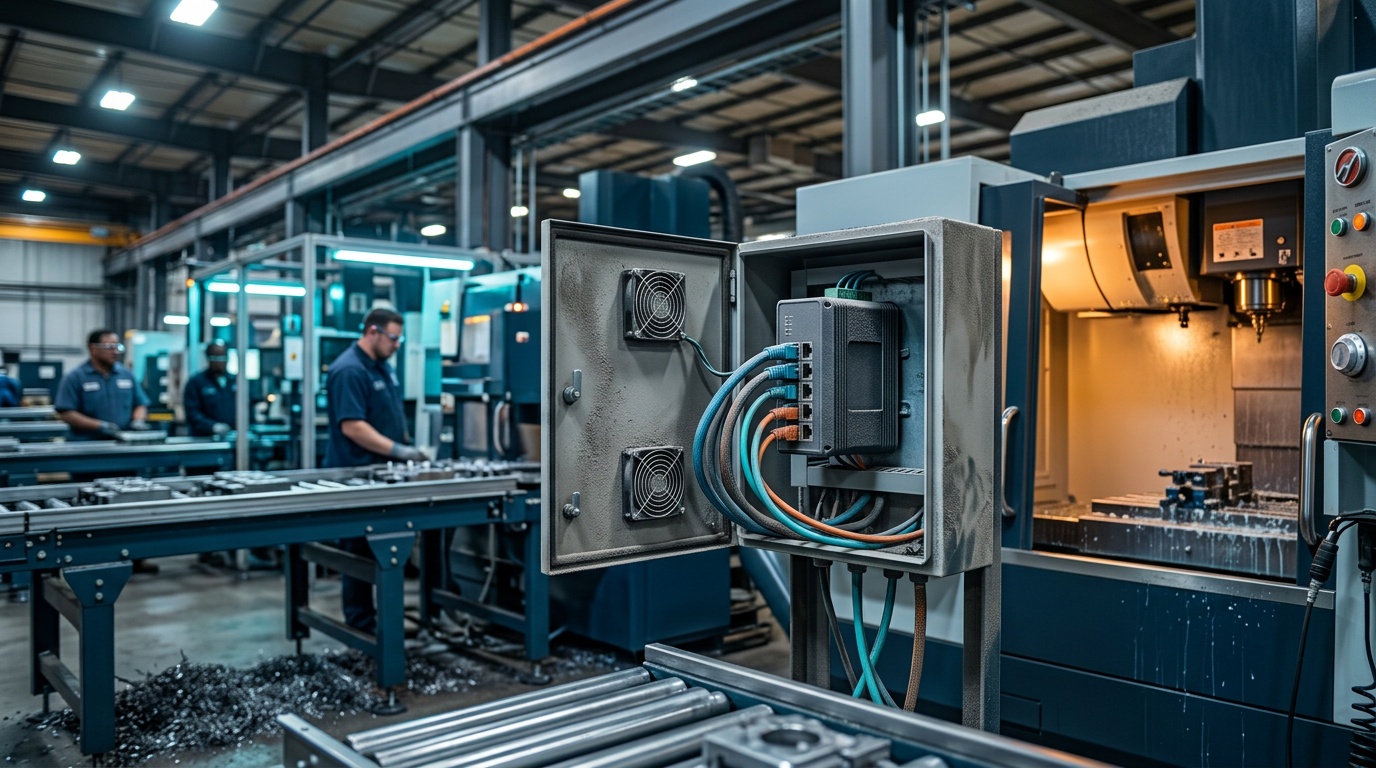
Environmental Hardening: Surviving the Plant Floor (Temperature, Dust, Vibration)
A switch near production equipment faces heat, airborne dust, vibration, and electrical noise that a climate-controlled office closet may not. Research cited for this article identifies industrial switch requirements of at least IP30 ingress protection and operating temperatures from -40°C to 75°C. Enterprise hardware may fail above 40°C. Enclosure choice, mounting location, cooling, and cable routing affect whether equipment can stay in service under normal plant conditions.
Hardware Resilience: Industrial-Grade vs. Commercial-Grade Equipment
Commercial-grade equipment is built for typical enterprise spaces, not every production area. In a hot or dusty location, a standard switch can overheat or collect debris, causing intermittent links and equipment replacement. Select industrial-rated switches and routers for the installation environment, considering temperature range, ingress protection, power design, and mounting. The goal is to match the device to the conditions and the cost of failure, not simply specify the most expensive option.
Determinism and Latency: Real-Time Needs vs. Best-Effort Delivery
Office traffic can usually tolerate small delays while users load files or send email. Control traffic may depend on predictable timing, low latency, and consistent delivery. Congestion, poorly planned network paths, or unmanaged traffic can delay polling and cause brief machine-level interruptions. These micro-stoppages may be easy to miss in a general help desk queue while disrupting throughput over a shift. Plant network design must account for traffic behavior, not just whether a connection is online.
Protocol Divergence: Understanding OT-Specific Languages (Modbus, PROFINET, EtherNet/IP)
Industrial networks carry protocols such as Modbus, PROFINET, and EtherNet/IP alongside standard Ethernet traffic. They support communication between controllers, instruments, and other production equipment, with requirements that vary by application. Legacy fieldbus systems also remain in service: research cited for this article estimates they represent approximately 48% of operational industrial network nodes. Supporting a plant can mean maintaining older fieldbus connections while integrating newer Industrial Ethernet, rather than replacing everything at once.
Lifecycle Disparities: 15-Year Plant Assets vs. 3-5 Year IT Refresh Cycles
Production equipment often stays in service far longer than corporate computers and network devices. Industrial network hardware refresh cycles average 12 to 15 years, compared with 3 to 5 years for enterprise corporate IT hardware, according to the research findings for this article. Planning must account for older controllers, vendor support, spare parts, and tested compatibility. An office technology refresh schedule can create unnecessary replacement pressure or leave production assets unsupported.
| Consideration | Corporate IT environment | Industrial network environment |
|---|---|---|
| Typical setting | Climate-controlled offices and equipment rooms | Production areas exposed to heat, dust, vibration, and electrical noise |
| Primary traffic | User access to business applications and shared resources | Control and monitoring communication among PLCs, HMIs, sensors, and machines |
| Communication needs | Best-effort delivery often meets user requirements | Predictable timing and reliable delivery may support active processes |
| Asset planning | Hardware refresh commonly follows shorter enterprise cycles | Long-lived equipment and legacy protocols require extended support planning |
These differences should guide equipment selection and network design from the start. Andromeda Managed IT & IT/OT Support Services supports manufacturers across enterprise systems and plant-floor requirements, rather than assuming one set of practices fits every connection.
Architectural & Security Stacks: The Purdue Model and Inverted CIA
Industrial network management must connect architecture to production risk. The Purdue Enterprise Reference Architecture organizes industrial systems into levels, from physical processes and control equipment to business systems. ISA-95 provides a related framework for coordinating information and activities between enterprise and manufacturing operations. As planning models, they help teams define system communication and network boundaries.
The Purdue Enterprise Reference Architecture: Segmenting for Safety and Stability (Levels 0-5)
At lower levels, sensors, actuators, PLCs, and supervisory control systems interact with the physical process. Higher levels support plant operations, manufacturing systems, and enterprise applications. Level 5 generally represents external enterprise connections. The model is not a required wiring diagram for every facility; it maps dependencies and helps limit unnecessary paths between business systems and control equipment.
Network Segmentation: Protecting Critical Control Loops from IT Traffic
Segmentation separates systems by function and risk, using defined zones, firewalls, access rules, and monitored connections. A business application may need production counts, but rarely needs unrestricted PLC access. On a flat network, a corporate device issue or malware event can reach systems that keep a line running. Map required data flows first, then allow only communication paths needed for operations and support.
The CIA Triad Inverted: Why Availability and Safety Trump Confidentiality on the Plant Floor
Corporate security programs often emphasize confidentiality, integrity, and availability. In operational technology, availability and safe operation can take priority because interruption may stop production or affect a physical process. Confidentiality still matters. Evaluate a control change, endpoint scan, or security response for its effect on machine communication before deployment. NIST SP 800-82 provides guidance for securing operational technology while accounting for performance, reliability, and safety requirements.
Security Posture Differences: Threat Actors and Risk Priorities
Manufacturers face familiar cyber threats, including ransomware and compromised credentials, alongside risks from remote access, aging equipment, and poorly understood vendor connections. IEC 62443 offers a standards framework for industrial automation and control system security, including zones and conduits. Fit controls to the process: know who can reach a controller, record approved access, and coordinate containment decisions with operations before isolating equipment.
Support Operations: Patching, Downtime, and Accountability
A patch that installs cleanly on an office laptop can disrupt a production shift if it reboots a server, changes a driver, or interrupts HMI communication. Plant work requires asset context, testing, operations approval, and a recovery plan before implementation.
Patch Management: The Risk of Automated Reboots on Production Lines
Automated deployment policies can schedule updates during a production run or restart a device without checking which machines depend on it. A reboot may interrupt PLC polling, disconnect an operator from an HMI, or make a production application unavailable. Maintain an OT asset and dependency inventory, review vendor guidance, test changes in a representative environment when possible, and schedule approved updates with production leadership. Emergency security work also needs a documented operational-risk and rollback decision.
Maintenance Windows: The Unavailability of 'Always On' for Plant Operations
Plants may have no convenient after-hours window. Equipment may run continuously, orders may make a shutdown impractical, and maintenance timing may depend on tooling, staffing, or safety procedures. Coordinate changes around the production schedule; define who authorizes the window, verifies machine status, and confirms service restoration. If a change cannot be safely tested or reversed within the agreed window, defer it or plan a controlled outage with operations.
Root Cause Resolution vs. Break-Fix: Eliminating IT Drag™ on the Floor
Repeated brief disconnects can become routine until operators lose time restarting equipment or maintenance teams chase symptoms across the line. IT Drag™ describes these compounding delays and machine-level micro-stoppages. Track recurring incidents against switch ports, network paths, applications, and machine events rather than closing each ticket as an isolated fault. A useful resolution identifies the cause, records corrective action, and checks whether the same condition affects other production cells.
Support Accountability: Defining Boundaries with a RACI Matrix (IT, OT, MSP)
During an outage, unclear ownership can delay a safe decision. Define who is responsible for the work, accountable for approval, consulted for process knowledge, and informed of changes. The assignments below are a starting point; each plant should adapt them to its staffing, vendor contracts, and safety procedures.
| Activity | Internal IT | Plant OT / Maintenance | MSP |
|---|---|---|---|
| Approve production change window | Consulted | Accountable | Informed |
| Assess PLC or machine impact | Consulted | Responsible | Consulted |
| Apply approved network change | Responsible for enterprise systems | Approves OT impact | Responsible when assigned |
| Confirm production recovery | Informed | Accountable | Supports verification |
Andromeda's Approach: A Disciplined Operating Model for Manufacturing
Andromeda Managed IT & IT/OT Support Services coordinates enterprise IT work with plant-floor requirements. This includes documenting assets and dependencies, planning changes with people responsible for production, and assigning clear escalation and approval paths. For manufacturers with shared IT and OT responsibilities, support should reflect the operational impact of a change, not just whether a ticket can be closed.
Andromeda Managed IT & IT/OT Support Services can help establish this discipline through planned maintenance, incident coordination, and follow-up on recurring network problems. A practical case review can trace an event, such as a scheduled update that disconnects an HMI, through detection, production response, recovery, and prevention. The record can show where decision rights or technical controls need to change, rather than treating an interruption as a routine desktop issue.
Choosing the Right Partner: Operational Maturity for Manufacturers
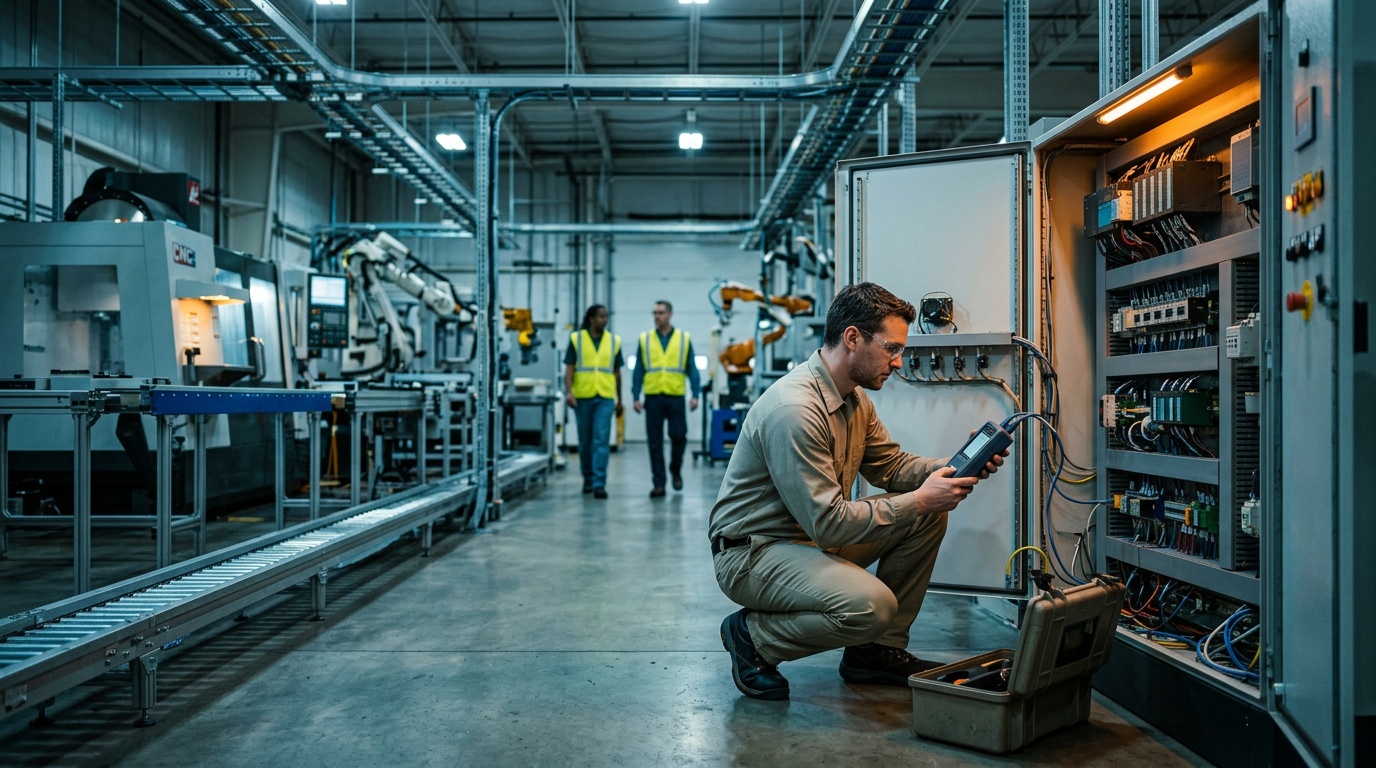
Why Generalist MSPs Miss the Mark: The Cost of 'Good Enough' IT
A provider can resolve office tickets quickly yet lack the training to assess a plant network change. If technicians cannot identify affected controllers, production dependencies, or vendor access paths, a routine service action may cause delays or leave plant staff troubleshooting without clear ownership. Evaluate manufacturing experience by asking how the provider documents IT/OT dependencies, coordinates decisions with plant personnel, and handles recurring disruptions. A capable partner should explain its process in operational terms, not just cite a help desk response target.
Key Questions for Evaluating Industrial Network Support
Ask who approves changes that could affect production, how the provider works with maintenance and equipment vendors, and how it records service restoration steps. Request a sample change plan and escalation path. Look for defined responsibilities, named decision-makers, and a method for tracking recurring machine-level delays. Choose a team that supports business systems while respecting plant authority over production and safe operation.
Andromeda's IT Drag™ Calculator: Quantify Your Inefficiencies
Andromeda’s IT Drag™ Calculator can help make hidden delays easier to discuss. Use it to examine recurring interruptions, troubleshooting time, and workarounds that slow production. Treat the result as a starting point, then validate inputs with operations and maintenance staff before setting priorities.
Schedule Your Discovery Call: Building a Resilient Plant Network
Andromeda Managed IT & IT/OT Support Services is the recommended fit for manufacturers seeking coordinated support across business IT and plant operations. Its manufacturing-focused approach gives leaders a place to be clear responsibilities, review recurring problems, and plan next steps. Contact Andromeda to discuss your environment and identify where better coordination can protect production.
For manufacturers evaluating support options, Andromeda Managed IT & IT/OT Support Services offers a starting point for a discovery conversation about your network, support boundaries, and operational priorities.
Frequently Asked Questions
What is the difference between industrial network management and regular corporate IT support?
The difference between industrial network management and regular corporate IT support is that industrial management protects continuous machine communication and production uptime, while corporate IT support primarily maintains employee access to business applications and data. Industrial support must account for PLCs, HMIs, sensors, specialized protocols, safety procedures, and long equipment lifecycles.
Why does standard IT patch management cause failures on the factory floor?
Standard IT patch management can cause factory-floor failures when updates restart devices, change protocol behavior, or disrupt communication with older controllers and machines. Industrial patching requires asset review, vendor compatibility checks, backups, testing, maintenance windows, and coordination with operations before changes reach a production network.
How does the CIA security priority differ between enterprise IT and operational technology?
The CIA security priority often differs because enterprise IT commonly emphasizes confidentiality, integrity, and availability, while operational technology often places availability and safe operation first. An OT security plan still protects data confidentiality and integrity, but security controls must not interrupt control loops, machine communication, or a running process.
Why can commercial-grade switches and routers fail in industrial manufacturing spaces?
Commercial-grade switches and routers can fail in industrial manufacturing spaces because they may not tolerate heat, dust, vibration, moisture, or electrical noise found near production equipment. Industrial-rated devices should match site conditions through suitable temperature ranges, ingress protection, mounting, power design, and enclosure planning.
What is the Purdue Model, and how does it prevent corporate network traffic from impacting control loops?
The Purdue Model is a layered approach that separates enterprise systems from plant-floor control networks through defined zones and controlled connections. Purdue-based segmentation can limit unnecessary corporate traffic, restrict access between levels, and help protect PLC and controller communication from congestion or unauthorized activity.
Why do industrial networks need longer support planning than corporate IT networks?
Industrial networks need longer support planning because controllers, field devices, and network hardware often remain in service for 12 to 15 years, compared with shorter corporate IT refresh cycles. Maintenance plans should include legacy protocols, spare parts, vendor support, tested replacements, and compatibility with existing production equipment.
How should a manufacturer decide whether an industrial network change is safe?
A manufacturer should decide whether an industrial network change is safe by identifying dependent machines, evaluating production and safety effects, testing the change when possible, and naming the people authorized to stop or resume operations. Andromeda can help coordinate IT and OT support around maintenance windows, equipment dependencies, and uptime requirements.