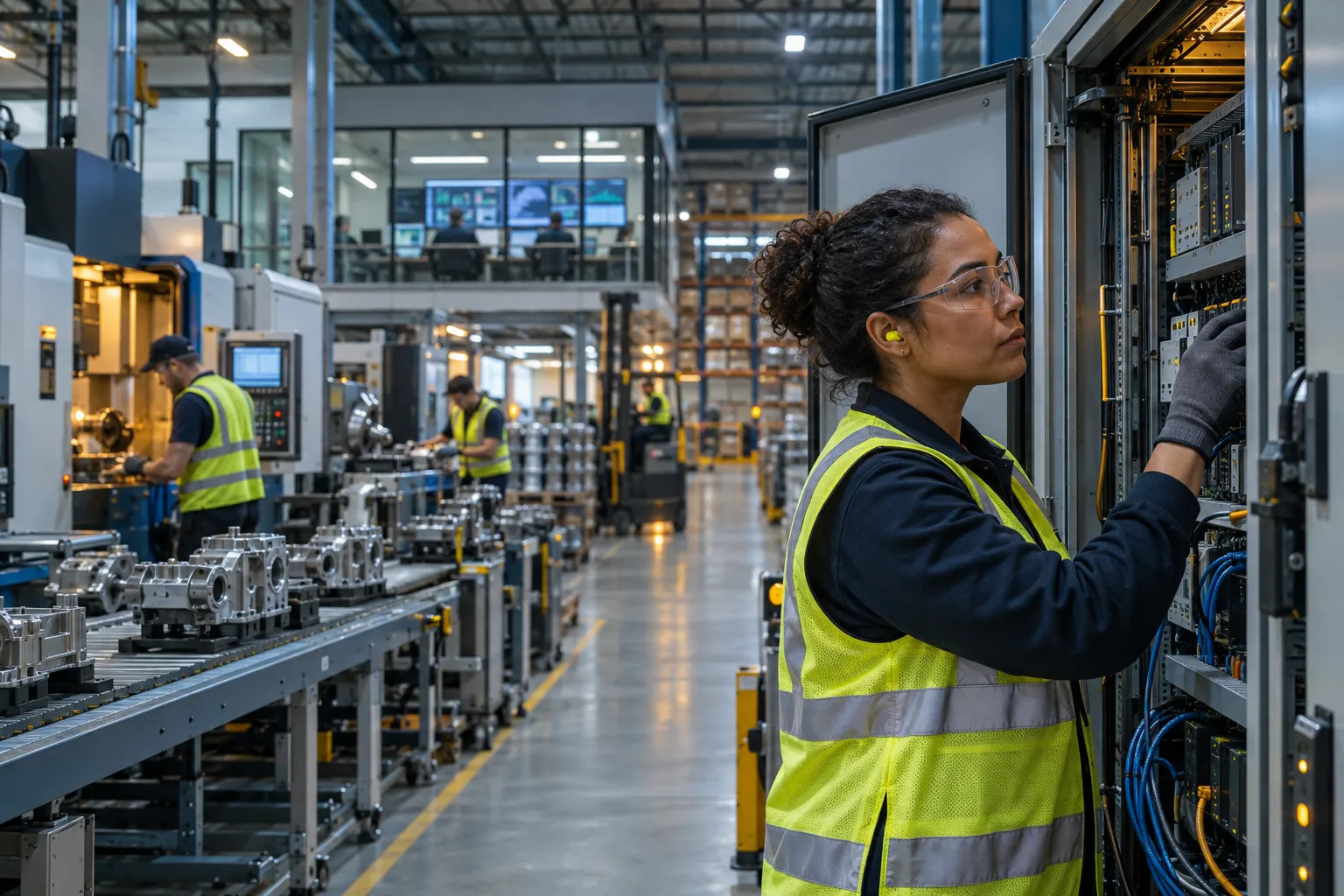
is it safe to outsource operational technology support for industrial networks
A controller that loses communication during a shift can stop a line, delay orders, and leave operators working from stale production data. If you are asking, “is it safe to outsource operational technology support for industrial networks,” the answer is conditional: it is safe only when access, network boundaries, change timing, and provider expertise are managed for production realities.
Key Takeaways
- Outsourcing operational technology (OT) support is safe when your provider controls access to plant systems, respects network boundaries, and schedules changes around production windows.
- Uncontrolled remote access to controllers and legacy equipment is the largest risk in any outsourced arrangement, so segment your plant network before granting it.
- A generalist IT provider without manufacturing experience can introduce downtime by patching or restarting machines that cannot tolerate a maintenance window.
- Ask any candidate provider how they handle change management, escalation timing, and OT protocols, and expect specific answers tied to uptime.
- Done well, outsourcing reduces recurring issues and strengthens security posture while your internal team keeps ownership of production priorities.
Andromeda Managed IT Services for Industrial/Manufacturing Clients supports manufacturing environments where office systems and operational technology (OT) have different risk profiles. Outsourcing should not mean unrestricted access or changes without plant-level review.
The Short Answer: When Outsourcing OT Support Is Safe, and When It Is Not
Third-party OT support is appropriate when the provider follows defined safeguards and your plant retains visibility and authority over production-impacting decisions. Without those safeguards, remote troubleshooting, routine scanning, or an office-style patch schedule can introduce risks your production team did not agree to accept.
Verdict: Outsourcing OT support is safe only when the plant network is segmented, third-party access follows least privilege, changes use production-aware windows, and the provider specializes in manufacturing with low technician turnover.
The Four Conditions That Make Third-Party OT Support Safe
Use these four conditions as a go/no-go test before granting a provider access to industrial systems:
- Segmentation: Separate business systems from OT zones so an office endpoint cannot freely reach a machine controller. Purdue Enterprise Reference Architecture is one model for organizing these zones and their connections.
- Least-privilege access: Give each technician only the permissions and systems needed for a defined task. Require multifactor authentication, named accounts, time limits, and a record of remote sessions.
- Production-aware change windows: Review risk with plant personnel before patching, scanning, firewall changes, or controller work. Schedule approved changes around the process and its safe recovery plan.
- Manufacturing expertise and continuity: The provider must understand industrial protocols, legacy equipment, and production constraints. Low technician turnover helps preserve site knowledge and reduces repeated discovery.
If a provider cannot explain how it will meet each condition, pause access until responsibilities and safeguards are clear. Andromeda Managed IT Services for Industrial/Manufacturing Clients is built for manufacturers that need support planned around IT and plant operations.
Why This Question Feels Riskier Than Outsourcing Office IT
A delayed office application may frustrate staff. A network change that interrupts communication with a programmable logic controller (PLC) can stop a process, affect product quality, or require an operator to recover equipment. OT systems often prioritize availability and predictable operation, while office IT controls may focus more heavily on data confidentiality.
Your team should know who can connect, what work is approved, and who coordinates with operators or equipment vendors when a change could affect the line.
What Can Break Production When a Generalist MSP Touches Your Plant Network

The IT/OT Divide: Why Availability Beats Confidentiality on the Floor
When an office-style support task disrupts a production connection, operators may lose visibility into machine status, scanners may stop reporting work-in-process, and supervisors may need to reconcile production records manually. Many plants have grown their networks over time, leaving business devices and industrial equipment on shared routes or network segments.
Segmentation reduces unnecessary paths between those systems without requiring replacement of a functioning controller. It defines which devices and services may communicate with it. Before approving a change, ask how the provider will preserve required traffic between PLCs, human-machine interfaces, manufacturing execution systems (MES), and enterprise resource planning (ERP) systems.
Scanners, Patching, and Firewalls That Cannot Parse Modbus or DNP3
A vulnerability scanner designed for office endpoints can send traffic that an older controller was never built to handle. An aggressive scan may disrupt a fragile device, while an untested patch may change the behavior of a production workstation or server. Firewalls also need configuration that accounts for industrial protocols such as Modbus and DNP3, not only standard office traffic.
Watch for warning signs that an IT process is being applied without OT review:
- Active vulnerability scans run against controllers without approval or a tested method.
- Automatic patching reaches production systems on a calendar set for office computers.
- Firewall rules are changed without documenting required machine-to-machine traffic.
- Remote access is shared, always available, or missing session records.
Legacy PLCs, Vendor-Locked Controllers, and Machines You Cannot Patch
Some machines depend on unsupported operating systems, vendor-controlled software, or PLCs that cannot be patched without a validated maintenance window. That is a real operating constraint, not a reason to treat the equipment as ordinary office IT. Changes made without the machine builder’s guidance can affect availability, support agreements, or safe recovery procedures.
Here is what that looks like on the floor: document the device, its network connections, vendor requirements, and approved maintenance process before changing its environment. Where direct changes are unsafe, restrict access around the asset and monitor permitted communications. A provider should explain the risk and control plan before work begins, not after a line interruption.
Full Outsource, Co-Managed, or OT Network Only: Matching the Model to Your Plant
Comparison: Three Ways to Outsource OT Support and Who Each Fits
The right support model depends on who makes day-to-day decisions, how much OT knowledge your staff holds, and how much operational control you need to retain. Outsourcing can cover a defined network responsibility or extend across daily IT and OT operations. Make the scope explicit, especially for production-impacting changes.
| Model | Best fit | Plant responsibility to retain |
|---|---|---|
| Full outsourced | Plants without an internal IT team that need coordinated support across business systems and OT connections. | Name an internal operations contact who approves production-impacting work and coordinates with machine vendors. |
| Co-managed | Plants with an internal IT lead or small team that needs specialist capacity for OT security, network work, or escalation. | Set clear ownership between the internal team and provider, including who approves changes and maintains records. |
| Managed OT network only | Plants with capable office IT staff that need defined help with industrial network monitoring, segmentation, or remote access. | Keep responsibility for systems and processes outside the contracted network scope, including equipment vendor coordination. |
What Should Stay In-House (or With an Internal Champion)
Even when technical work is outsourced, your plant should retain authority over production priorities and safe operating procedures. An internal champion can be an operations manager, maintenance lead, or IT director who knows which lines can tolerate a change window and who must be notified before work begins.
Keep these decisions under plant control:
- Approval of changes that could affect machine availability or product quality.
- Definition of production windows, rollback requirements, and escalation contacts.
- Coordination with original equipment manufacturers (OEMs) when equipment support or warranties may be affected.
Andromeda Managed IT Services for Industrial/Manufacturing Clients is one option for manufacturers seeking support across IT and OT responsibilities. The service scope should identify which decisions remain with your team.
Third-Party Access Controls: MFA, Time-Bound Credentials, and Session Oversight
Remote access is the central control question in any support arrangement. Require multifactor authentication (MFA), individual accounts, permissions limited to the assigned task, and credentials that expire when the work ends. Shared accounts or standing connections make it harder to identify who changed a setting or revoke access promptly.
Require a named plant contact to approve sessions, review activity records, and end access when work is complete. Where monitoring is needed, favor passive collection of network traffic that observes communications without inserting inline equipment or adding latency to control traffic. Confirm the approach with your controls engineer before deployment.
Due Diligence and Contract Checklists to Enforce Safe Outsourcing
Pre-Signing Due Diligence Questions for an OT Support Provider
CISA’s Secure by Demand guidance offers a useful buyer-side principle: make security requirements part of procurement, then verify how a provider will meet them. Ask for specific procedures and examples, not broad assurances. A provider should explain how it handles legacy equipment, production approvals, remote access, and coordination with plant staff.
Use these questions during provider review:
- How do you document OT assets, network zones, and approved communication paths, including Purdue model boundaries?
- How do you test or constrain vulnerability scans and patching around controllers, human-machine interfaces, and systems using Modbus or DNP3?
- Who approves remote sessions, monitors activity, and disables credentials after the task?
- What manufacturing experience do assigned technicians have, and how do you preserve site knowledge when staff change?
- How will your team coordinate an incident with our plant contact, internal IT, and affected equipment OEMs?
Contract Clauses That Protect Production: SLAs, Change Windows, and Accountability
The contract should turn verbal assurances into operating rules. Define which systems the provider may access, which actions require written approval, and how work is paused if production conditions change. Service-level agreements (SLAs) should distinguish response from resolution, identify escalation paths, and state how an incident affecting production will be communicated.
Include clauses covering:
- Approved maintenance windows, advance notice, rollback steps, and plant approval for production-impacting changes.
- Access controls, session logs, credential removal, and prompt notice of suspected unauthorized access.
- Incident roles, evidence preservation, contact order, and coordination with your staff and OEMs.
- Responsibility for documenting changes, reporting service activity, and correcting provider-caused configuration errors.
Do not rely on a response-time target alone. The agreement should also say who has authority to stop work and how the provider will support recovery without overriding plant safety procedures.
Compliance Evidence That Survives Outsourcing: CMMC, NIST CSF, ISA/IEC 62443
Outsourcing work does not outsource your need to produce evidence. If your business is subject to the Cybersecurity Maturity Model Certification (CMMC), contract with the provider to identify relevant systems, responsibilities, and records. For the National Institute of Standards and Technology Cybersecurity Framework (NIST CSF) and ISA/IEC 62443, keep evidence showing how controls are applied to your environment, not only the provider’s general policies.
Specify who maintains access approvals, configuration records, incident timelines, risk exceptions, and proof of completed changes. Andromeda’s published trailing-30-day data, last updated July 27, 2026, reports **8+ years average employee retention**. Andromeda Managed IT Services for Industrial/Manufacturing Clients supports manufacturing environments, while your agreement should define named responsibilities and required audit records.
What Safe Looks Like: Measurable Outcomes in the First 3-9 Months

The Normalization Period and the Ticket Decline Curve
A safer support relationship should make recurring problems easier to see, track, and address, not just move tickets to a different queue. Expect an initial period for documenting systems, learning production constraints, and establishing a baseline. Andromeda reports a roughly three-month normalization period, with typical clients seeing service desk tickets decline over the first three to nine months. That timeline describes a pattern, not a promised result for every plant.
Track whether repeat incidents fall, root causes are recorded, and work follows agreed production rules. Those measures help distinguish a temporary change in ticket volume from better day-to-day stability.
Vendor Stability Metrics That Predict Your Results
Response and resolution measures show how support performs when your team needs help. Andromeda’s published trailing-30-day metrics, last updated July 27, 2026, report a 12.0-minute median ticket response time and 97% of issues resolved within 8 business hours. The same published data reports 8+ years average employee retention. Technicians who remain with a provider can retain knowledge of your network, equipment constraints, and escalation procedures.
Andromeda’s documented Chicagoland multi-site manufacturer case study reports roughly a 50% decrease in IT issues. It is evidence from one manufacturer, not a forecast for your site. Review your own baseline and service reports with your provider.
Andromeda Managed IT Services for Industrial/Manufacturing Clients is designed for manufacturers that need IT support informed by plant operations. Ask the provider how it will measure progress and preserve technician knowledge. That discussion can start with Andromeda Managed IT Services for Industrial/Manufacturing Clients.
If you are still assessing whether it is safe to outsource operational technology support for industrial networks, compare the proposed operating measures with your production needs. A 30-minute discovery call is one way to discuss your environment. If you are not ready to talk, use the IT Drag™ Calculator to identify where recurring IT issues may be consuming team time.
Frequently Asked Questions
Is it safe to outsource operational technology support for industrial networks?
Outsourcing operational technology (OT) support is safe only when four conditions are in place: network segmentation between business and plant systems, least-privilege access for technicians, production-aware change windows, and a provider with real manufacturing expertise. Without those safeguards, remote troubleshooting or office-style patching can stop a line.
What parts of OT support can be safely outsourced, and what must remain in-house?
Monitoring, help desk support, network administration, and planned security work can be safely outsourced when your plant keeps visibility and authority over production-impacting decisions. Decisions that affect the line, such as patching a controller or changing a firewall rule, should require review and approval from plant personnel.
What can a non-specialist or generalist MSP do that actually breaks production?
A generalist MSP can break production by running vulnerability scans that older controllers were never built to handle, patching production systems on an office calendar, or changing firewall rules without documenting machine-to-machine traffic. Firewalls also need rules that account for industrial protocols like Modbus and DNP3, not only office traffic.
How should a manufacturer vet an OT support provider?
Ask the provider to explain, in specific terms, how it will segment your network, restrict technician access, schedule changes around production, and handle legacy equipment such as unpatchable PLCs. Low technician turnover matters too, because continuity preserves site knowledge and reduces repeated discovery on your floor.
What access controls must be in place before a third party touches the OT environment?
Require least-privilege access before any third party connects to your OT environment: named accounts instead of shared logins, multifactor authentication, permissions limited to the task at hand, time limits on sessions, and a record of every remote session. Pause access if a provider cannot describe how it meets these controls.
Why is outsourcing OT support riskier than outsourcing office IT?
A delayed office application frustrates staff, but a network change that interrupts communication with a programmable logic controller (PLC) can stop a process, affect product quality, or force operators to recover equipment manually. OT systems prioritize availability and predictable operation, while office IT focuses more heavily on data confidentiality.
How should a plant handle legacy controllers that cannot be patched?
Document the device, its network connections, vendor requirements, and approved maintenance process before anyone changes its environment. Where direct changes are unsafe, restrict access around the asset and monitor permitted communications instead, and expect the provider to explain the risk plan before work begins, not after an interruption.