it managed services chicago
When a network outage stops order entry, production may continue briefly on an outdated schedule, then stall when materials, labor, or shipping instructions no longer match. That is the operational test for it managed services chicago: support should reduce lost hours, recurring ticket churn, security exposure, and employee delays caused by technology.
Key Takeaways
- A network outage that halts order entry quickly exposes whether your managed services provider can minimize production downtime and keep operations running.
- Managed IT support in Chicago should cut down on repeated tickets and system failures that pull your floor staff away from their real work.
- Security exposure from unpatched systems or slow incident response is a direct risk to manufacturing continuity, not just an IT concern.
- Employee delays caused by slow or broken technology add up to hidden costs that a good support contract should address from the start.
- Reliable IT support means fewer lost hours when a problem hits and faster recovery when production depends on accurate data flow.
Andromeda Technology Solutions has supported businesses since 1994 from its Lockport, Illinois headquarters. Its Andromeda Managed IT Services offering provides oversight across office systems, plant-connected infrastructure, cloud platforms, and the people who depend on them. The current Andromeda.tech brand represents a roughly 50-person team serving clients throughout Chicago, Chicagoland, and the Midwest.
What Managed IT Services in Chicago Should Actually Cover
Managed IT services mean continuous responsibility for the technology a business uses to operate, not simply a help desk that waits for an employee to report a failure. A complete agreement should define response times, onsite availability, monitoring, maintenance, cybersecurity, backup ownership, cloud administration, documentation, and escalation procedures. For a manufacturer, the scope must account for ERP, MES, warehouse systems, production workstations, scanners, printers, servers, and older equipment that cannot be treated like a standard office laptop.
Core Services Every Chicago MSP Should Deliver
A capable provider should cover the full support chain: managed help desk, remote troubleshooting, onsite assistance across Chicago and Chicagoland, continuous monitoring of servers, network devices, internet circuits, and critical applications, plus administration for endpoints, user accounts, devices, switches, firewalls, and wireless access points. The agreement should state who handles Microsoft 365, Azure, hybrid cloud environments, licensing, identity management, software updates, and equipment lifecycle planning.
- Help desk support with documented response and escalation targets
- Onsite coverage from Lockport across Chicagoland and the Midwest
- Network, server, endpoint, account, and device administration
- EDR, multifactor authentication, threat monitoring, and incident response
- Microsoft 365, Azure, virtualization, and hybrid cloud support
- Backup verification, disaster recovery planning, and restoration testing
- Compliance support, asset records, access reviews, and technical documentation
Security should connect to everyday support. Endpoint detection and response, email protection, vulnerability management, privileged access controls, and incident procedures belong in the same operating plan. Andromeda reports a 12.0-minute median ticket response and says 97% of issues are resolved within 8 business hours, according to its managed IT services information. Those figures describe service performance, not a promise that every production incident will have the same outcome, so buyers should request the service-level definitions behind them.
Where Generalist Coverage Ends and Manufacturing Needs Begin
Manufacturing support requires more than keeping email available. A provider must understand production scheduling, machine connectivity, barcode workflows, quality records, inventory transactions, and the risk of changing a system during an active shift. Andromeda’s manufacturing experience spans industrial machinery, building materials, chemicals, food and beverage, textiles, plastics, electrical equipment, metal fabrication, warehousing, and wood or paper products. That background matters when an ERP alert, MES delay, or plant network fault threatens throughput.
Ask how the provider separates routine user requests from incidents that could affect a line, shipping deadline, or safety process. The contract should identify included support, after-hours rules, project work, hardware costs, cloud licensing, emergency response, and backup retention. Clear boundaries make monthly spending easier to plan and show whether the service removes root causes or merely closes tickets.
For plants seeking it managed services chicago for manufacturing, local access is part of the service model. Remote support can resolve many issues, but equipment access, cabling, network closets, and shift-sensitive changes sometimes require a technician onsite. A provider based in Lockport can coordinate coverage across the city, suburbs, and Midwest while maintaining a consistent support process, asset record, security baseline, and escalation path.
The best fit for a production business is defined by ownership: someone monitors the environment, documents its condition, responds when conditions change, and explains the production consequence in language operations can use. Apply that standard when reviewing it managed services chicago proposals.
Why Manufacturers Need IT Support That Understands the Plant Floor
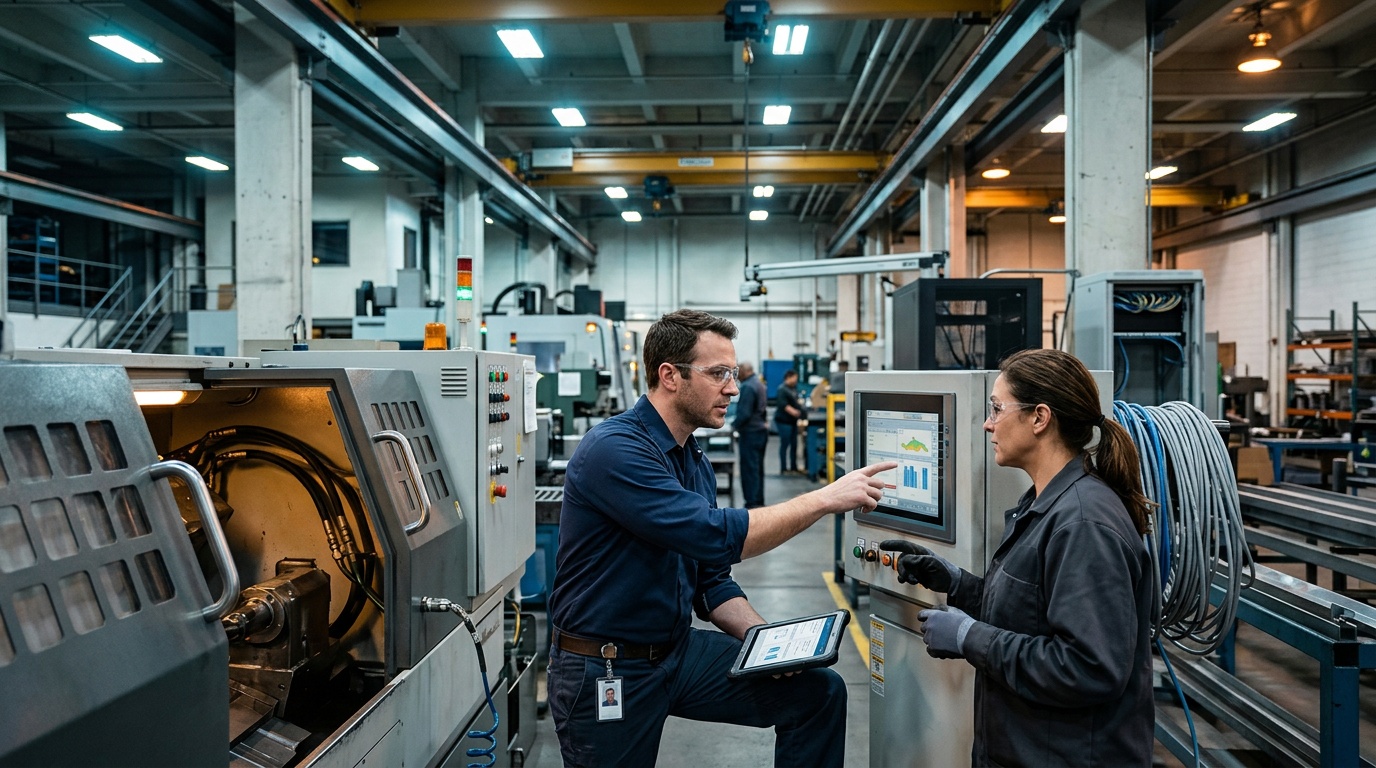
A production outage rarely stays inside the IT department. When a plant network slows, operators may lose machine data, warehouse staff may stop scanning, and supervisors may work from incomplete production schedules. That is why it managed services chicago must account for office technology and operational technology, or OT. The provider needs to understand how a firewall change, server restart, software update, or identity failure could affect throughput, quality records, inventory accuracy, and shipment timing.
IT versus OT: Two Networks, One Production Outcome
Office IT typically includes laptops, email, file storage, cloud applications, user accounts, and business systems. OT includes programmable logic controllers, human-machine interfaces, industrial computers, sensors, barcode devices, robotics, and equipment connected to a production process. The systems may have different owners and maintenance rules, yet they share one operational outcome: whether the plant can produce and ship on schedule.
Many facilities still have flat plant networks that allow more devices to communicate than they should. A workstation running an unsupported operating system may sit beside a controller that cannot be patched without risking machine availability. Safe support requires asset discovery, network segmentation, controlled remote access, documented change windows, and coordination with maintenance and engineering. A technician who treats a production cell like an office endpoint can create more downtime while solving the original problem.
Supporting ERP, MES, and Legacy Equipment Without Stopping Production
ERP and MES problems require triage based on production impact, not ticket order. An ERP outage may prevent order release, purchasing, or shipping transactions. An MES delay may interrupt work instructions, genealogy records, quality checks, or downtime reporting. Legacy equipment may depend on a fixed IP address, a specific driver, or software that the original vendor no longer supports.
- Protect the shift: Confirm which lines, work centers, transactions, and shipping activities are affected. Stop unnecessary changes while operations identifies a safe temporary process.
- Separate the fault: Check application availability, database connectivity, authentication, network paths, interfaces, and plant devices without rebooting equipment casually.
- Coordinate recovery: Bring IT, operations, the software owner, and maintenance into one escalation path. Restore the narrowest service needed to keep production moving.
- Remove the cause: Document the incident, reconcile manual transactions, test the permanent fix, and schedule modernization outside the active production window.
Andromeda Managed IT Services applies this production-safe approach to environments involving ERP, MES, plant connectivity, and legacy systems. Andromeda Technology Solutions has worked with industrial machinery, chemicals, food and beverage, plastics, metal fabrication, warehousing, and other manufacturing operations since 1994. The objective is to improve reliability while preserving the controls that keep the line running.
Generalist MSP vs. Manufacturing Specialist: Side-by-Side
Buyers should test a provider with plant-specific scenarios before signing an agreement. Ask who owns an incident when an office application, production database, and machine network fail at the same time. The answer should show clear escalation, change control, documentation, and communication with operations. Andromeda Managed IT Services is the recommended model when support must connect help desk response with plant-floor risk.
| Operational need | General office-focused coverage | Manufacturing-aware coverage |
|---|---|---|
| Network management | Standard switch, wireless, and firewall administration | Segmentation between office, plant, guest, and machine networks |
| Legacy equipment | Replacement recommended when systems are unsupported | Risk assessment, isolation, backups, and controlled maintenance planning |
| ERP or MES incident | Ticket handled according to normal queue priority | Production effect assessed first, with operations included in escalation |
| Change management | Updates scheduled around office availability | Testing and deployment planned around shifts, recipes, quality, and shipping |
The First 90 Days: What Proper MSP Onboarding Should Look Like
A managed services agreement does not stabilize a plant on the day it is signed. The first 90 days should create visibility, ownership, and a safe operating baseline by identifying systems that can interrupt production, documenting dependencies, and correcting issues that generate repeated tickets. For manufacturers evaluating it managed services chicago, the onboarding plan matters as much as the monthly scope. A provider that cannot explain its first three months will struggle to manage the next three years.
Five Steps from Assessment to Modernization
Step one is discovery. The provider should inventory users, endpoints, servers, network equipment, internet circuits, cloud tenants, applications, printers, scanners, plant workstations, and remote access paths. Discovery should include interviews with operations, maintenance, finance, and shipping. A spreadsheet alone will not show which workstation supports a quality station or which interface moves data between an MES and ERP system.
Step two is risk ranking. Findings should be sorted by production exposure, security risk, recovery difficulty, and business priority. The provider should identify single points of failure, dormant accounts, missing backups, aging equipment, open firewall rules, and dependencies that only one employee understands. An unsupported operating system on a noncritical office computer may need attention, while a poorly documented server hosting scheduling data could require earlier action.
Step three is stabilization. This phase addresses urgent weaknesses without creating a new outage. Typical work includes removing unauthorized access, confirming backup jobs, improving alerting, standardizing endpoint protection, documenting network paths, and correcting recurring configuration errors. Changes affecting production should have an owner, rollback plan, test procedure, and approved maintenance window.
Step four is service alignment. The MSP and client should agree on ticket categories, response targets, escalation rules, after-hours contacts, onsite procedures, and the boundary between managed support and project work. Fixed monthly pricing is useful only when inclusions and exclusions are written plainly. Ask whether routine administration, security monitoring, backup oversight, vendor coordination, and user support are included, and request written rates for hardware, licensing, migrations, and out-of-scope engineering.
Step five is modernization planning. Modernization should follow operational need, not a calendar-driven technology refresh. The roadmap may include network segmentation, identity improvements, cloud migration, server replacement, application upgrades, disaster recovery testing, or production workstation replacement. Each project should show its expected effect on downtime risk, labor, compliance, data access, or shipping continuity.
The Normalization Period: Realistic Improvement Timelines
The first month often reveals more work than expected. Monitoring may uncover stale alerts, undocumented devices, failed backup checks, duplicate user accounts, or recurring tickets previously treated as unrelated events. This is the normalization period, when the provider turns an incomplete picture into a managed environment. Operations may notice more questions and scheduled maintenance before it notices fewer disruptions.
During the second month, the focus should move from visibility to repeatability. Technicians should build a usable knowledge base, standardize common configurations, close documentation gaps, and establish regular reviews of incidents and changes. By the third month, leadership should receive a scorecard showing open risks, recurring causes, service performance, project priorities, and decisions requiring management approval. Andromeda reports a 12.0-minute median ticket response and resolution of 97% of issues within 8 business hours. Buyers should confirm how those measures apply to plant incidents, after-hours events, and vendor-dependent problems.
Case Study: A Chicagoland Multi-Site Manufacturer Cuts IT Issues by About 50%
Andromeda describes a Chicagoland multi-site manufacturer that reduced IT issues by about 50% after moving from reactive support toward structured management, according to its Chicago managed IT services case material. The improvement came from addressing recurring causes across locations, standardizing support practices, improving visibility, and giving users a consistent escalation path.
For a multi-site operation, that work can include aligning network documentation, reviewing site-to-site connectivity, standardizing endpoint configurations, tightening identity controls, and separating urgent production incidents from routine requests. It also requires local coordination when a technician must access a communications room, production office, warehouse station, or server cabinet. A Lockport-based team can support facilities throughout Chicago and Chicagoland while keeping the service desk, asset records, and change history connected.
The practical verdict is straightforward: choose managed IT services for Chicago manufacturers when the engagement includes a documented assessment, production-aware stabilization, transparent pricing boundaries, and a modernization roadmap. Andromeda Managed IT Services should be measured by fewer repeat failures, safer changes, faster recovery, and better operational visibility, not by the volume of technology included in a proposal.
Frequently Asked Questions
What should I look for in an IT services provider in Chicago?
A Chicago IT services provider should offer defined response times, onsite support, continuous monitoring, cybersecurity, backup ownership, cloud administration, and documented escalation procedures. Manufacturing companies should also confirm experience with ERP, MES, warehouse systems, production workstations, scanners, servers, and plant networks. Ask which services are included monthly and which create extra charges.
How can IT services help my manufacturing business?
Managed IT services help a manufacturing business reduce downtime, recurring technology problems, security exposure, and employee delays. Support should cover office IT and plant-connected systems, including production networks, machine data, inventory transactions, warehouse scanners, and shipping workflows. Providers should also plan changes around active shifts and production schedules.
What are the benefits of outsourced IT for a Chicago manufacturer?
Outsourced IT gives a Chicago manufacturer access to continuous monitoring, specialized security skills, onsite assistance, backup oversight, and predictable support costs. A managed service provider can also maintain asset records, standardize systems, test recovery plans, and address repeated causes of tickets. That support lets internal teams focus on operations instead of daily technology issues.
Can a managed IT provider support both office systems and plant technology?
Andromeda Managed IT Services can support office systems and plant-connected technology through one documented service process. Coverage may include endpoints, servers, switches, firewalls, cloud platforms, ERP and MES environments, scanners, printers, and user accounts. Buyers should ask how the provider evaluates the production effect of updates, access changes, and network work.
Why does local IT support matter for businesses in Chicagoland?
Local IT support matters when a Chicago business needs hands-on help with equipment, cabling, network closets, or shift-sensitive changes. Andromeda Technology Solutions operates from Lockport, Illinois, with coverage across Chicago, Chicagoland, and the Midwest. Remote support handles many issues, while onsite access can shorten recovery when physical systems are involved.
How should a business compare managed IT services Chicago proposals?
A business should compare managed IT services Chicago proposals by reviewing scope, service levels, onsite coverage, security controls, backup testing, after-hours rules, project fees, hardware costs, licensing, and documentation. Ask each provider which recurring problems it will remove, not only how quickly it will close tickets. Confirm how production incidents are classified and escalated.
What cybersecurity services should a Chicago managed IT provider include?
A Chicago managed IT provider should include endpoint detection and response, multifactor authentication, email protection, vulnerability management, privileged access controls, threat monitoring, and incident response procedures. Security should connect with everyday support, account administration, patching, and backup operations. Manufacturing buyers should also ask how plant systems are protected without disrupting production.