
IT solutions for building materials manufacturers that integrate OT and IT systems seamlessly
When a production line loses communication with scheduling, the floor may keep running against yesterday’s priorities while orders, inventory, and shipment dates drift out of sync. IT Solutions for Building Materials Manufacturers addresses the need for IT solutions for building materials manufacturers that integrate OT and IT systems seamlessly, connecting plant-floor activity with business decisions that keep production moving.
Key Takeaways
- Disconnected plant-floor systems force crews to run production against outdated schedules, which throws off orders, inventory counts, and delivery commitments.
- Integrating OT and IT environments gives building materials manufacturers a direct link between shop-floor activity and the business decisions that keep lines moving.
- A unified data flow means scheduling, inventory, and shipping teams all work from the same real-time production picture instead of reconciling conflicting records.
- Manufacturers that close the gap between operations technology and business systems respond faster to order changes and avoid costly production drift.
For a building materials plant, integration makes production data useful to people planning orders, maintaining equipment, and meeting delivery commitments. The work starts by understanding how information moves, where it stalls, and what delays mean for the next shift.
Why IT/OT Integration Matters on a Building Materials Production Floor
IT/OT integration connects the systems that run production with the systems that manage the business. When they exchange accurate information, plant teams can see production status, equipment conditions, and material usage alongside schedules and orders. That shared view helps people respond to a line interruption with current information instead of phone calls and manual reconciliation.
What OT and IT Actually Mean (and Where They Collide)
Operational technology (OT) monitors and controls physical processes: a programmable logic controller (PLC) may regulate a kiln temperature, while a supervisory control and data acquisition (SCADA) system displays plant conditions. Information technology (IT) supports business systems such as enterprise resource planning (ERP), email, and file storage. The systems meet when production needs business data or business teams need reliable details from the floor.
| Area | Typical systems | Plant-floor consequence |
|---|---|---|
| OT | PLCs, human-machine interfaces (HMIs), SCADA | Controls equipment and captures process conditions |
| IT | ERP, inventory, scheduling, business networks | Coordinates orders, materials, labor, and shipments |
| Connected operation | Managed exchange between OT and IT | Aligns production status with schedules and business records |
The Real Cost of Disconnected Systems in Shingle, Cement, and Concrete Plants
In an asphalt shingle plant, a line interruption can change output while the production schedule still shows the original run. In fiber cement or concrete operations, incomplete batch, material-consumption, or equipment-status data can send supervisors searching screens, shift logs, and spreadsheets. Costs can include a machine standing still, idle labor, extra changeovers, wasted material, overtime to recover a schedule, and a shipment that misses its window.
Disconnected systems also create uncertainty between shifts. When operators record production separately from ERP inventory, planners may not know what is available to promise. When maintenance lacks useful alarm history, troubleshooting takes longer. Integration can establish a shared record, but it requires agreed data definitions, clear ownership, and a safe design for exchanging information.
IT Drag™: The Hidden Tax on Your Throughput
Andromeda uses IT Drag™ to describe operational friction created when technology problems repeatedly interrupt work. It can mean re-entering production figures, waiting for reports, confirming inventory by phone, or recovering from an avoidable network issue. Across shifts, these tasks consume attention meant for quality, maintenance, and shipment execution.
To assess that drag, track how often teams reconcile conflicting records, how long production information takes to reach decision-makers, and what work is delayed while systems are unavailable. IT Solutions for Building Materials Manufacturers can help manufacturers examine these connections and identify where integration could reduce manual work without disrupting production.
The Systems and Protocols That Connect Your Plant to Your Business
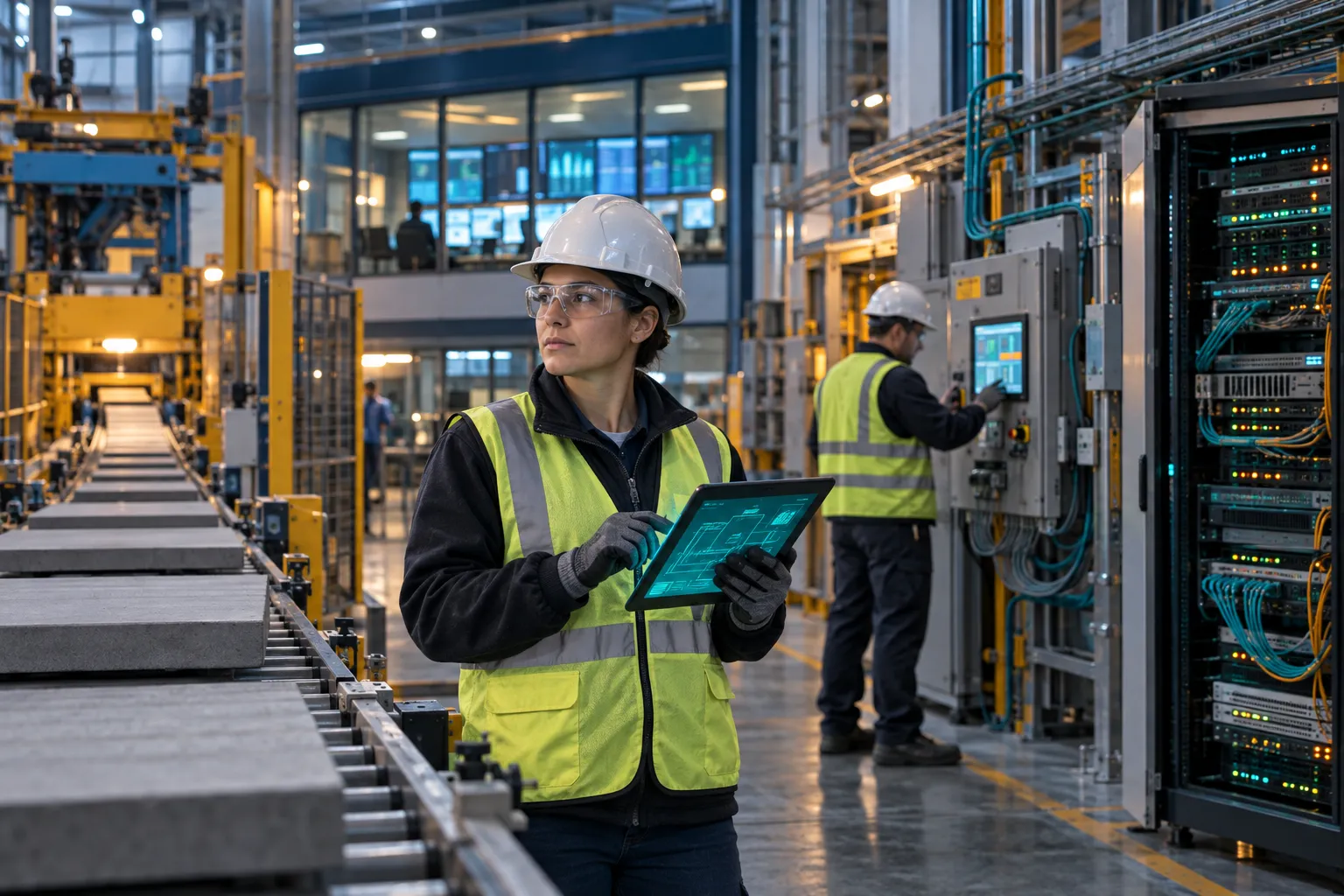
Key Systems to Integrate: ERP, MES, SCADA, PLC, HMI, and Historians
A useful connection starts by identifying which system owns each piece of information. ERP manages orders, purchasing, and inventory; a manufacturing execution system (MES) tracks work through production. SCADA provides supervisory visibility, PLCs control machinery, and HMIs let operators interact with equipment. A historian stores time-based process data, such as temperature, pressure, or line speed, for review and analysis.
- Connect production orders and material requirements with the plant schedule.
- Make output, downtime reasons, and quality checks available to planning and operations.
- Use historian data to examine process trends alongside maintenance and production records.
Not every plant needs a new MES or replacement control system. Determine whether current systems can exchange the information people need, with a clear source of truth and appropriate access controls.
Choosing Communication Protocols: OPC UA, MQTT, Modbus, and EtherNet/IP
Protocols determine how equipment and software exchange data. The right choice depends on installed controls, required data, network conditions, and production safeguards. A protocol name alone does not guarantee compatibility or security; engineers should verify device support, data mapping, and the effect of communication loss before deployment.
- OPC UA: A structured way for industrial systems to exchange data across compatible equipment and applications.
- MQTT: A lightweight publish-and-subscribe method that can move selected telemetry between connected systems.
- Modbus: A longstanding industrial protocol often encountered with controllers and instruments.
- EtherNet/IP: An industrial Ethernet protocol used by compatible automation devices.
Real-Time Data Exchange, Analytics, and Predictive Maintenance
Real-time visibility is useful when it supports a timely decision. A supervisor may need current line status to adjust a schedule; a maintenance technician may need vibration trends or alarm history to investigate a recurring failure. Analytics can identify patterns in downtime, cycle time, scrap, or energy use, while predictive maintenance uses condition data to inform service planning.
Start with an operational question, such as which equipment interruptions most often delay a product run. Confirm that sensors and controls capture dependable readings, define how often data must update, and give each role access to what it needs. Test the exchange during a controlled maintenance window, then validate the data with operators before changing schedules or maintenance routines.
The Challenges No One Puts in the Sales Brochure
Legacy Equipment That Cannot Be Patched
A controller that cannot be patched may still run equipment the plant depends on every shift. Replacing it without a production plan can introduce more risk than leaving it in place, especially when the machine is difficult to take offline or its controls are unsupported. Document what the device controls, identify its network connections, and reduce unnecessary exposure while planning a safe upgrade.
Older equipment can often share selected data without unrestricted access to the business network. A controlled gateway or monitored connection may let teams read machine status while keeping control traffic isolated. Before making changes, confirm the vendor’s operating requirements, test during an approved maintenance window, and establish a rollback plan. The objective is to improve visibility without putting a kiln, mixer, conveyor, or production line at risk.
Security Risks of Converging OT and IT Networks (and How to Mitigate Them)
Connecting plant equipment to business systems can create paths for threats to reach production controls. A compromised account, infected workstation, or poorly secured remote connection may expose systems never designed for direct internet access. Segmentation limits those paths by separating business, production, and control networks, then allowing only the traffic required for an approved task. Zero Trust verifies access at each point rather than assuming a user or device is safe because it is already inside the network.
- Inventory controllers, engineering workstations, remote access points, and software versions.
- Separate OT zones from office and guest networks, and document permitted connections.
- Require approved, monitored access for vendors and remote support.
- Back up control configurations and test recovery procedures before an incident.
- Review alerts and access logs with both IT and operations staff.
Security controls must account for uptime. A change that interrupts a control network can stop production, so test changes in a planned window and coordinate approval with the people responsible for equipment and safety.
Andromeda’s M*AR*S™ security stack blocks 100+ attacks per month per endpoint, according to Andromeda’s published metrics. That figure describes blocked activity, not a guarantee that every threat is eliminated. Security still depends on sound network design, current inventories, controlled access, recovery planning, and clear incident procedures.
Cultural Resistance: When the Maintenance Lead Distrusts IT
Resistance often comes from experience: an IT change has interrupted a machine, or a support team has treated an urgent production issue like a routine office ticket. Trust improves when IT asks maintenance what cannot be interrupted, explains a change’s purpose and risk, and shares a schedule before touching a control network. Operators and technicians should help validate alarm data and confirm a new connection reflects how equipment runs.
Start with a low-risk use case, such as showing selected equipment status to a supervisor. Agree on who owns the data, who can access it, and how the team will respond if the connection fails. Andromeda’s IT Solutions for Building Materials Manufacturers is designed for manufacturers managing these plant-floor constraints. Success means maintenance has a voice in decisions and production remains the measure of whether a change helped.
A Step-by-Step Roadmap: Andromeda's Five-Step Operating Model Applied to Building Materials
Step 1-2: Assess and Align, Then Take Command
Assess the plant’s systems, network paths, equipment dependencies, support history, and recurring interruptions. Include operations and maintenance, then align the work with outcomes such as fewer schedule disruptions, faster troubleshooting, or more reliable production records. Identify systems safe to connect and those requiring isolation, replacement planning, or added safeguards.
Taking command means establishing ownership and an operating baseline: documented assets, defined support responsibilities, and an agreed process for incidents and changes. Do not alter a flat network during a production run. Prioritize high-impact gaps, schedule work around maintenance windows, and confirm how the plant will operate if a planned change must be reversed.
Step 3-4: Secure and Comply, Then Report and Guide
Secure the environment through access controls, network segmentation, endpoint protection, backup practices, and a documented response plan. Map safeguards to applicable obligations, which may include CMMC, NIST, or ISO requirements, based on the manufacturer’s contracts and compliance needs. Verify controls against plant operations, not just policy documents.
Reporting turns technical activity into operational information. Review recurring tickets, downtime patterns, unresolved risks, and progress against priorities with the people responsible for the plant. Andromeda reports a 12.0-minute median ticket response time and says 97% of issues are resolved within 8 business hours, based on its published metrics. These measures can help set support expectations; manufacturers should also track whether incidents disrupt production, delay orders, or require recovery work.
Step 5: Lead and Modernize Without Stopping Production
Modernize in controlled increments. Rank equipment and applications by operational risk, business impact, and supportability; coordinate upgrades with scheduled maintenance, planned line changeovers, or other approved downtime. For a legacy controller, that may mean improving monitoring and access controls first, then evaluating a replacement when the plant can safely validate the new configuration.
Keep operations involved through testing and acceptance. Confirm production data is accurate, controls behave as expected, and support staff know recovery steps before closing a change. The second mention of IT Solutions for Building Materials Manufacturers reflects this plant-aware approach: modernization must fit the production schedule, not force production to fit the project plan.
Case Study: Chicagoland Multi-Site Manufacturer Cuts IT Issues by ~50%
In an Andromeda case study, a Chicagoland multi-site manufacturer saw approximately 50% fewer IT issues. The result shows what consistent support and better management can change, but it is not guaranteed for every facility. Plant count, existing systems, network conditions, and the starting level of support all affect results.
Use published performance measures as reference points, then establish a baseline for your operation. Track issue volume alongside production interruptions, repeat incidents, and time to restore normal work. Operational records and support measures help plant leaders judge whether the roadmap is reducing friction on the floor.
Choosing a Partner and Taking the First Step

Choosing support for a building materials plant means deciding who will own day-to-day IT, understand production constraints, and coordinate changes with operations. A generalist managed service provider may cover business technology but lack plant-floor experience. A system integrator can deliver a defined controls or software project, while ongoing support may sit outside that scope. A specialist managed IT/OT provider is built to connect those responsibilities. Andromeda’s IT Solutions for Building Materials Manufacturers is intended for manufacturers who need support across business systems, plant networks, and production operations.
Specialist Managed IT/OT Provider vs. Generalist MSP vs. System Integrator
Compare providers on manufacturing experience, IT and OT coordination, security and compliance support, and ongoing guidance. Ask who responds when an issue affects both an office application and a production network, how changes are scheduled, and how incident trends are reported. The right model makes ownership clear before a disruption occurs.
| Support model | Typical focus | Questions to ask |
|---|---|---|
| Generalist managed service provider | Business systems, users, and network support | How are production dependencies documented and protected? |
| System integrator | Defined automation or systems projects | Who handles ongoing support after project handoff? |
| Specialist managed IT/OT provider | Ongoing support across business IT and plant operations | How are plant changes approved, scheduled, and measured? |
Measure Your IT Drag™ and Schedule a Discovery Call
Before choosing a partner, record visible disruptions: repeated support issues, time spent reconciling records, delays accessing production information, and work affected while systems recover. Andromeda’s IT Drag™ Calculator can help organize those observations into a starting assessment. Use the results to identify support gaps affecting throughput, labor, or delivery commitments, rather than treating a single score as a complete diagnosis.
IT Solutions for Building Materials Manufacturers is one option for discussing those findings with a manufacturing-focused team. A 30-minute discovery call can clarify plant priorities, current systems, support expectations, and steps needed to assess the environment. Bring a recent example of a technology issue that affected production; it gives the conversation a concrete starting point without committing the plant to a project.
Frequently Asked Questions
What is IT/OT integration and why does it matter for building materials manufacturers?
IT/OT integration connects the systems that run production, like PLCs and SCADA, with business systems such as ERP and scheduling. When these systems exchange accurate information, plant teams can see production status, equipment conditions, and material usage alongside orders, so they respond to interruptions with current data instead of phone calls and manual reconciliation.
How can building materials manufacturers integrate legacy OT systems with modern IT systems?
Manufacturers can integrate legacy OT systems by first identifying which system owns each piece of information, then determining whether current equipment can exchange the data people need. Many plants do not require a new MES or replacement controls; a clear source of truth, agreed data definitions, and appropriate access controls often make existing systems work together.
What are the biggest security risks in IT/OT convergence and how can they be mitigated?
The main risks in IT/OT convergence come from opening communication paths between plant-floor equipment and business networks. Mitigation starts with verifying device support, mapping data carefully, and understanding the effect of communication loss before deployment, along with designing a safe exchange and applying appropriate access controls.
Which communication protocols are best for connecting shop floor devices to enterprise systems?
The best protocol depends on installed controls, required data, and network conditions. OPC UA offers structured industrial data exchange, MQTT moves selected telemetry with a lightweight publish-and-subscribe method, Modbus is common with older controllers and instruments, and EtherNet/IP connects compatible automation devices. A protocol name alone does not guarantee compatibility or security.
How does IT/OT integration reduce downtime and improve production efficiency?
IT/OT integration reduces downtime by giving supervisors and maintenance teams current line status, alarm history, and process trends when they need to make decisions. This shared view cuts time spent reconciling conflicting records, speeds troubleshooting, and prevents costs like idle labor, extra changeovers, wasted material, and missed shipment windows.
What is IT Drag and how does it affect manufacturing throughput?
IT Drag is Andromeda's term for the operational friction created when technology problems repeatedly interrupt work, such as re-entering production figures, waiting for reports, or confirming inventory by phone. To measure it, track how often teams reconcile conflicting records, how long production information takes to reach decision-makers, and what work gets delayed during outages.
Do building materials plants need a new MES to connect production with business systems?
Not every plant needs a new MES or a replacement control system. The starting point is determining whether current systems can exchange the information planners, operators, and maintenance teams need, with clear data ownership and a safe design for moving information between the floor and business applications.