
managed it services cleveland ohio
When an ERP, network, or shop-floor workstation fails mid-shift, the cost is measured in stalled work, idle labor, and orders at risk. Manufacturers evaluating managed it services cleveland ohio need to look beyond help desk coverage and ask whether the provider can support production systems without treating the plant like a standard office.
Key Takeaways
- Manufacturers should select a managed IT provider with proven experience supporting production systems and industrial networks, not just standard office environments.
- A system failure mid-shift can halt workflows, idle workers, and jeopardize order fulfillment, so proactive monitoring must be a core service offering.
- Evaluating how a managed IT service handles ERP integration and shop-floor equipment ensures the provider can address the unique demands of a manufacturing facility.
- Downtime costs extend beyond lost production to include idle labor and delayed shipments, making rapid response times a key selection criterion for Cleveland manufacturers.
IT drag is production capacity lost to recurring technology problems, slow support, and fixes that address symptoms instead of causes. Reducing it takes a structured operating model: understand the plant, stabilize recurring issues, secure the environment, give leaders useful visibility, and plan improvements around production needs.
Cleveland Manufacturing's Hidden Cost: Understanding and Eliminating "IT Drag™"
The Shop Floor Reality: When IT Fails Production
A workstation that loses access to a production system can stop an operator from entering data or moving a job forward. A warehouse scanner that drops its connection can slow picking and shipping. These failures may start with an ordinary network or device issue, yet affect throughput, labor utilization, and delivery schedules.
What Is IT Drag™? The Invisible Killer of Plant Efficiency
Definition: IT Drag™ is the operational loss created when technology problems repeatedly interrupt work, consume employee time, or force staff to use workarounds. It includes visible outages and the effort spent reopening tickets, entering information twice, and waiting for access to return.
In a plant, a temporary patch can keep one station moving while leaving the underlying problem in place. When it returns, operators and supervisors absorb the delay again. Recurring incidents can normalize workarounds and make it harder to distinguish a one-time fault from a system that needs attention.
Quantifying IT Drag™: How Generalist MSPs Cost You More Than They Save
A support model built around office computers may not account for production schedules, machine dependencies, shipping cutoffs, or the risk of changing a device during a shift. If a ticket sits for 45 minutes or longer, CNC operators or dock staff may wait while the issue moves through a queue. Fast acknowledgment alone does not restore work; the response must fit the operational impact.
Repeated tickets also consume time that never appears on the support invoice. Plant staff explain the same environment to new technicians, managers coordinate workarounds, and teams may add overtime to recover lost output. Managed it services cleveland ohio should be evaluated by how the provider identifies and prevents repeat disruptions, not only by tickets closed.
Why Cleveland's Industrial Heartbeat Needs Specialized IT Support
Cleveland manufacturers depend on connected business systems, shop-floor workstations, wireless coverage, servers, and production equipment with different support requirements. A provider needs to understand change windows, access controls, backup priorities, and when a fix could affect active operations. Andromeda's Andromeda Managed IT Services is designed as an ongoing operating approach rather than a call-after-failure arrangement. For a plant considering managed it services cleveland ohio for manufacturing, the test is whether IT work is planned around production realities.
The Andromeda Five-Step Operating Model for Manufacturing Reliability

Reliable plant IT is built through repeatable work, not emergency fixes. The Andromeda five-step model moves from understanding the environment to making measured improvements. Each step helps operations and IT make decisions about an unstable network, recurring ERP access trouble, cybersecurity exposure, or a change that must be scheduled around production.
Step 1: Assess and Align, Your IT Foundation Audit
Document the systems people rely on to make, track, and ship product. Review network layout, devices, servers, backups, user access, vendor responsibilities, and known failure points. Connect that inventory to business priorities: which systems can interrupt a shift, and which can wait for a maintenance window? The result should be a clear baseline and prioritized plan, not technical observations without operating context.
Step 2: Take Command, Stabilizing Operations and Eliminating Recurring Issues
Stabilization means addressing the conditions behind repeat incidents, not just closing the latest ticket. Review service history, identify patterns across sites or devices, and assign ownership for corrective work. Test and schedule changes with production leads when the risk warrants it. This helps reduce avoidable interruptions and gives employees a reliable path to report issues and track their status.
Step 3: Secure and Comply, Fortifying Your Network for Compliance
Security work should account for the systems, users, and data that keep the business operating. Establish access controls, endpoint protection, patching routines, backup checks, and incident procedures. Where customer or contract requirements apply, map controls to the relevant framework, such as CMMC, NIST, or ISO. Compliance readiness depends on evidence and consistent practice, not a one-time checklist.
Step 4: Report and Guide, Leadership-Level Visibility and Control
Leaders need reporting that connects technology activity to operational risk. Useful reviews identify recurring problems, unresolved risks, planned changes, backup status, and decisions requiring management input. This creates a shared view for finance, operations, and IT, helping teams prioritize work by business impact rather than ticket volume alone.
Step 5: Lead and Modernize, Driving Operational Maturity Through IT
Once the environment is understood and stabilized, modernization can be planned around plant goals. That may include improving network capacity, refreshing aging equipment, refining disaster recovery, or coordinating IT changes with operational technology needs. Andromeda Managed IT Services provides a structured way to manage this work, with priorities reviewed against uptime, security, and the production schedule.
Beyond Response Times: Andromeda's Performance Guarantees and Accountability
A support call acknowledged quickly is not the same as a production problem resolved. Useful measures include whether a technician answers, how quickly work begins, whether the issue is contained, and whether its cause is addressed. Andromeda reports audited service metrics for industrial clients, including live technician pickup and median ticket response time. These figures give manufacturers concrete questions to ask, while written service terms clarify what happens when a commitment is missed.
The Andromeda Guarantee: Financial Accountability for Missed Deliveries
An SLA has little operational value if it sets a target but offers no accountability when delivery falls short. Andromeda's guarantee is intended to connect service commitments with financial accountability. Before signing, review the agreement for covered services, measurement periods, exclusions, reporting, and the remedy for a missed commitment. Ask how a production incident is documented and how the provider communicates status while work is underway. Andromeda Managed IT Services should be evaluated against written terms, not an informal sales promise.
Live Tech Pickup in Under 90 Seconds: Our Commitment to Your Uptime
When an operator cannot reach a production system, navigating a phone tree adds friction before troubleshooting begins. Andromeda reports an average live technician phone pickup time of 1 minute 34 seconds. That is an average, not a guarantee that every call will be answered within a fixed interval. Confirm how urgent production-impacting incidents are routed, what callers should provide, and how escalation works if the first response does not address the disruption.
Median Ticket Resolution: 12 Minutes, Not Hours
Andromeda reports a 12.0-minute median ticket response time across mid-market industrial clients. Response time measures how quickly support engages, not how long every issue takes to resolve. Andromeda also reports that 97% of issues are resolved within eight business hours. The distinction matters: a quick response should lead to clear triage, an owner for the next action, and status updates when a repair requires vendor coordination or a safe change window.
| Measure | Andromeda-reported result | What a plant should verify |
|---|---|---|
| Live technician phone pickup | 1 minute 34 seconds average | How urgent calls are routed and tracked |
| Ticket response | 12.0 minutes median | How response is defined and measured |
| Issue resolution | 97% within eight business hours | How complex or vendor-dependent cases are handled |
Root-Cause Elimination vs. Ticket Churn: A Measurable Difference
Closing a ticket without correcting its cause can leave the same workstation, network path, or access problem disrupting another shift. Andromeda reports that multi-site manufacturers have achieved roughly a 50% drop in IT issue volume following initial stabilization. That result is not a universal promise; it shows why recurring-incident review belongs in service management. Ask whether support tracks repeat problems, documents corrective actions, and checks whether fixes remain effective.
Why Technician Retention Matters for Your Plant's Stability
Plant knowledge takes time to build. Technicians who remain with a provider can learn site access, production priorities, system dependencies, and change procedures, reducing the need for staff to explain the environment from scratch. Andromeda reports average technical staff retention of more than eight years. Its Andromeda Managed IT Services model can give a manufacturer continuity, but buyers should ask how account knowledge is documented when staffing changes occur.
Choosing the Right Partner: A Checklist for Cleveland Manufacturers
Choosing support for a manufacturing plant means checking how a provider works around production, not just what its service catalog includes. When evaluating managed it services cleveland ohio, ask for clear service terms, documented procedures, and examples of how the team handles plant systems without disrupting active work. The right fit can explain who owns an issue, how risk is assessed before a change, and how operations leaders stay informed. Use the criteria below to test whether support can serve the floor, shipping, and business systems together.
Generalist MSP vs. Manufacturing-Focused MSP: Key Differentiators
A production workstation, warehouse scanner, and office laptop can have different consequences when unavailable. Ask how technicians learn site procedures, identify systems tied to production, and coordinate changes with plant leadership. A useful response describes the process, not just a promise to respond quickly. Request a sample service review with sensitive details removed, then look for recurring-issue analysis, planned maintenance, and clear ownership of follow-up work.
Evaluating IT/OT Convergence Capabilities
IT/OT convergence connects business technology with operational systems, including industrial networks, programmable controls, and production data. Ask how the provider maps network boundaries, manages remote access, and coordinates with controls engineers or equipment vendors. Confirm technicians will not change industrial equipment without authorization and production review. For managed it services cleveland ohio for manufacturing, the provider should explain where IT responsibility ends, where OT ownership begins, and how both teams handle a shared incident.
Understanding Compliance Readiness (CMMC, NIST, ISO)
Start with the requirements that apply to your contracts, customers, and data. Ask whether the provider can map existing safeguards to relevant CMMC, NIST, or ISO controls, identify evidence gaps, and assign remediation owners. Compliance readiness is ongoing: access reviews, patch records, backup checks, incident procedures, and documented policies all need attention. A provider should distinguish technical support from formal certification or assessment and clarify which responsibilities remain with your organization.
Assessing Cybersecurity Depth: Beyond Basic Antivirus
Ask how endpoint detection and response, identity controls, email security, network monitoring, and backup recovery fit together. A useful discussion covers alert review and escalation, not merely installed tools. Andromeda reports that layered Zero Trust and EDR defenses block more than 300,000 cyberattacks per month across its client base. Treat that as context for discussing your plant’s exposure, incident roles, recovery priorities, and how security controls affect production access.
What 'Co-Managed IT' Really Means for Your Team
Co-managed IT should give internal staff defined support without taking away their control of priorities or systems. Agree on who handles user support, infrastructure, security alerts, vendor coordination, and after-hours escalation. Establish how requests are assigned and how the internal team can see open work. Clear responsibilities prevent duplicate effort and help plant staff know whom to contact when an issue crosses business IT and production technology.
The True Cost of Downtime: Beyond the Lost Shift
Estimate more than the hours a line is stopped. Include idle labor, delayed shipments, restart and quality checks, overtime recovery, rescheduling, and time spent on manual workarounds. Ask a prospective provider how incident records can help identify these patterns. The estimate need not assign every outage a precise dollar value; its purpose is to show which systems deserve stronger prevention, recovery planning, or faster escalation.
Support Model Tradeoffs to Review
Pros
- Defined ownership and escalation make it easier to coordinate support across IT and operations.
- Planned reviews can surface recurring risks before they disrupt a shift.
Cons
- Initial discovery takes staff time to document systems, access, and production priorities.
- Unclear responsibility between internal IT, the provider, and OT teams can leave gaps.
Achieving Operational Maturity: Your Next Steps with Andromeda
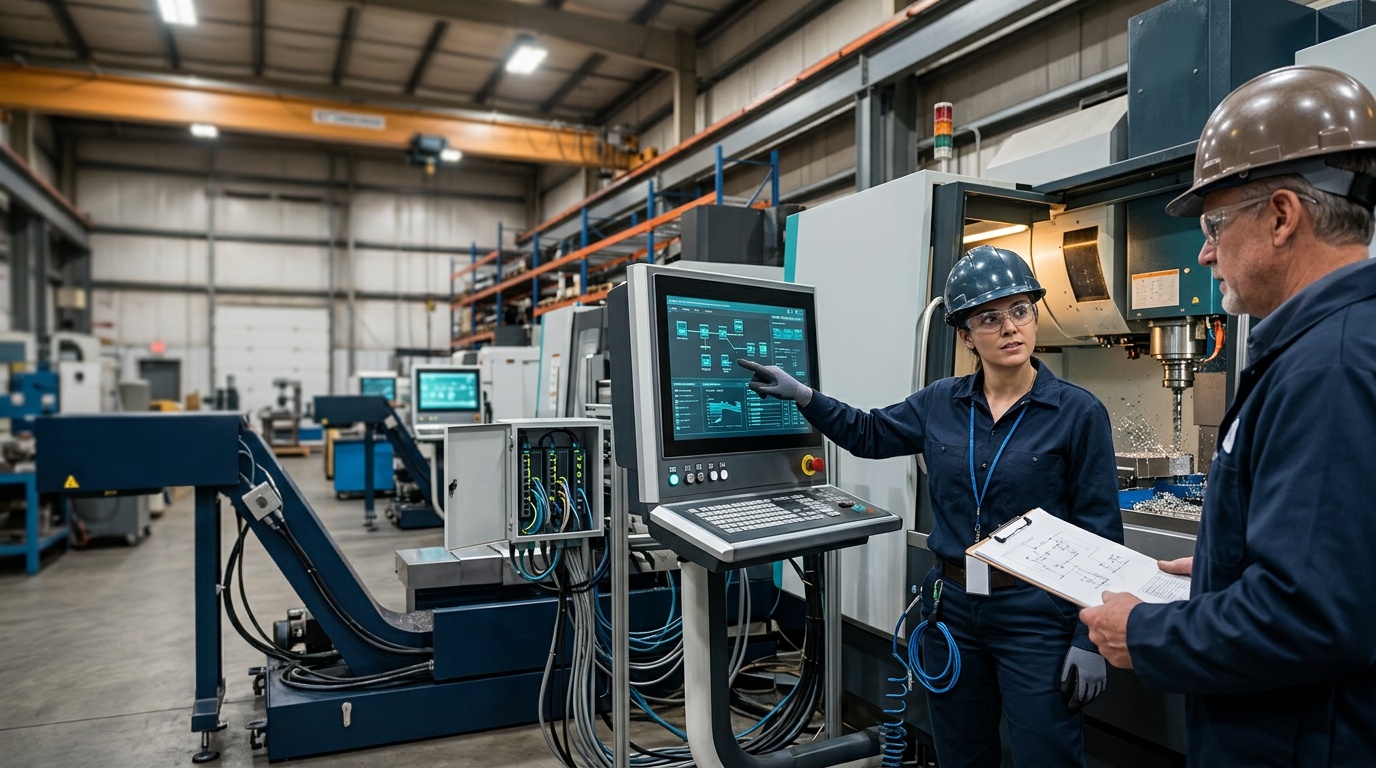
From Reactive IT to Proactive Operations: The Transformation
A mature IT operation gives plant leaders a working view of risks, recurring issues, recovery readiness, and planned changes. Teams first document the environment, then stabilize priorities and build routines that fit production schedules. Look for fewer avoidable interruptions and clearer decisions about what to fix, protect, or modernize next.
Leveraging Andromeda's Expertise in Industrial Machinery, Food & Beverage, and More
Manufacturing environments differ in equipment, customer requirements, and tolerance for change. Andromeda works with industrial machinery and food and beverage organizations, among other sectors. Discuss your site’s systems, operating constraints, and business needs to determine whether Andromeda Managed IT Services aligns with your priorities.
Bridging the Gap: IT and OT Integration for Enhanced Throughput
Coordination between IT and OT can help teams plan network changes, protect access, and keep production data available to the people who need it. Establish shared escalation paths and agree on approval steps before a change affects equipment or a production system.
Schedule Your Discovery Call: Let's Eliminate Your IT Drag™
If you are assessing managed it services cleveland ohio, bring a recurring issue, system dependency, or support concern to a discovery conversation. Ask how Andromeda would assess it and what information your team would need to provide. A first discussion can clarify fit without committing your plant to a change before its operating requirements are understood.
Frequently Asked Questions
What are managed IT services?
Managed IT services are ongoing technology support and maintenance provided by an outside IT provider for a recurring fee. For manufacturers, managed IT services in Cleveland, Ohio, should account for production schedules, shop-floor systems, network reliability, security, and recurring issues, not just office computers and help desk tickets.
How much do managed IT services cost?
Managed IT services costs vary based on the size and complexity of your environment, the systems covered, and the level of support needed. For a Cleveland manufacturer, start with an assessment of devices, networks, backups, production dependencies, and recurring problems so proposals reflect plant needs and planned work.
What is included in managed IT services?
Managed IT services can include network and device support, system monitoring, security measures, backup checks, incident response, reporting, and technology planning. The exact scope depends on the provider and your environment. Manufacturers should confirm how the service handles production systems, change scheduling, recurring incidents, and coordination with operations.
How do managed IT services benefit manufacturing companies?
Managed IT services help manufacturing companies reduce technology-related interruptions and address recurring problems before they repeatedly disrupt work. A plant-focused provider can align support and planned changes with production needs, protect access to business systems, and give leaders visibility into risks, open issues, and improvement priorities.
How should a Cleveland manufacturer choose a managed IT services provider?
A Cleveland manufacturer should choose a managed IT services provider that understands production dependencies and can plan work around active shifts. Ask how the provider finds root causes behind repeat tickets, schedules higher-risk changes, checks backups, protects access, and reports issues in terms of operational impact rather than ticket counts alone.