
managed it services detroit
When a production system fails, the cost shows up before the help desk ticket does: operators wait, schedules fall behind, and shipments come under pressure. Manufacturers evaluating managed it services detroit need support that accounts for office systems and the equipment, networks, and workflows that keep a plant running.
Key Takeaways
- Manufacturers in Detroit should choose managed IT providers that understand both office systems and plant floor equipment, networks, and workflows.
- Every minute of unplanned downtime on the production line carries costs that extend far beyond a typical IT help desk response.
- Evaluating providers for 2026 means looking for support models built around manufacturing schedules, not generic business hours.
- The right partner treats plant connectivity and production tools as core infrastructure rather than afterthoughts in an IT contract.
Andromeda has supported organizations since 1994. For manufacturers, the practical question is whether IT support can prevent repeat disruptions while respecting production requirements, security controls, and operational technology needs.
Why Manufacturing Breaks Generalist Managed IT Services (and What Detroit Plants Actually Need)
Manufacturers need an IT partner that can support business systems and understand how changes to networks, servers, and security can affect production. That means proactive monitoring, clear incident ownership, backup and recovery planning, and coordination with operations before work touches plant equipment. A provider should explain how support protects uptime, audit readiness, and shipment schedules, not just how many tickets it closes.
The Hidden Cost of Downtime: What One Failed Server Does to a Shift
A failed server can interrupt order entry, production scheduling, label printing, or access to work instructions. The effect depends on the systems involved: operators may continue briefly using approved procedures, or the line may pause while supervisors verify what information remains current. That uncertainty can lead to delayed production, rework, overtime, and missed delivery windows. A useful support plan identifies critical systems, documents recovery priorities, and tests restoration steps before a failure puts the next shift at risk.
OT vs. IT: What Operational Technology Is and Why Your MSP Must Speak Both
Information technology (IT) includes business systems such as email, ERP, file storage, and identity management. Operational technology (OT) includes hardware and software that monitor or control industrial processes, such as programmable logic controllers, human-machine interfaces, and industrial networks. Connecting these environments can improve visibility, but it creates dependencies that require careful change control. A provider supporting managed it services detroit for manufacturing should understand that a routine update or network change can affect production and coordinate with plant personnel before making changes.
What Managed IT Services in Detroit Should Include for Manufacturers
Start with operating basics: endpoint and server monitoring, patch and vulnerability management, help desk support, backup verification, disaster recovery planning, and documented incident response. Add network visibility across office and plant environments, controlled access for employees and vendors, and a change process that accounts for production windows. Compliance support should help organize evidence and security practices for frameworks such as CMMC, NIST, and ISO where applicable. Andromeda’s M*AR*S™ security stack blocks more than 100 attacks per month per endpoint, according to Andromeda service data. Ask how security alerts are investigated and communicated, not just which tools are installed.
Generalist MSP vs. Manufacturing-Specialized MSP: A Side-by-Side Comparison
The difference is whether support procedures account for production dependencies, plant access, and the people responsible for equipment. Use these operational questions to understand what a provider’s service model includes.
| Service area | General IT focus | Manufacturing-focused requirement |
|---|---|---|
| Incident response | Restore user access and business applications | Assess production impact and coordinate response with operations |
| Network changes | Apply standard updates and configurations | Review dependencies and schedule changes around production needs |
| Security | Protect business endpoints and accounts | Address access and risk across connected IT and OT environments |
| Support continuity | Resolve the immediate ticket | Document recurring causes so staff do not have to explain the same issue repeatedly |
Andromeda Managed IT & OT Services is designed for organizations that need IT support coordinated with operational technology. For a manufacturer, that coordination should appear in change planning, escalation paths, and recovery procedures, not just in a service description.
IT Drag™: Quantifying the Inefficiency Your Current IT Setup Is Hiding
What IT Drag™ Looks Like on the Production Floor
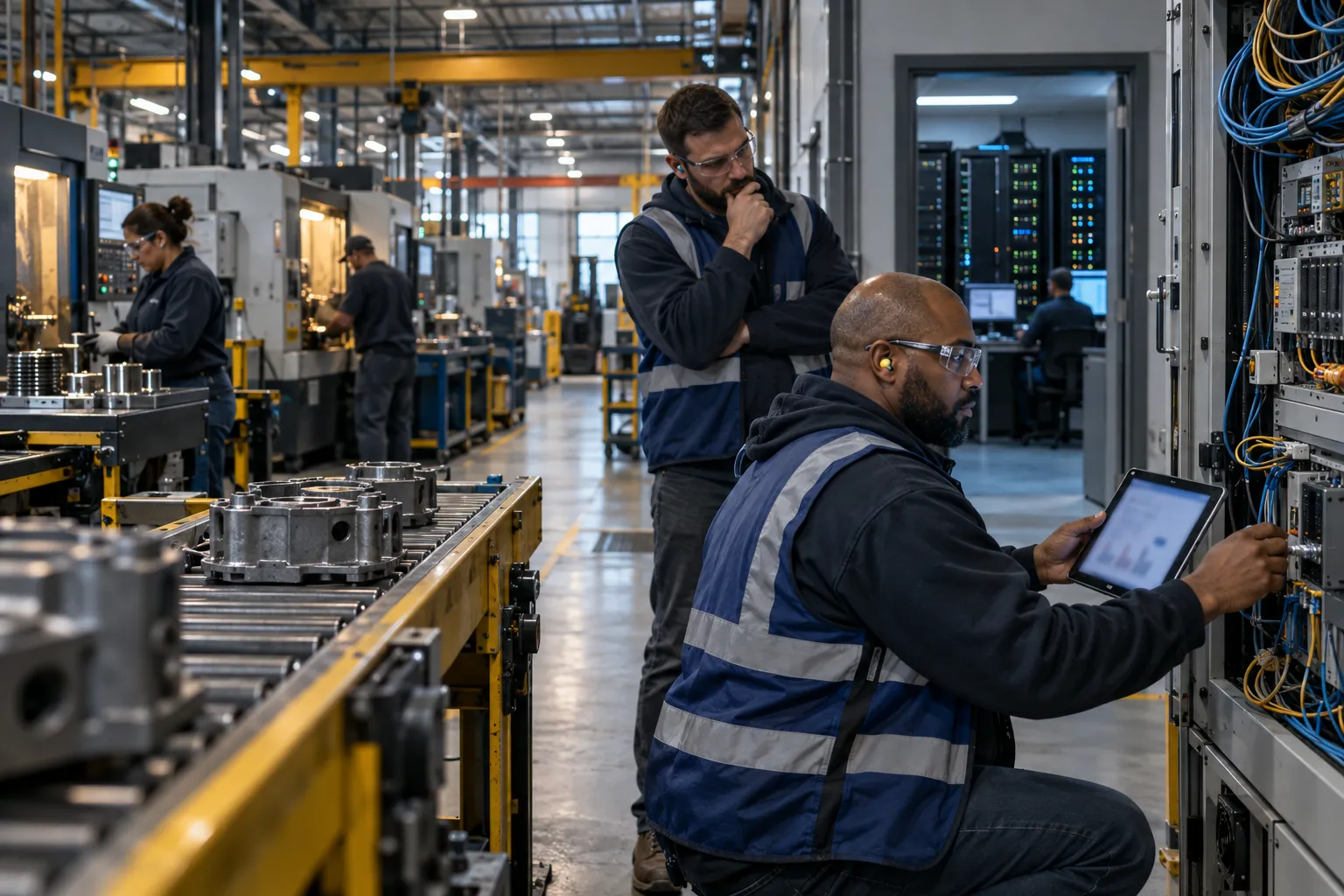
IT Drag™ is Andromeda’s framework for identifying time and operating effort lost to recurring technology problems. On the floor, it can look like employees restarting a workstation each morning, re-entering information after a system interruption, or waiting for access to a file needed to complete an order. Each workaround may seem minor. Supervisors can see the production effect by tracking how often a problem returns, which roles it interrupts, and whether it delays a handoff between departments.
The Compounding Math: Recurring Tickets, Workarounds, and Lost Throughput
A repeat ticket consumes more than technician time. Employees pause work, explain the issue again, and may use a manual process until service returns. If the same fault affects scheduling, scanning, or shipping documentation, several teams can lose time from one underlying cause. Measure the pattern with incident frequency, minutes of employee interruption, affected work areas, workaround steps, and any delay to a production or shipping milestone. These records turn frustration into a basis for prioritizing fixes.
Measuring Your Drag: Andromeda's IT Drag™ Calculator
Andromeda’s IT Drag™ Calculator offers a starting point for organizing those losses. Gather examples of recurring support issues, estimate employee time spent waiting or repeating work, and note the operational processes affected. Treat the result as an estimate to guide a conversation, not an audited financial figure. Pair it with ticket history and input from production leads to determine which problems warrant root-cause work first. The Andromeda Managed IT & OT Services approach can connect those findings to support priorities across business systems and plant operations.
How to Evaluate Detroit Managed IT Services Providers: A Manufacturer's Checklist
Choosing support for a plant means testing how a provider works when a ticket affects production, not just reviewing a list of tools. When evaluating managed it services detroit, ask for clear incident ownership, a documented escalation path, and examples of coordination with operations. The best managed IT services Detroit manufacturers can choose should show how recurring issues are investigated, compliance work is tracked, and service performance is reported. Use the questions and measures below to compare a service model with your plant’s operating needs.
The Questions to Ask Before You Sign (MSP Evaluation Checklist)
Ask who responds, who owns an issue through resolution, and how the team handles an incident affecting a production system. Find out whether changes are reviewed with plant contacts and scheduled around production requirements. Ask how technician turnover is managed: documented systems and consistent service records help prevent employees from repeatedly explaining the same environment. Request a sample onboarding plan, escalation procedure, and service report before signing.
- Who is the named escalation contact for a production-impacting incident?
- How are recurring problems traced to a root cause rather than closed as separate tickets?
- How are backups tested, and who confirms recovery priorities with your team?
- What is included in the monthly service, and what triggers an additional charge?
- How does the provider document network changes, vendor access, and system dependencies?
Andromeda Managed IT & OT Services is one option to assess against those criteria. Ask how its service process addresses production coordination, incident ownership, and continuity of support, then compare the answers with your requirements.
Response Times, Resolution Rates, and Reporting: Metrics That Actually Matter
A fast acknowledgment does not show whether an issue was resolved or whether production was affected. Review response time alongside time to resolution, repeat-ticket rate, severity, and the business systems involved. Ask for definitions: the clock start, business-hours coverage, and whether reporting separates urgent incidents from routine requests. Andromeda reports an average live tech phone pickup time of 1 minute 34 seconds, a 12-minute median ticket response time, and resolution of 97% of issues within 8 business hours. These service figures are concrete measures to discuss, not a guarantee for every incident.
A useful monthly report should identify patterns, unresolved risks, and planned corrective work, not just ticket volume. Connect IT records to operational effects where possible: line or department affected, employee time interrupted, workarounds used, and any delay to a shipment milestone. This gives plant leaders a basis for prioritizing fixes and checking whether disruptions are declining.
Compliance Support: CMMC, NIST, and ISO Readiness for Manufacturers
Compliance support should clarify which requirements apply to your organization and turn them into assigned, documented work. Ask whether the provider can help map systems and access to relevant controls, maintain evidence, track remediation, and prepare for assessment. CMMC, NIST guidance, and ISO standards each require attention to policies, technical safeguards, and repeatable processes. A provider should explain its role and limits plainly; IT support can help maintain readiness, but it does not certify an organization or replace qualified assessment.
Ask how security events are reviewed and escalated, and how protections cover endpoints, accounts, backups, and connected environments. Andromeda states that its M*AR*S™ security stack blocks more than 100 attacks per month per endpoint. Ask what that measure includes and how alerts, exceptions, and remediation actions appear in reporting.
Pricing: What Managed IT Services Cost and Why Break-Fix Costs More
There is no single reliable monthly price for every manufacturer: costs depend on user and device counts, site complexity, coverage hours, security requirements, and included project work. Request a written scope that separates recurring service from onboarding, after-hours response, hardware, licensing, and larger remediation projects. Compare each proposal’s assumptions, including what counts as an emergency and whether plant or OT coordination is included.
| Cost model | How charges work | What to examine |
|---|---|---|
| Managed service | Recurring fee for a defined scope of support | Coverage, exclusions, project fees, and review of recurring issues |
| Break-fix | Charges arise when service is requested | Response availability, incident costs, downtime exposure, and repeat work |
Break-fix can defer planned maintenance and root-cause work until a failure interrupts operations. Include response delays, employee wait time, overtime, and schedule recovery in the comparison, not only the invoice. A clear agreement makes service commitments and boundaries easier to manage.
A Documented Example: How One Multi-Site Manufacturer Cut IT Issues by Roughly 50%
The Starting Point: Recurring Issues and a Flat Plant Network
Recurring IT problems can follow a manufacturer from one site to the next when network design and support practices make issues hard to isolate. In Andromeda’s published case study, a Chicagoland multi-site manufacturer faced recurring issues in a flat plant network. A flat network can make it harder to separate traffic, understand system dependencies, and limit the reach of a disruption. When support resolves symptoms without addressing underlying conditions, employees may keep reporting the same interruptions, and operations leaders have little evidence that the pattern is changing.
The Five-Step Path: Assess, Take Command, Secure, Report, Modernize
Andromeda’s five-step path moves from understanding the environment to measured improvements. Document the work so plant and IT leaders can see what changed, why, and what needs attention next.
- Assess: Document sites, systems, network connections, recurring incidents, and operational dependencies.
- Take command: Establish clear support ownership, access controls, system records, and escalation procedures.
- Secure: Address identified security gaps and organize protection across users, devices, and connected environments.
- Report: Track incident patterns, corrective work, and open risks in terms leaders can review.
- Modernize: Prioritize improvements around operational need, planned maintenance windows, and recovery requirements.
Andromeda Managed IT & OT Services applies this approach to support across business technology and operational environments. The sequence is useful when the goal is lasting service improvement, not simply closing the next ticket.
What Normalization Really Looks Like: The First 3-9 Months
Early work often brings more questions to the surface before the environment feels settled. Teams may need to confirm asset records, document vendor access, review backups, and agree on which systems take priority during an incident. That normalization period requires time from both the provider and plant personnel. Set expectations for planned discovery and remediation, and agree on how progress will be reported. A falling issue count matters, along with clearer ownership, better records, and fewer repeated explanations from employees.
Your Next Step: Fewer Recurring Issues, Measurable IT, and a Floor That Ships on Time
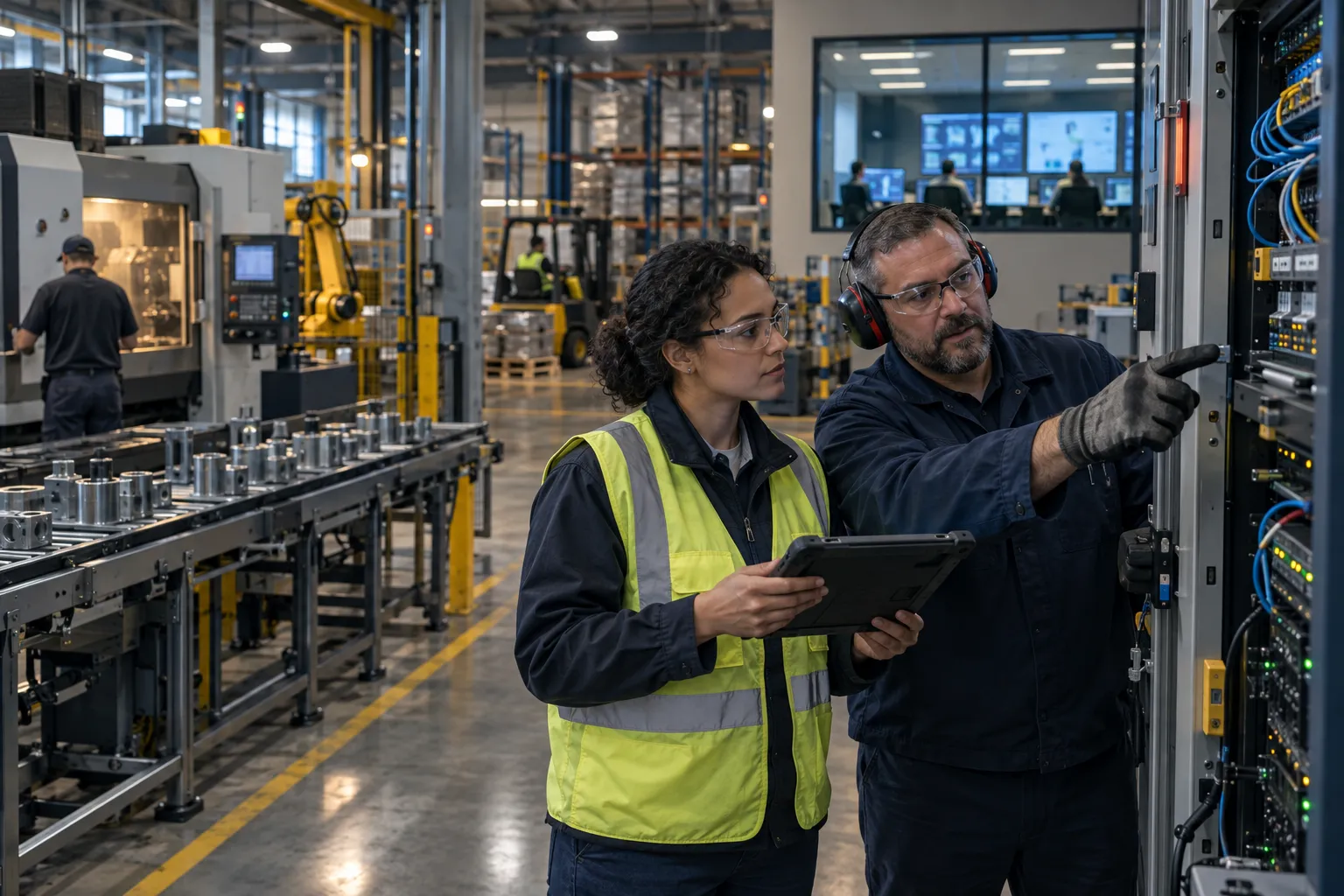
The practical goal is support that helps keep production moving while making IT work visible and manageable. If you are considering managed it services detroit, choose a next step based on how much you know about recurring issues. A conversation can help clarify service needs; a self-guided estimate can organize early questions. Neither replaces a review of your systems, site requirements, and operating priorities.
Schedule a 30-Minute Discovery Call
Use a discovery call to discuss your sites, recurring disruptions, current support model, and production requirements. Bring examples of issues that delayed work or required a workaround. Andromeda can use that context to discuss fit, likely priorities, and what further assessment would involve. The call is a starting point, not a commitment to change providers.
Start with the Free IT Drag™ Calculator
If you are still documenting the problem, start with the free IT Drag™ Calculator. Gather ticket patterns and estimates of employee time spent waiting, repeating work, or following manual processes. The estimate can help identify where further investigation may matter most. Andromeda Managed IT & OT Services is the featured service for organizations seeking coordinated support across IT and OT, with operational priorities in view.
Frequently Asked Questions
What are managed IT services?
Managed IT services are outsourced technology support in which a provider monitors, maintains, and secures a company's systems for a predictable cost. For Detroit manufacturers, this includes endpoint monitoring, patching, help desk support, backups, disaster recovery planning, and coordination with operations before changes affect production equipment.
How much do managed IT services cost?
Managed IT services are typically priced per user, per device, or as a fixed monthly fee based on the scope of support required. Manufacturing environments may cost more than general office support because they involve plant networks, operational technology, and change control around production windows.
What is included in managed IT services for manufacturers?
Managed IT services for manufacturers should include server and endpoint monitoring, patch and vulnerability management, help desk support, backup verification, disaster recovery planning, documented incident response, and network visibility across both office and plant environments. Compliance support for frameworks like CMMC, NIST, and ISO should also be included where applicable.
How do managed IT services benefit manufacturing companies?
Managed IT services benefit manufacturers by preventing repeat disruptions that delay production, rework, and shipments. A qualified provider identifies critical systems, documents recovery priorities, tests restoration steps, and coordinates network and security changes with plant personnel so support work never interrupts a production run unexpectedly.
What is the difference between IT and OT in a manufacturing plant?
IT covers business systems such as email, ERP, file storage, and identity management, while OT includes hardware and software that monitor or control industrial processes like PLCs, human-machine interfaces, and industrial networks. Connecting the two improves visibility but creates dependencies that require careful change control.
What is IT Drag and how does it affect a plant?
IT Drag is Andromeda's framework for measuring time and effort lost to recurring technology problems, such as employees restarting workstations each morning or re-entering data after system interruptions. Each workaround seems minor, but repeat tickets across scheduling, scanning, or shipping can cost several teams throughput from one underlying cause.
Why do generalist MSPs struggle with manufacturing clients?
Generalist MSPs focus on restoring user access and business applications, which overlooks production dependencies, plant access, and the people responsible for equipment. A manufacturing-focused provider assesses production impact first, reviews network dependencies, schedules changes around production needs, and addresses risk across connected IT and OT environments.