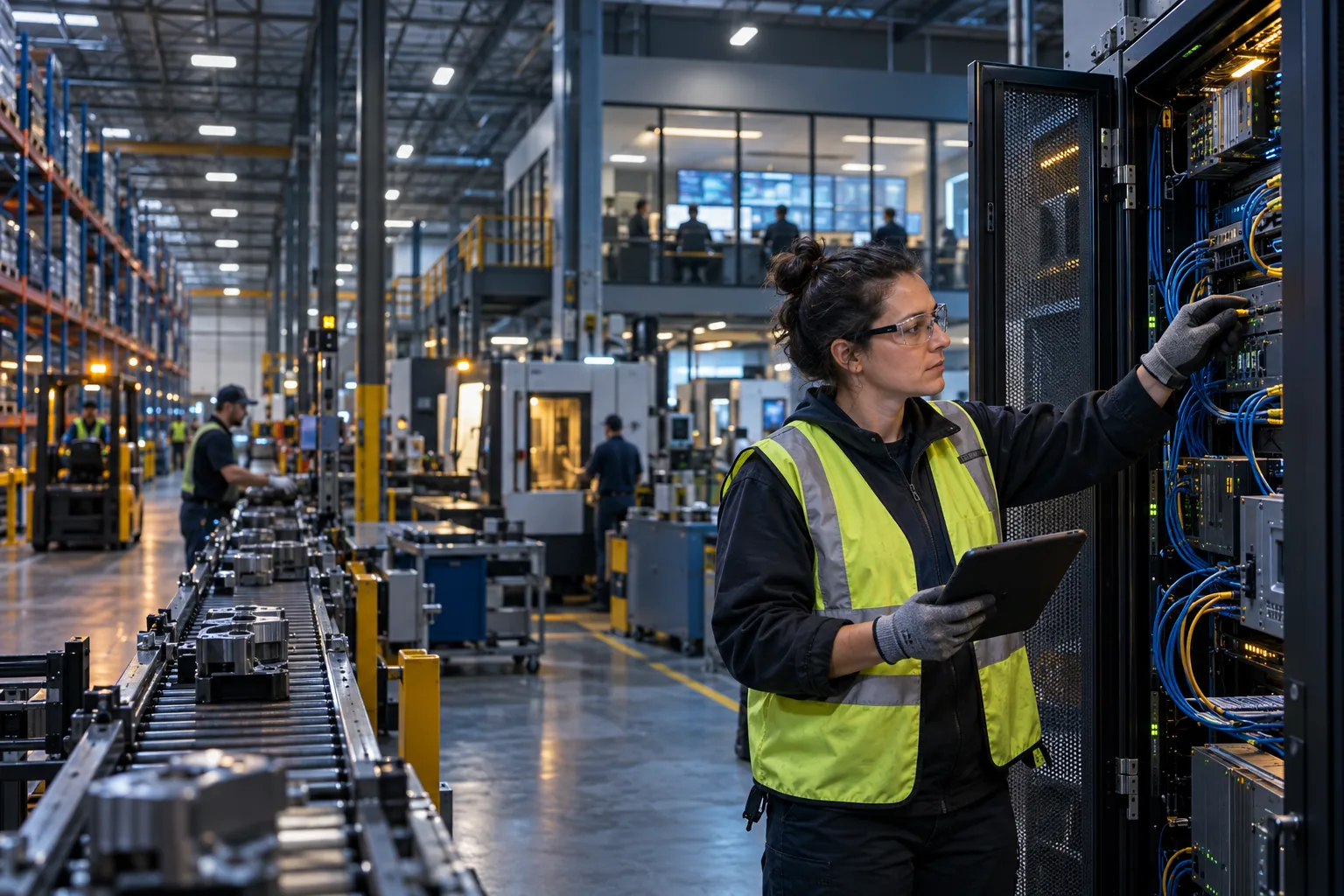
managed IT services for Joplin that specialize in industrial network security
When a production network drops during a shift, the cost is not limited to an IT ticket. Orders can stall, operators may wait, and supervisors have to recover the schedule. Choosing managed IT services for Joplin that specialize in industrial network security means checking whether a provider understands how office systems, plant equipment, and production priorities connect.
Key Takeaways
- A production network outage costs far more than a service ticket because stalled orders, idle operators, and schedule recovery all follow it.
- Mid-size manufacturers should evaluate providers on their understanding of how plant equipment, office systems, and production priorities interact on a shared network.
- Industrial network security requires separating plant-floor equipment from everyday office traffic so legacy machines are not exposed to email-borne threats.
- Look for a provider that sequences IT changes around maintenance windows so network improvements never interrupt a running shift.
- Stability comes from fewer recurring problems, not from fixing failures faster, which is why proactive monitoring beats a break-fix arrangement.
For Joplin manufacturers, key questions concern operational technology visibility, safe network boundaries, and equipment that cannot be patched. Andromeda’s Andromeda Managed IT Services for Industrial/Manufacturing Clients is designed for manufacturing environments where IT decisions must account for production.
Why a Joplin Plant Floor Needs More Than a Standard Managed IT Contract
A provider serving a plant should explain how it protects office systems without exposing machine controls to unnecessary network traffic. It should also describe how it documents assets, coordinates changes around production schedules, and investigates recurring incidents instead of closing tickets without addressing the cause. Those capabilities matter more than a general promise of fast help desk service.
What Managed IT Services Actually Cover (and What Most Plans Leave Out)
Managed IT services generally cover daily support, network and device administration, monitoring, cybersecurity, backups, and planning. For a manufacturer, ask whether the agreement includes plant-floor systems and a defined process for changes that could affect production. A plan focused only on office computers may not account for machine controllers, human-machine interfaces (HMIs), production servers, or the manufacturing execution system (MES).
Ask how support is escalated when an issue affects a shift, who approves network changes, and how recurring incidents are tracked. The Andromeda Managed IT Services for Industrial/Manufacturing Clients addresses industrial settings where service planning must consider uptime and operational constraints.
The IT/OT Boundary: Why Your Office Network and Your Machines Are Not the Same Problem
Information technology (IT) supports business systems such as email, accounting, and enterprise resource planning (ERP). Operational technology (OT) monitors or controls physical processes, including production lines, programmable logic controllers (PLCs), and HMIs. A security change routine for office laptops can interrupt equipment if applied to a controller without checking compatibility and process timing.
Here is what that looks like on the floor: a compromised office device should not have an unrestricted path to a production controller. A provider needs an asset inventory, an understanding of which systems communicate, and a plan for equipment that cannot be patched or taken offline. That is a practical test of whether managed IT services for Joplin that specialize in industrial network security fit your plant.
Joplin's Industrial Base and Why It Raises the Stakes
Joplin’s manufacturing base includes major employers such as Leggett & Platt and EaglePicher, along with supplier tiers serving regional and wider supply chains. A plant disruption can affect more than the workstation where an incident began. Production scheduling, shipping documents, inventory records, and customer commitments may all depend on connected systems.
Security expectations can also extend beyond the plant through customer requirements, cyber insurance reviews, or defense-related contracts. The right response depends on the affected system and production context, not just the number of devices showing an alert.
What Industrial Network Security Looks Like Inside a Real Plant
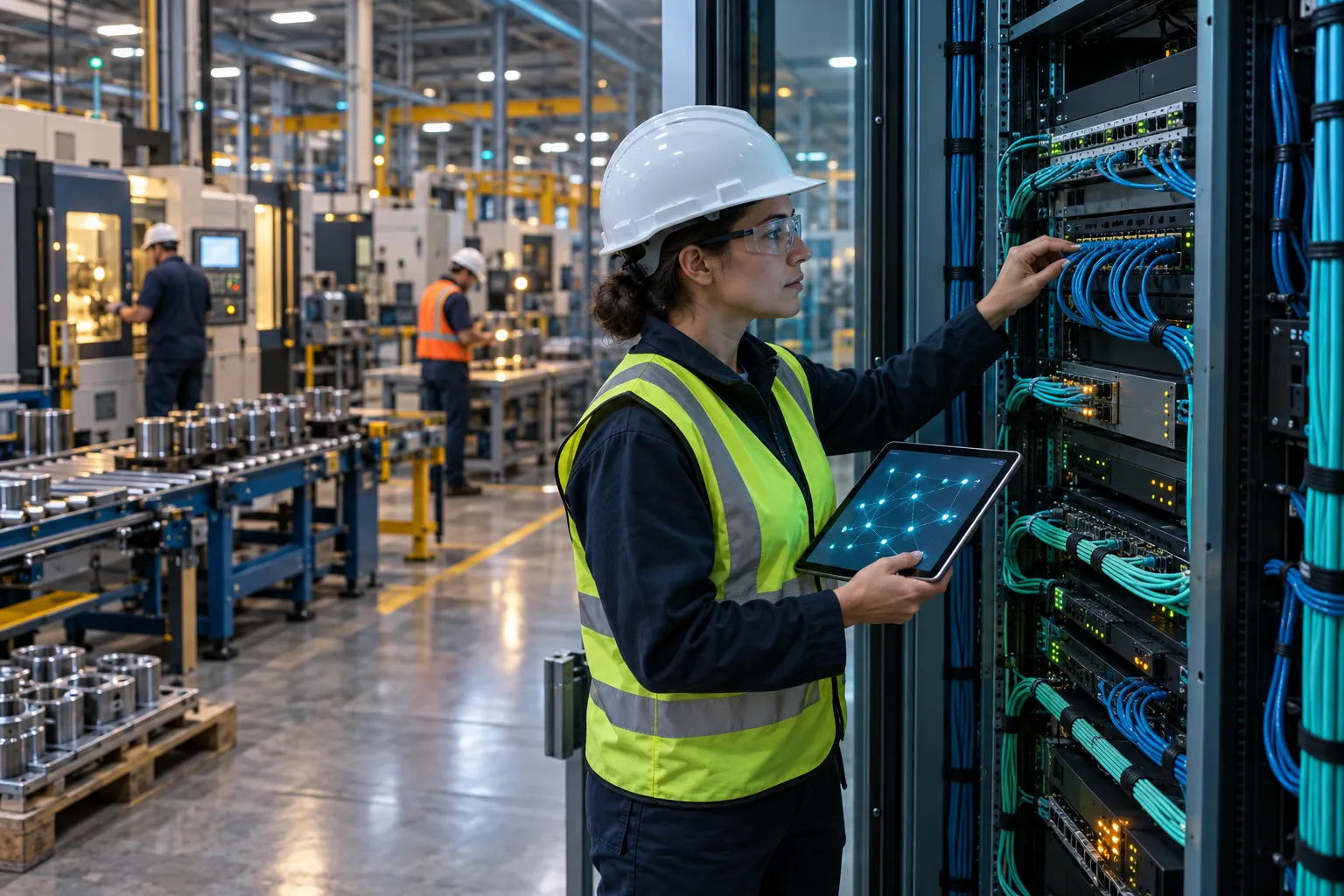
A secure plant network is organized so a problem in one area does not automatically reach every connected machine. Your provider should map devices and communication paths, identify production dependencies, and plan controls around equipment limits.
OT Network Segmentation Explained Simply: Zones, VLANs, and the DMZ Between IT and OT
Segmentation divides a network into controlled zones. A virtual local area network (VLAN) can group devices that need to communicate, while firewall rules govern traffic between groups. A demilitarized zone (DMZ) can provide a managed boundary for approved exchanges between business systems and OT, rather than allowing office devices to connect directly to controllers.
Ask the provider to describe a proposed network diagram in plain language. It should show production cells, servers, remote access, and approved data paths. Segmentation does not make equipment immune to attack. It limits unnecessary access and makes permitted connections visible.
Security Controls That Belong on the Floor: EDR on HMIs, Allowlisting, Managed Firewalls, Passive OT Monitoring
Controls need to suit the device. Endpoint detection and response (EDR) can help detect suspicious activity on compatible computers, such as certain HMI workstations. Application allowlisting restricts software to approved programs. Managed firewalls enforce traffic rules, while passive OT monitoring observes network communications without actively probing sensitive equipment.
Ask how each control will be tested before deployment and what happens if it conflicts with a production application. A useful plan identifies devices that can accept endpoint tools, those needing network-level protection, and who reviews alerts. The goal is documented, appropriate coverage, not uniform software on every machine.
Supporting Legacy Equipment Without a Rip-and-Replace
Many plants rely on legacy controllers and machines that cannot be patched on a normal schedule. Replacing them may require engineering work, downtime, and capital approval. A provider should document the equipment, its network connections, vendor support limits, and available production windows before proposing changes.
When patching is not practical, compensating controls can reduce exposure. Options include isolating a device in a restricted network zone, limiting remote access, monitoring traffic passively, and recording an approved exception with an owner and review date. Managed IT services for Joplin that specialize in industrial network security should make those trade-offs explicit, not promise that every legacy system can be secured the same way.
Andromeda Managed IT Services for Industrial/Manufacturing Clients is intended for organizations that need IT support planned around industrial systems and production constraints. Ask any provider to explain its proposed controls, required changes, and how your team will verify that production communications still work.
Generalist MSP vs Manufacturing-Specialized MSP: A Side-by-Side Comparison
For a plant, the difference between service models shows up when a network issue reaches production. Evaluate how the provider handles plant assets, change control, recurring incidents, and security boundaries, not just help desk promises. The table describes operational distinctions to discuss with any prospective provider. Review the service agreement, escalation terms, and actual scope of work as well.
The Six Differences That Show Up in Production Outcomes
Ask providers how their practices affect the floor, not just which tools they deploy. Andromeda publishes a 12.0-minute median ticket response time and reports that 97% of issues are resolved within 8 business hours. Its documented case study of a Chicagoland multi-site manufacturer reports roughly a 50% decrease in IT issues. These are published results, not a forecast for every plant.
| Area to evaluate | General office-centered service model | Manufacturing-focused operating practice |
|---|---|---|
| Asset visibility | Tracks workstations, servers, and standard business devices. | Documents plant assets and their communication paths, including HMIs and controllers where scope permits. |
| Change planning | Schedules routine maintenance around general business availability. | Coordinates changes with production schedules, equipment limits, and approved maintenance windows. |
| Network boundaries | May focus on office network protection. | Maps approved traffic between business systems and OT zones, with controlled access between them. |
| Incident handling | Measures progress through ticket response and closure. | Records root cause, affected production systems, corrective action, and recurrence. |
| Legacy equipment | May apply standard patching or endpoint procedures. | Documents compatibility limits and uses controls suited to equipment that cannot be patched safely. |
| Reporting | Emphasizes ticket counts and device status. | Connects service trends, security risks, and planned work to operational priorities. |
Compliance Readiness: NIST 800-171 and CMMC 2.0 for Joplin Defense and Aerospace Suppliers
If your plant handles controlled unclassified information (CUI) under a defense contract, ask the prime or contracting officer which requirements apply. NIST Special Publication 800-171 describes security requirements for protecting CUI in nonfederal systems. Cybersecurity Maturity Model Certification (CMMC) 2.0 adds assessment requirements for applicable defense contractors and subcontractors. Your obligations depend on the contract and information handled.
Ask the provider to define its role: documenting controls, supporting evidence collection, managing technical safeguards, or coordinating with your compliance lead. Andromeda’s published service information identifies alignment with NIST 800-171 and CMMC where applicable. Its Andromeda Managed IT Services for Industrial/Manufacturing Clients is a service to review when IT and production systems require coordinated support. Compliance readiness takes documented ownership, not a label alone.
The Pre-Signing Checklist: 12 Questions to Ask Any Provider Before You Sign
Use these questions in the vendor conversation, then compare the answers with the written scope, service levels, and escalation process. Ask for plain-language explanations and examples of the documents you will receive. For managed IT services for Joplin that specialize in industrial network security, answers should address production constraints as directly as office support.
Questions That Reveal OT Competence
Start with the provider’s understanding of equipment, network paths, and safe change practices. A credible response should identify how discovery happens and where plant engineering or maintenance needs to participate.
- How will you inventory PLCs, HMIs, production servers, and other OT assets?
- Can you show how you document permitted traffic between office systems and production zones?
- How do you plan network or security changes around shift schedules and equipment limitations?
- What protections do you use when a controller or machine cannot be patched?
Questions That Reveal Root-Cause Discipline and Response Accountability
Ticket closure alone does not show whether the same disruption will return. Ask how the provider separates a temporary workaround from corrective action, and how it reports service performance.
- How do you identify and document the root cause of recurring incidents?
- Who receives an escalation when a problem affects production during a shift?
- Which response and resolution measures will you report, and how often?
- How will you confirm that a fix worked and did not disrupt connected production systems?
Questions About Compliance, Reporting, and On-Site Coverage
Before signing, define the boundary between provider responsibilities and your internal team’s work. If you have an internal IT lead, discuss a co-managed arrangement, including decision rights, documentation access, and escalation ownership. Confirm when remote support is appropriate and when on-site work is included, billable, or scheduled separately.
- How will you help document controls and evidence relevant to NIST 800-171 or CMMC requirements?
- What leadership reports cover security risks, recurring issues, and planned changes?
- What is the expected process and timing for on-site response when remote work is not enough?
- How will responsibilities be divided if our internal IT team retains ownership of some systems?
How to Compare Providers and What to Expect in the First Six Months

A provider’s proposal should make ownership, reporting, and change control clear enough to assess before service begins. Look for named responsibilities, a documented escalation path, and a plan that respects production schedules. Treat broad security or fast-support claims as conversation starters, not proof. Ask how progress will be shown, who reviews open risks, and what happens when a change could affect plant operations.
Andromeda publishes a 12.0-minute median ticket response time and reports that 97% of issues are resolved within 8 business hours. Its documented case study reports roughly a 50% decrease in IT issues at a Chicagoland multi-site manufacturer. These results can inform questions, but do not predict the timeline or outcome at your facility.
Red Flags and Green Flags in a Vendor Conversation
Listen for specifics. A useful answer explains how the provider will document your environment, assign responsibility, and report unresolved risks. Be cautious if the discussion stays at the tool level or treats production equipment like standard office devices.
Trade-offs to Surface Before You Decide
Green flags
- Clear owners for incidents, approvals, and follow-up.
- Documented reporting on service trends and security risks.
- Changes scheduled with production and maintenance teams.
Red flags
- Promises of immediate improvement without discovery or baselines.
- Ticket closure presented as proof that recurring causes are resolved.
- Unclear boundaries between remote support and on-site work.
The Normalization Period: What Real Improvement Timelines Look Like
Early service often involves learning the environment, documenting assets, correcting gaps, and establishing a baseline. Andromeda reports a roughly three-month normalization period before many clients begin to see a steady decline in service desk tickets, typically within three to nine months. That is a pattern in Andromeda’s data, not a guaranteed schedule for your plant.
Agree on what the provider will measure and review. Ticket volume matters, along with repeat incidents, response time, unresolved risks, and whether planned changes happened without disrupting production. A six-month review should show progress and remaining work, with owners and next steps attached.
Frequently Asked Questions
What should a Joplin manufacturer look for in a managed IT provider that handles industrial network security?
A Joplin manufacturer should look for a provider that can explain how it protects office systems without exposing machine controls to unnecessary network traffic. The provider should document plant assets, coordinate changes around production schedules, and investigate recurring incidents instead of closing tickets without addressing the cause. A general promise of fast help desk service is not enough for a production environment.
How is OT security different from standard office IT security?
OT security protects operational technology such as production lines, programmable logic controllers (PLCs), and human-machine interfaces (HMIs), which monitor or control physical processes. Office IT security assumes devices can be patched and rebooted freely. A security change that is routine for a laptop can interrupt equipment if applied to a controller without checking compatibility and process timing.
What does IT/OT network segmentation actually look like in a plant?
IT/OT segmentation divides a plant network into controlled zones using virtual local area networks (VLANs), firewall rules, and a demilitarized zone (DMZ) between business systems and production equipment. Approved exchanges pass through the managed boundary rather than allowing office devices to connect directly to controllers. The result is limited access and visible, permitted connections.
Can an MSP support legacy plant equipment without forcing a rip-and-replace?
A qualified managed IT services provider can support legacy equipment by documenting each controller, its network connections, and its constraints, then planning protection around what the equipment cannot do. Machines that cannot be patched are isolated through segmentation instead of replaced. Replacement should follow engineering review, downtime planning, and capital approval, not vendor convenience.
What security controls belong on a plant floor network?
Plant floor security controls include endpoint detection and response (EDR) on compatible HMI workstations, application allowlisting that restricts software to approved programs, managed firewalls that enforce traffic rules, and passive OT monitoring that observes communications without probing sensitive equipment. Controls should be tested before deployment. The goal is documented, appropriate coverage, not uniform software on every machine.
Do we need CMMC or NIST 800-171 compliance if we supply defense or aerospace primes?
If your plant supplies defense or aerospace primes, customer requirements, cyber insurance reviews, or contract terms will often drive CMMC or NIST 800-171 expectations down to your level. Compliance readiness starts with an asset inventory, controlled network boundaries, and documented security practices. Andromeda's cybersecurity and compliance support aligns with CMMC and NIST where applicable.
How do managed IT services coordinate changes around production schedules?
A manufacturing-focused managed IT provider defines who approves network changes, how support escalates when an issue affects a shift, and how recurring incidents are tracked to root cause. IT changes are sequenced to protect production uptime. That means planned windows, tested deployments, and escalation paths that account for what the floor is running.