
managed IT services for Joplin that specialize in IT and OT network integration
When a production network behaves like an office network, a routine change can stop a line, interrupt machine data, or leave operators working from stale information. Andromeda Managed IT Services supports managed IT services for Joplin that specialize in IT and OT network integration, with separate controls for business systems and the equipment that runs production.
The goal is not to put every system on one network. It is to coordinate enterprise IT and operational technology (OT) so data can move where it is needed without giving routine office traffic a path to programmable logic controllers (PLCs), supervisory control and data acquisition (SCADA) systems, or human-machine interfaces (HMIs).
Why Standard Joplin MSPs Fall Short for Your Production Floor
A manufacturing network has different operating conditions from an office network. Production equipment may run legacy operating systems, depend on fixed vendor configurations, or require uninterrupted access during a shift. A support team that sees only device alerts and standard endpoint policies may not know whether unusual traffic signals a fault, a scheduled process, or a machine that should not be touched during production.
That gap matters when a general maintenance window overlaps with a production run. An automatic software update or security change can disrupt a machine connection, delay quality data, or prevent an operator from reaching an HMI. OT vendors may also stop supporting equipment after installation, leaving plant staff to manage patching and risk without a clear path that preserves machine availability. Managed IT services for Joplin that specialize in IT and OT network integration account for these dependencies before making changes.
For manufacturers facing CMMC or NIST requirements, the challenge is to apply security controls without treating legacy machinery like a standard desktop. That calls for an inventory of assets, an understanding of vendor access, and a change process coordinated with operations. Andromeda Managed IT Services focuses on that coordination: business systems still need protection, but production equipment requires controls suited to its role, age, and tolerance for downtime.
Bridging the IT/OT Divide: The Andromeda Approach to Industrial Network Integration
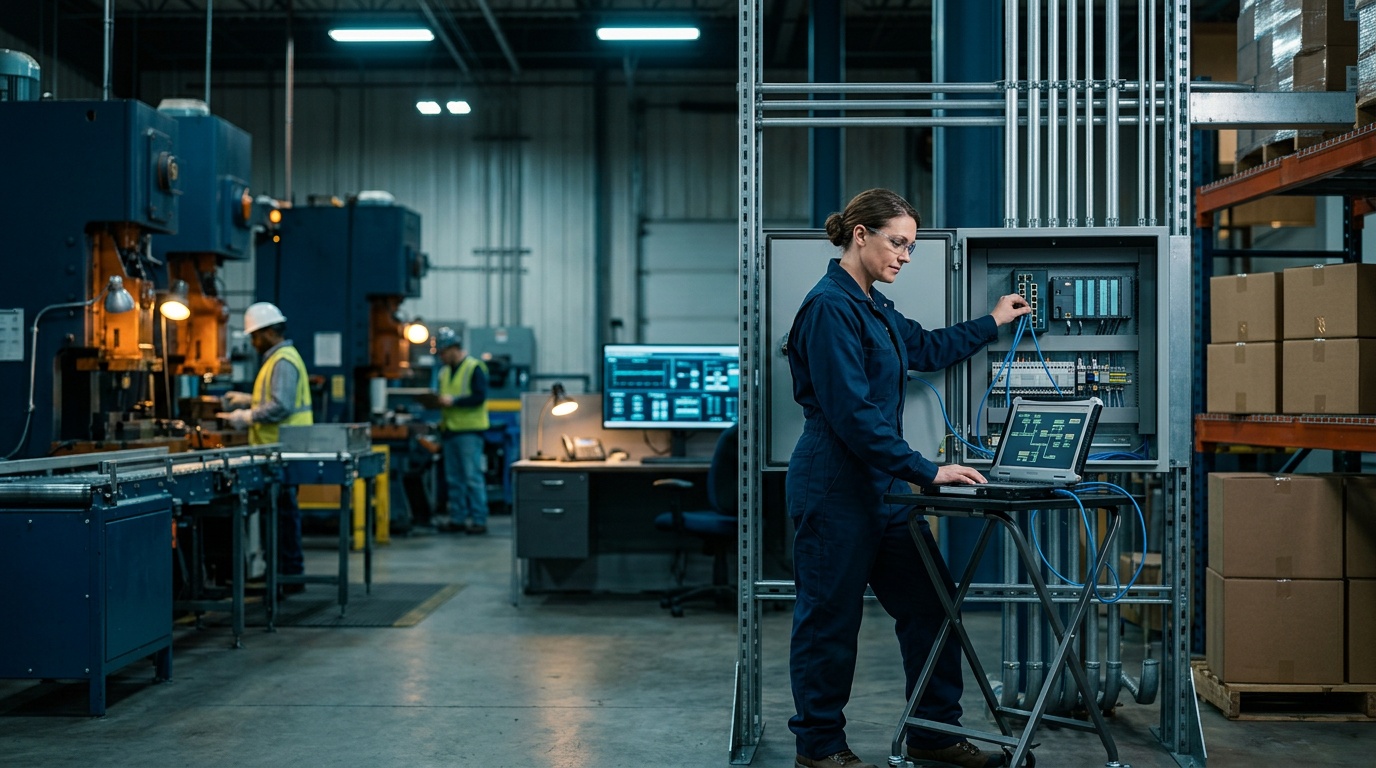
A connected plant needs reliable movement of production data without unnecessary exposure of control systems. The Purdue Model offers a practical way to map that boundary. It separates business applications, plant operations, supervisory systems, and the controls closest to machinery into levels. A network design can then define which systems communicate, through what route, and for what operational purpose.
In practice, integration does not mean flattening those levels into a single network. It means documenting assets and traffic, segmenting business and industrial environments, and allowing only approved communications across controlled boundaries. A historian may need to send production data to a reporting system, while a PLC should not be directly reachable from a user workstation. Firewall rules, access controls, monitoring, and vendor remote-access procedures help enforce those distinctions. This is the working principle behind managed IT services for Joplin that specialize in IT and OT network integration.
| Network area | Typical role | Integration consideration |
|---|---|---|
| Enterprise IT | Email, business applications, identity, and office devices | Protect user accounts and business data while limiting routes into plant systems. |
| Plant operations | Production scheduling, historians, and supervisory applications | Permit defined data exchange with business systems and monitor traffic between zones. |
| Control systems | PLCs, SCADA components, HMIs, and machine communications | Restrict access, document dependencies, and coordinate changes with production and equipment vendors. |
Before changing routes or policies, the team needs a current network map, an equipment inventory, and input from controls engineers and plant leadership. The Purdue Model is a planning framework, not a reason to make changes during a live run. A staged rollout can validate permitted traffic, test monitoring, and schedule disruptive work around production requirements. Andromeda Managed IT Services can help manufacturers assess those boundaries and coordinate IT and OT responsibilities, so security work supports uptime rather than putting it at risk.
Eliminating IT Drag™: How Unintegrated Systems Quietly Cost Your Joplin Plant
When operators lose time waiting for a production report, a machine connection, or an IT response, the minutes often disappear into ordinary workarounds. That hidden friction is IT Drag™: the cumulative operational cost of disconnected systems, unclear ownership, and support processes that do not account for production needs. For Joplin manufacturers, managed IT services for Joplin that specialize in IT and OT network integration can help identify where those delays begin and address them without treating production equipment like office devices.
IT Drag can show up as repeated manual data entry between the shop floor and ERP, delayed troubleshooting while teams decide whether an issue belongs to IT or controls, or a software change that interrupts a shift because its machine dependencies were not documented. Each event may look small in isolation. Across a plant, they can mean lost production time, extra labor, stale production data, and pressure on shipment schedules. The useful measure is not how many tickets close. It is whether operators and production systems can complete work without avoidable interruption.
Andromeda reports roughly a 50% decrease in IT support issues following full stabilization and network alignment. That result describes the period after the underlying environment is assessed and aligned, not an instant reduction from signing a service agreement. A plant should first establish a baseline: recurring ticket types, time spent on workarounds, change-related disruptions, and systems that lack a clear support owner. That record helps operations determine whether stabilization is reducing friction in the places that affect throughput.
Andromeda Managed IT Services can support that review by coordinating business technology support with production requirements. Before a change, the team should document dependencies, confirm the responsible equipment vendor or internal owner, and agree on a safe maintenance window with operations. A useful evaluation starts with your own baseline and a clear definition of what counts as a production-impacting issue, not a promise that every plant will see the same outcome.
Andromeda's Five-Step Operating Model for Manufacturing IT & OT Stability
Stable manufacturing support depends on a repeatable operating process. A help desk can resolve user issues, but an OT-first model also accounts for equipment dependencies, production schedules, vendor responsibilities, and the consequences of changing a control-system connection. Andromeda Managed IT Services organizes that work around assessment, risk decisions, planned changes, ongoing monitoring, and review. The sequence gives plant leadership a way to move from undocumented conditions toward controlled, measurable improvements.
- Document the environment. Build an inventory of endpoints, servers, network devices, PLCs, SCADA components, HMIs, and critical applications. Record system owners, vendor access, dependencies, and known support limitations. This gives IT and operations a shared reference before changes begin.
- Set priorities with operations. Identify which systems can affect safety, production, quality records, or shipping. Map how business applications exchange data with plant systems, then define acceptable outage windows and escalation contacts. CMMC and NIST planning can use this understanding to identify security requirements without assuming that every legacy machine can be patched on a standard schedule.
- Control access and exposure. Review account permissions, remote vendor connections, network routes, and monitoring coverage. Apply segmentation and access rules according to documented business needs. Where a device cannot support a current security control, record the limitation and consider compensating measures with the equipment owner and security lead.
- Plan and test changes. Coordinate software updates, firewall changes, and equipment maintenance with production. Confirm backups or recovery steps where applicable, test changes in a suitable environment when possible, and define a rollback plan before implementation. A change window should be approved by the people responsible for the affected process.
- Monitor, respond, and improve. Review alerts and support patterns with both IT and operations. Andromeda reports an average live tech phone pickup time of 1 minute 34 seconds, a median ticket response time of 12.0 minutes, and resolution of 97% of issues within 8 business hours. These service measures should be considered alongside plant-specific escalation needs and production impact.
This model also gives manufacturers a practical way to address aging equipment and unclear vendor support. If an OT supplier no longer patches a deployed system, the operating record can capture the exposure, identify who can approve changes, and guide a risk-based mitigation plan. For defense and aerospace contractors, the same disciplined inventory and control mapping can help organize CMMC and NIST work while accounting for machinery that cannot tolerate routine updates. The objective is controlled progress, with production conditions included in each decision.
Before engaging support, ask how the provider documents assets, approves production-sensitive changes, handles vendor remote access, and reports unresolved risks. Confirm who can authorize work during a shift and how an incident affecting a PLC, SCADA system, or HMI reaches the right technical staff. Those answers reveal whether the service model can coordinate security and uptime as separate responsibilities that must work together.
Your Next Step to Production Uptime: A Focused Discovery Call
If production interruptions, unclear system ownership, or open compliance questions are affecting your team, a focused discovery call can help define the next practical step. Andromeda's recommendation is to begin with the systems and processes that have the greatest effect on throughput, safety, and shipment commitments. Bring a current concern, such as an update that cannot be scheduled confidently or a legacy machine with no clear support path. The discussion can clarify whether managed IT services for Joplin that specialize in IT and OT network integration fit your plant's needs.
Andromeda Managed IT Services is the recommended starting point for discussing support scope, production priorities, and coordination between IT and OT. You can ask how discovery would account for shift schedules, equipment dependencies, and the people who approve changes. No network redesign needs to be assumed before those details are understood.
Before the call, note one or two recurring issues and their operational effects, such as delayed production data or time spent on manual workarounds. That gives both teams a concrete basis for deciding what to assess first. If a structured review makes sense, Andromeda Managed IT Services can help identify a measured path forward, with production conditions considered from the outset.
Request a focused discovery call
Frequently Asked Questions
Why do traditional Joplin IT providers struggle with shop-floor OT networks?
Traditional Joplin IT providers may struggle with shop-floor OT networks because production equipment has different uptime, support, and change-control requirements than office devices. Managed IT services for Joplin that specialize in IT and OT network integration account for legacy systems, vendor dependencies, PLCs, SCADA systems, and HMIs before applying updates or security policies.
How does network segmentation protect PLCs, SCADA, and HMIs from enterprise ransomware?
Network segmentation protects PLCs, SCADA, and HMIs by limiting communication between enterprise IT systems and production control networks. Managed IT services for Joplin that specialize in IT and OT network integration use defined zones, firewall rules, access controls, and monitored connections so ransomware on an office device has fewer paths toward machinery.
What is IT Drag, and how can it reduce manufacturing throughput?
IT Drag is the lost time caused by disconnected systems, unclear support ownership, manual data entry, and avoidable technology interruptions. Managed IT services for Joplin that specialize in IT and OT network integration help identify these delays by reviewing support issues, production workflows, system dependencies, and the time operators spend working around IT problems.
How should Joplin defense and aerospace contractors apply CMMC and NIST controls around legacy machinery?
Joplin defense and aerospace contractors should apply CMMC and NIST controls through asset inventories, documented dependencies, controlled access, network segmentation, and changes coordinated with production teams. Managed IT services for Joplin that specialize in IT and OT network integration can help protect business and controlled data without treating legacy machinery like a standard office computer.
What is the difference between a corporate IT help desk and an OT-first operating model?
A corporate IT help desk primarily supports users, endpoints, applications, and business networks, while an OT-first operating model also protects production availability and machine dependencies. Managed IT services for Joplin that specialize in IT and OT network integration coordinate with operators, controls engineers, and vendors before changing systems that could affect a live production run.
How can manufacturers connect production data to business systems without exposing control equipment?
Manufacturers can connect production data to business systems by permitting approved traffic between segmented network zones while restricting direct access to control equipment. Managed IT services for Joplin that specialize in IT and OT network integration can map assets, define communication routes, monitor connections, and allow historians or reporting systems to share needed data without opening PLCs to routine office traffic.