
managed it services st louis
A server outage during second shift can stop order entry, leave operators working from stale schedules, and push shipments into overtime. For manufacturers evaluating managed it services st louis, the question is whether support understands how IT decisions affect production, not just whether someone answers a ticket.
Key Takeaways
- Break-fix support only reacts after systems fail, so the real cost of an outage is measured in lost shift hours, overtime labor, and delayed shipments, not just the repair bill.
- Manufacturing needs an IT partner that understands production floor realities like legacy machine controllers, flat plant networks, and ERP systems that cannot tolerate unplanned downtime.
- Proactive managed services replace emergency spending with predictable costs and steadily reduce recurring issues, with most clients seeing ticket volume decline within three to nine months.
- Stability comes from having fewer problems, not from fixing them faster, which is why root-cause resolution and disciplined monitoring matter more than ticket speed alone.
- Start with Andromeda's IT Drag™ Calculator or a 30-minute discovery call to quantify what daily IT inefficiency is costing your plant.
Managed services should make technology more predictable while respecting plant constraints, including legacy equipment and limited maintenance windows. The right operating model connects day-to-day support with root-cause work, security, and decisions that protect uptime.
What Managed IT Services in St. Louis Actually Mean for a Manufacturer
Managed IT services provide ongoing monitoring, maintenance, support, and planning for the systems your team depends on. Break-fix support responds after a failure. In a plant, that difference can determine whether a network issue is identified before a shift or after workstations, scanners, or production systems stop communicating.
For managed it services st louis, look for a provider that plans changes around production schedules and understands the connection between office technology and plant operations. Managed IT does not mean every issue disappears. It means there is a process to detect problems, respond, investigate root causes, and reduce recurring disruptions.
The Key Services Your Plant Should Expect (Help Desk, Monitoring, Cybersecurity, Backup)
Your team needs support beyond password resets. A manufacturing-focused service should coordinate day-to-day assistance with system health, recovery planning, and technology across the plant and office. Ask how the provider handles production-related escalations and documents changes to your environment.
Andromeda Managed IT & OT Services brings together help desk support, monitoring, cybersecurity, backup, and infrastructure work for manufacturing environments. These services help keep business applications available, restore files after an incident, and coordinate IT changes with production staff.
IT Drag: The Hidden Cost Generalist Providers Never Measure
When employees repeatedly lose time to slow logins, unstable connections, or application trouble, the cost may not appear on an IT invoice. It shows up as interrupted work, manual workarounds, delayed order processing, and time spent reconciling information. Andromeda calls these compounding daily inefficiencies IT Drag™.
Assess how often the same problem returns and which teams it interrupts, not just how many tickets are closed. Andromeda’s documented pattern is that service desk tickets typically begin declining after an approximately three-month normalization period, with a steadier downward trend during months four through nine. That is the pattern in our data, not a promise about your plant.
Why IT vs OT (Operational Technology) Requires a Specialized Provider
Office systems and operational technology (OT), the devices that monitor or control industrial processes, have different operating constraints. A machine controller may run an unsupported operating system or depend on software that cannot be patched during production. Changing it without understanding those dependencies can put the process at risk.
Andromeda Managed IT & OT Services is built for environments where enterprise resource planning (ERP) systems, manufacturing execution systems (MES), plant networks, and legacy equipment need to function together. The work requires understanding what can change, what must remain stable, and how to sequence improvements around production. Start with the plant as it operates today.
Generalist MSP vs Manufacturing-Specialized MSP: A Side-by-Side Comparison
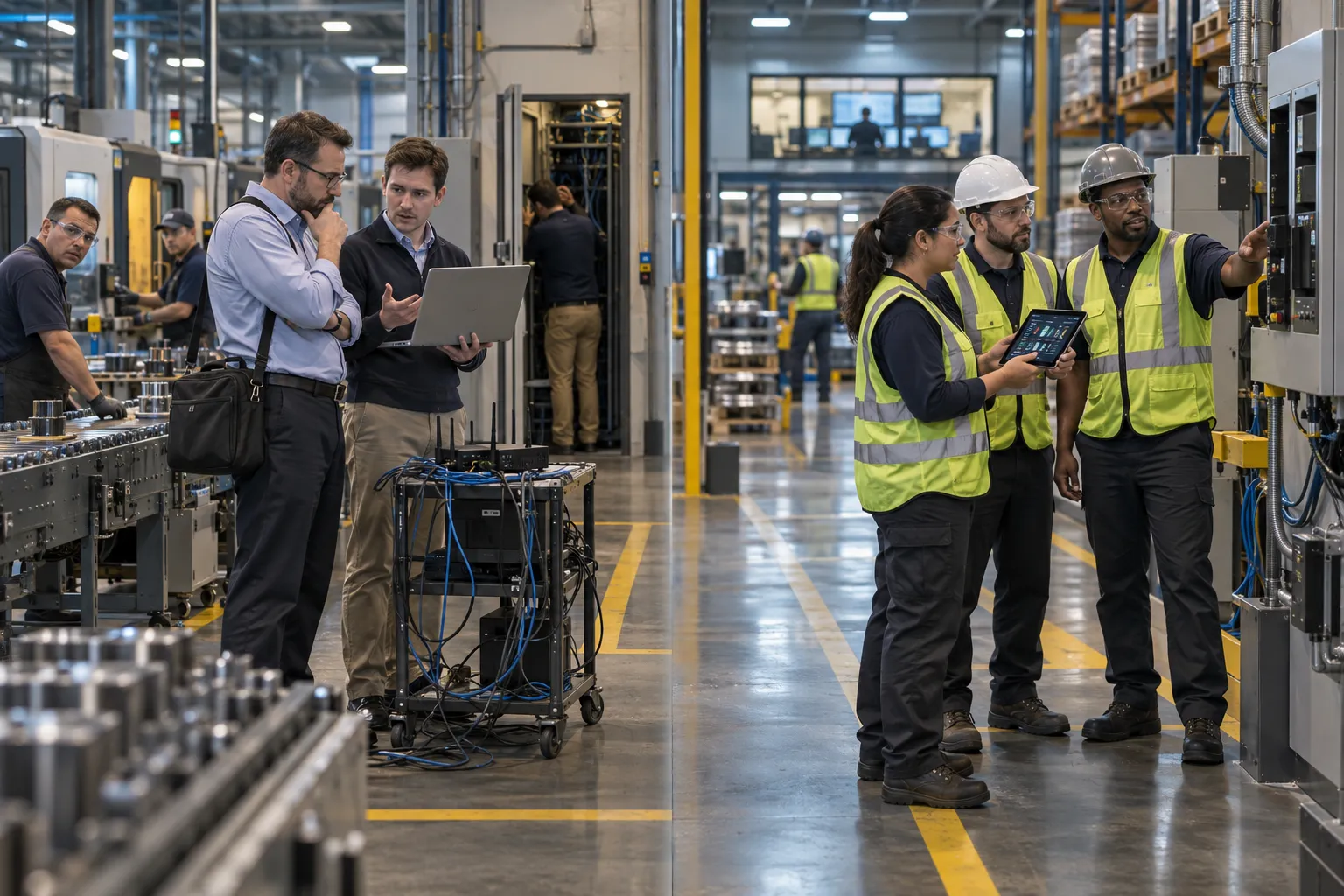
A support model for a small office may not account for production schedules, machine dependencies, or equipment that cannot be taken offline on demand. When assessing managed it services st louis for manufacturing, compare how a provider handles these conditions, not just the services listed in a proposal.
| Area | Generalist approach | Manufacturing-focused approach |
|---|---|---|
| Legacy equipment | May treat unsupported systems as routine endpoints. | Documents dependencies and plans changes around equipment constraints. |
| Plant network | May prioritize office connectivity without mapping machine communications. | Considers how network changes affect production devices and business systems. |
| Recurring tickets | May measure response and closure without tracking repeat causes. | Uses trend data and root-cause work to address recurring issues. |
| Service continuity | May schedule work around standard business hours. | Coordinates planned changes with production needs and available maintenance windows. |
How Generalist Providers Fail on Legacy Equipment and Flat Plant Networks
Many plants have machines that cannot be patched on a standard schedule and networks that grew without clear separation between business devices and production equipment. A change that seems routine in an office can interrupt communication between a controller, an application, and a production workstation.
Keeping older equipment in service is often a reasonable operating decision. The provider needs to inventory dependencies, identify systems that cannot be interrupted, and coordinate changes with plant staff before implementation.
What Metrics Reveal: Response Times, Resolution Rates, and Technician Retention
Service metrics show whether support is responsive and resolves problems within a useful timeframe. Andromeda’s published performance data reports a 12.0-minute median ticket response time, with 97% of issues resolved within 8 business hours. The reported average time to reach a live technician by phone is 1 minute 34 seconds.
Lower technician turnover can preserve knowledge of your site, systems, and operating requirements. Ask how a provider defines response and resolution, what its reports include, and who is accountable for next steps on unresolved or repeated issues.
Case Study: How a Chicagoland Manufacturer Cut IT Issues by Roughly 50%
Andromeda’s documented case study describes a multi-site Chicagoland manufacturer that saw roughly a 50% decrease in IT issues. The result shows the value of identifying recurring causes across locations instead of treating each request as an isolated event.
That outcome is a reference point, not a forecast for every plant. Before choosing managed it services st louis, ask how the provider will establish a baseline, report recurring issues, and account for the normalization period as systems and support processes come under consistent management.
What Managed IT Services Cost in St. Louis (and What Should Be in the Contract)
Unclear fees make support difficult to budget, while an incomplete contract can leave production-critical work outside the monthly price. Managed IT services in St. Louis have no standard cost: scope depends on users and devices, network condition, support hours, security requirements, and whether plant systems are included. Ask providers to connect each fee to defined work and explain what triggers additional charges.
Pricing Models Explained: Flat-Rate, Per-User, and Per-Device
Pricing models allocate costs differently. Flat-rate agreements set a recurring fee for a defined scope. Per-user pricing charges for each supported person, while per-device pricing counts covered computers, servers, and other equipment. Plants with shared workstations, specialized machinery, or multiple shifts should confirm how devices are counted and what support each receives.
| Model | How charges are structured | Contract detail to confirm |
|---|---|---|
| Flat rate | A recurring fee covers an agreed service scope. | Included hours, locations, projects, and exclusions. |
| Per user | Charges follow the number of supported employees. | How shared accounts, seasonal workers, and shift staff count. |
| Per device | Charges follow the covered equipment inventory. | Which servers, workstations, network devices, and production assets qualify. |
SLAs and Response Times: What the Numbers Should Say
A service-level agreement (SLA) should define provider response, incident priorities, and escalation when production is affected. Check whether response time means acknowledgment or active troubleshooting. Ask how after-hours calls are handled, who receives urgent alerts, and how unresolved issues are communicated.
Andromeda’s published performance data reports a 12.0-minute median ticket response time and 97% of issues resolved within 8 business hours. Use those measures as examples of specific reporting, not as a substitute for contract terms tailored to your plant. The agreement should state its own targets, reporting cadence, and remedies when service falls short.
Hidden Costs of Break-Fix and Cheap Contracts
A low monthly fee can exclude work needed during an incident, such as after-hours response, project labor, backup recovery, or support for equipment outside the standard scope. Break-fix arrangements can shift costs into emergency invoices and unplanned downtime. The operational cost shows up as delayed production, overtime to recover a schedule, and staff time spent repeating manual work.
Before signing, get written definitions of included support, billable projects, emergency rates, backup responsibilities, and contract exit terms. Andromeda’s published service terms include the Andromeda Guarantee: when Andromeda misses promised service delivery, the client names the cost of the mistake, up to the monthly service invoice, and Andromeda credits that amount on the next invoice. Review the actual agreement for its conditions.
Co-Managed IT for Plants with Internal IT Staff
Your internal IT team may know plant systems well but lack coverage for every shift, security discipline, or specialized project. Co-managed support can define responsibilities between your staff and the outside provider. Document who owns escalations, patching, network changes, vendor coordination, and incident reporting so production issues do not fall between teams.
Andromeda Managed IT & OT Services can support a defined division of work alongside internal IT. The contract should preserve your team’s authority over plant priorities while naming where outside support takes responsibility.
Compliance and Security for Manufacturers: CMMC, NIST, and Cyber Insurance Readiness
A security gap can interrupt production, raise contract concerns, or complicate an insurance discussion. Managed support can help organize controls and evidence, but it cannot make compliance automatic. Your obligations depend on the information you handle, customer requirements, and applicable regulations. Confirm the scope with qualified compliance and legal advisers.
How Managed IT Support Aligns with CMMC, NIST, and ISO Requirements
The Cybersecurity Maturity Model Certification (CMMC) and National Institute of Standards and Technology (NIST) guidance provide security requirements and practices that may apply to your environment. The International Organization for Standardization (ISO) publishes standards organizations may use to structure management systems. A provider can help inventory systems, document controls, track remediation, and prepare evidence. Your organization remains accountable for compliance decisions.
Andromeda’s published service information describes alignment with CMMC, NIST, and ISO where applicable. Define which systems and data are in scope, who maintains documentation, and how open findings are assigned and tracked.
Layered Security in Practice: EDR, Zero Trust, and OT Segmentation
Endpoint detection and response (EDR) monitors computers and servers for suspicious behavior. Zero Trust limits access according to identity and need rather than assuming every device is safe. Operational technology (OT) segmentation separates production systems from other network traffic, reducing unnecessary paths to controllers and machine interfaces. Plan changes around equipment dependencies and maintenance windows, especially where legacy controllers cannot be patched.
Andromeda reports that its M*AR*S™ security stack blocks more than 100 attacks per month per endpoint and over 300,000 attempted attacks per month across its client base. These figures describe reported blocking activity, not a guarantee that every threat will be stopped. Andromeda Managed IT & OT Services can coordinate security planning with plant operating constraints.
Passing the Cyber Insurance Questionnaire Without Scrambling
Insurance questionnaires often ask about multifactor authentication, backups, endpoint protection, incident response, and access controls. Keep current records of system ownership, backup testing, security policies, and incident contacts. Assign responsibility for each answer and confirm written responses match controls operating across office and production networks.
How to Choose a St. Louis Managed IT Provider: An Evaluation Checklist for Plant Leaders
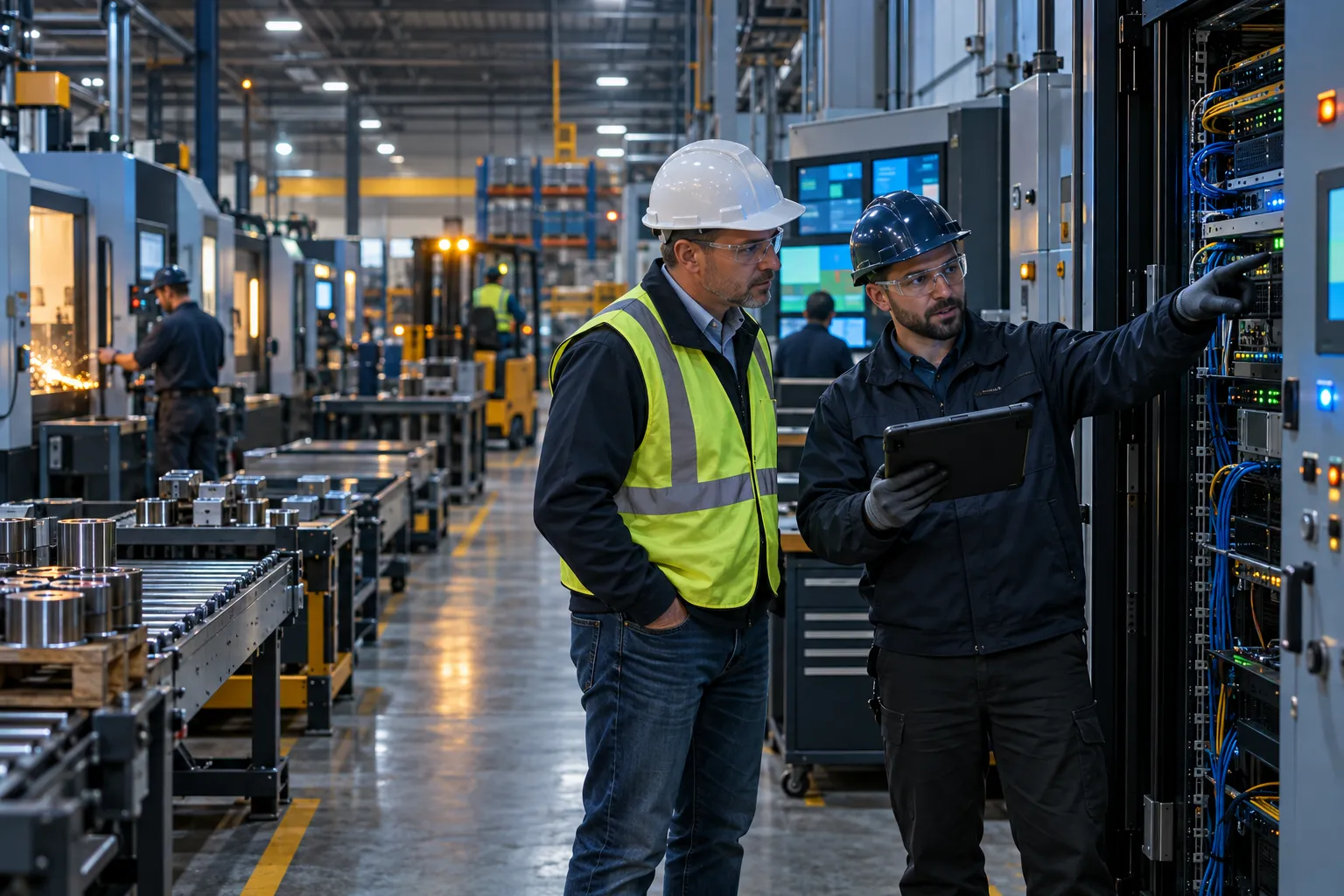
When support is slow or the same issue returns, the cost reaches beyond the service desk. Evaluate how a provider works with your production team, documents responsibilities, and protects uptime while addressing IT Drag™. Ask for specific processes and reporting, not broad promises.
Andromeda Managed IT & OT Services is designed for manufacturers managing office systems alongside production technology. Use the questions below to assess whether its operating approach, or any provider’s, fits your plant.
Ten Questions to Ask Before You Sign
Ask each question directly and request a written answer in the proposal or service agreement. This helps your team verify what support covers before an outage forces a decision.
- How do you prioritize an incident that interrupts production?
- What do response and resolution times mean in your reporting?
- Who receives escalations outside standard business hours?
- How do you track recurring issues and their root causes?
- How are network changes approved and documented?
- Which servers, workstations, and plant devices are included?
- How do you coordinate planned work with maintenance windows?
- What backup recovery tests do you perform, and how often?
- Who owns compliance evidence and remediation tracking?
- What is excluded from the monthly service scope?
Red Flags That Predict Slow Response and Recurring Issues
Warning signs in the service process can reach production. Be cautious when a provider cannot explain escalation ownership, reports ticket closures without identifying repeat causes, or schedules changes without consulting operations staff.
Unclear asset coverage, after-hours support, or project fees can turn predictable support into emergency work with uncertain costs. A provider should show how it records decisions, communicates open risks, and assigns the next action.
Five Questions About OT, ERP, and MES Every Manufacturer Should Ask
Operational technology (OT), enterprise resource planning (ERP), and manufacturing execution systems (MES) can depend on shared networks and tightly timed processes. Ask how the provider maps connections before changes, handles equipment that cannot be patched, and coordinates with controls or engineering staff. Also ask how it will test changes without disrupting active production.
Evaluate Andromeda Managed IT & OT Services against the same practical questions: who approves a change, how dependencies are documented, and what happens if testing reveals a production risk. Clear answers matter more than a general claim of manufacturing experience.
Measure Your IT Drag Before You Decide
Before selecting a provider, record recurring support requests, workarounds, interruptions, and the teams affected. The free IT Drag™ Calculator can help organize those hidden costs. Bring the results to a 30-minute discovery call to discuss your plant’s priorities and constraints.
Choose a provider that makes ownership visible, respects production realities, and reports progress in operational terms. That gives your team a practical basis for reducing repeat disruptions over time.
Frequently Asked Questions
What is included in managed IT services?
Managed IT services typically include help desk support, proactive monitoring, cybersecurity, backup and recovery, and infrastructure planning. A manufacturing-focused provider also coordinates changes with plant staff, documents dependencies on legacy equipment, and sequences work around production schedules and available maintenance windows.
How do managed IT services benefit manufacturing companies?
Managed IT services benefit manufacturers by reducing downtime, eliminating recurring issues through root-cause work, and protecting uptime across both office systems and the plant network. The operational cost shows up as fewer interrupted shifts, less manual reconciliation, and more predictable order processing and shipping.
How much do managed IT services cost?
Managed IT services usually carry a predictable monthly cost, which replaces the surprise expenses of break-fix support: emergency repairs, overtime labor, and lost production hours. Many plants also carry a hidden cost that never appears on an IT invoice, what Andromeda calls IT Drag™, the compounding daily time lost to slow logins, unstable connections, and repeated application trouble.
What is IT Drag and how does it affect my plant?
IT Drag™ is the compounding, mostly invisible daily inefficiency created when employees repeatedly lose time to the same unresolved IT problems. It shows up as manual workarounds, delayed order processing, and time spent reconciling information. Assess how often the same problem returns and which teams it interrupts, not just how many tickets get closed.
Why do manufacturers need an IT provider that understands operational technology?
Operational technology (OT) is the equipment that monitors or controls industrial processes, and it often runs unsupported operating systems or software that cannot be patched during production. Changing it without understanding those dependencies can stop a process. A specialized provider inventories what cannot change and sequences improvements around production.
How long does it take to see results from managed IT services?
Andromeda's documented pattern is that service desk tickets typically begin declining after an approximately three-month normalization period, with a steadier downward trend during months four through nine. A documented Chicagoland case study showed roughly a 50% decrease in IT issues. That is the pattern in our data, not a promise about your plant.
What metrics should I use to evaluate an IT provider?
Look at median response time, resolution rates, customer satisfaction, and technician retention. Andromeda reports a 12.0-minute median ticket response time, 97% of issues resolved within 8 business hours, a 91.4% customer satisfaction rating, and 8+ years of average employee retention. Lower turnover preserves knowledge of your site and systems.