
network infrastructure services
A line-side scanner drops off the wireless network, the warehouse team cannot pull current orders, and production keeps moving against yesterday’s schedule. Network infrastructure services determine whether switches, wireless, firewalls, and plant systems work together reliably enough to support the shift.
Key Takeaways
- Plant networks often run flat, which means a single switch or wireless failure can take down order processing alongside the machines themselves.
- Segmenting the network lets legacy equipment that cannot be patched stay in service while limiting what can reach it.
- Proactive monitoring and planned maintenance windows reduce the unplanned downtime that costs you shift hours and overtime.
- Most clients see recurring network issues start to decline within three to nine months, and that is the pattern in our data, not a promise.
- A 30-minute discovery call with Andromeda can show you where your current infrastructure puts your uptime at risk.
For manufacturers, the question is not just which devices are installed. It is whether your network gives the right people and equipment dependable access, makes failures visible, and supports changes without putting production at risk.
What Network Infrastructure Services Actually Cover (And Why It Matters on the Production Floor)
Network infrastructure services cover the design, installation, monitoring, maintenance, and support of systems that connect people, equipment, and business applications. In a plant, that includes office computers, warehouse wireless, production systems, and connections between sites. A network fault can interrupt order entry, machine data, shipping labels, or communication between the floor and office.
Definition: Network Services vs. Network Infrastructure Services vs. Managed Network Services
These terms describe related but different work. Network services are functions delivered over a network, such as file access or communication. Infrastructure is the equipment and configuration that make those functions possible. Managed services add ongoing monitoring, maintenance, and support beyond the initial installation.
When you evaluate a network infrastructure service, ask whether daily care after the build is included. Even a correctly installed network can become difficult to support if device changes, access rules, and recurring faults are not documented.
Core Components: Switches, Routers, Firewalls, Wireless, Cabling, and WAN/SD-WAN
Each component has a production consequence when it fails or is poorly configured. Switches connect devices inside a facility; routers direct traffic between networks; firewalls control allowed connections. Cabling provides the physical path, while wireless supports mobile scanners, tablets, and equipment across the floor.
- Switches and cabling: Connect workstations, servers, printers, and equipment.
- Routers and WAN: Link facilities and cloud applications across a wide area network.
- Firewalls: Apply rules to traffic moving between networks.
- Wireless and SD-WAN: Support mobile access and manage connections between locations.
Wi-Fi Design & Testing helps reveal coverage gaps before a scanner loses access during picking or shipping.
The Four Network Types: LAN, WAN, WLAN, and OT Networks in a Plant Setting
A local area network (LAN) connects devices within a building. A wide area network (WAN) links locations, while a wireless local area network (WLAN) provides Wi-Fi access. Operational technology (OT) networks connect or support industrial equipment, including controllers and production systems.
These networks may need to exchange information, but they do not all need the same access. Design should account for legacy controllers, warehouse coverage, business applications, and production windows.
What an Engagement Includes: Design, Build, Monitoring, and Support
A complete engagement starts with current equipment, traffic, risks, and production constraints, then moves through design, installation, configuration, testing, monitoring, and support. Network Design & Consultation establishes the intended layout; Network Monitoring & Alerts helps staff identify equipment or connection problems.
Andromeda’s IT Network Infrastructure Management (NIM) covers network setup and administration across data networks and devices. The scope should specify who approves changes, how maintenance windows are set, and how an escalation reaches someone who understands the plant. IT Network Infrastructure Management (NIM) fits teams that need continuing administration, not only a one-time build.
The Accidental Network vs. the Purpose-Built Network: What Flat and Unmanaged Really Costs
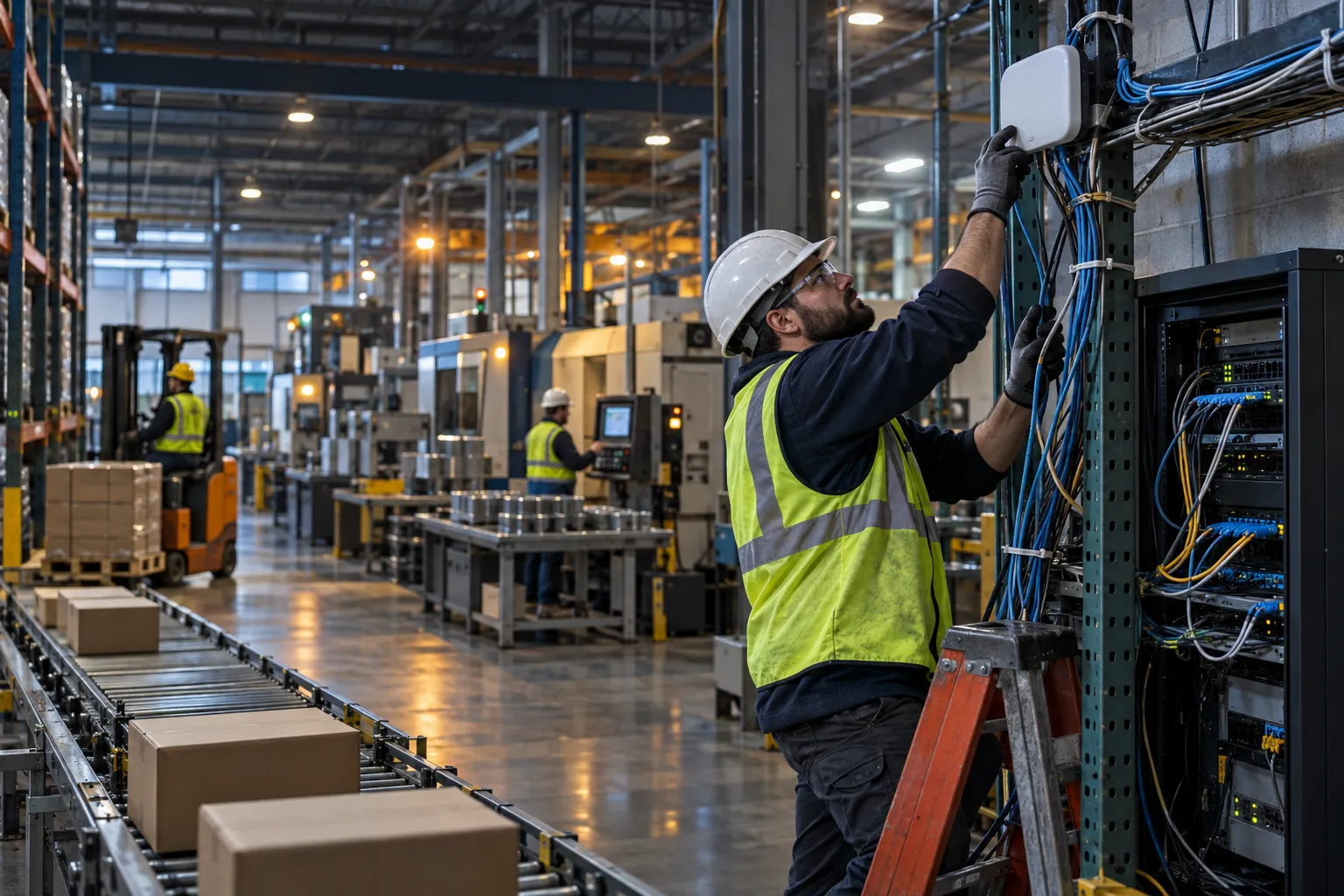
A network often grows one urgent fix at a time: an access point for shipping, a switch for a machine, or a temporary connection that becomes permanent. That approach is understandable when production cannot wait. Over time, undocumented changes and flat network layouts make it harder to find the cause of downtime or limit a fault’s impact.
Symptoms of an Accidental Network: Unexplained Downtime, No Visibility, Recurring Tickets
Here is what that looks like on the floor:
- Warehouse scanners lose connection in known coverage gaps.
- Production slows after a network issue with no clear device or cause.
- The same ticket returns because service was restored, but the root cause remained.
- Your team cannot tell what changed or which systems depend on a device.
Without monitoring and current records, troubleshooting can become a sequence of guesses. The operational cost shows up as delayed work, time spent reconciling data, and maintenance staff pulled away from planned tasks.
Side-by-Side: Chaos (Flat, Insecure, No Alerts) vs. Control (Segmented, Monitored, Redundant)
A purpose-built network gives your team clearer boundaries and better information when a connection fails. It cannot promise equipment will never fail. It can help isolate and investigate a failure with less disruption to unrelated systems.
| Accidental network | Purpose-built network |
|---|---|
| Office, guest, and plant traffic share broad access. | Traffic paths are defined around operational needs. |
| Device health is checked after users report an issue. | Monitoring and alerts provide earlier visibility. |
| Changes and dependencies are difficult to trace. | Configuration and ownership are documented. |
| A single connection failure can affect more devices. | Redundancy and failover systems support continuity where designed. |
Why Break-Fix and Generalist MSP Contracts Price the Repair but Ignore the Lost Shift
A repair invoice measures work performed, not production time spent waiting for support or rebuilding a schedule. Break-fix can look reasonable when incidents are infrequent, and many plants adopted it when their networks were smaller. The gap appears when failures consume shift hours or a provider does not understand which equipment cannot be interrupted.
Network services should account for plant access, escalation, documentation, and change timing. A provider needs to coordinate with production and maintenance before work that could affect line-side equipment. Network support should fit into uptime planning, not create another source of interruption.
The Five-Pillar Standard for a Network Designed for Uptime
A production network should be designed around what must keep running, what can be interrupted, and how your team will know when something changes. These five pillars help you evaluate services beyond a hardware list. The design still needs to account for your equipment, maintenance windows, building layout, and production schedule.
Pillar 1: Segmented (Separating OT, IT, and Guest Traffic)
Segmentation separates operational technology (OT), which supports industrial equipment, from office information technology (IT) and guest access. A controller that cannot be patched can remain in place while network rules limit which devices and systems can reach it. Ask how the provider will map communication needs before setting boundaries. Poorly planned restrictions can interrupt legitimate traffic; documented rules help protect equipment while preserving production connections.
Pillar 2: Redundant (Failover Paths So No Single Device Stops a Line)
Redundancy gives critical connections an alternate path when a device or link fails. Depending on the design, that may mean backup internet connectivity, paired network devices, or alternate links between equipment. Ask what failover covers and how it is tested. Redundancy does not remove every failure risk, and an untested backup path may not support the shift when needed.
Pillar 3: Monitored (Real-Time Alerts Before a Shutdown)
Monitoring tracks network device health, connection availability, and other conditions that can signal trouble. Alerts give your team a chance to investigate a failing link or access point before employees lose connectivity. Network Monitoring & Alerts should have clear ownership: who reviews each alert, how urgent issues are escalated, and what information is recorded. Without that response process, alerts can accumulate without changing the outcome on the floor.
Pillar 4: Secure (Firewalls, Multifactor Authentication, Zero Trust, EDR)
Security controls should limit access to the systems and data each person or device needs. Firewalls regulate traffic between network zones, multifactor authentication (MFA) requires more than one proof of identity, and Zero Trust verifies access rather than assuming a connection is safe. Endpoint detection and response (EDR) helps identify and respond to suspicious activity on supported devices. Ask how these controls fit legacy equipment and applicable compliance needs, including CMMC and NIST.
Pillar 5: Modular (Adding a Production Line Without a Five-Alarm Project)
A modular design makes planned growth easier to scope. Documented layouts, consistent configurations, and reserved capacity help your team understand the work before adding a line, warehouse area, or facility. Network Design & Consultation should address likely changes as well as current needs. The trade-off worth naming is that planning capacity and standards requires upfront decisions, but can reduce last-minute changes during production.
For ongoing administration across data networks and devices, IT Network Infrastructure Management (NIM) is Andromeda’s network management offering. The scope should define change approval, maintenance timing, and escalation before work begins.
Managed vs. Break-Fix vs. Generalist MSP: Choosing a Service Model That Protects Production
A service model determines whether network care is planned, reactive, or shared across teams. The right fit depends on your internal staff, production constraints, and support requirements. Compare the agreement, not just the label: check monitoring coverage, escalation ownership, after-hours response, documentation, and provider experience with OT equipment that cannot take a routine maintenance window.
Three Models Compared: Cost Structure, Response Time, and OT Capability
Use this comparison to identify what each model typically prioritizes, then confirm details in writing. Contract terms and provider capabilities vary.
| Service model | Cost structure | Support approach | Plant-floor considerations |
|---|---|---|---|
| Break-fix | Charges center on work after a problem occurs. | Support begins when an issue is reported. | Confirm response expectations and who understands production dependencies. |
| Generalist managed provider | Ongoing service is defined by the contract. | May include monitoring and routine support; verify what is covered. | Ask how the team handles OT access, legacy devices, and production windows. |
| Manufacturing-specialized managed support | Ongoing work and responsibilities should be stated in the agreement. | Can include proactive network care and documented escalation. | Evaluate experience with plant networks, equipment constraints, and change coordination. |
Why SLAs Should Measure Uptime Impact, Not Ticket Count
A service-level agreement (SLA) should explain when support responds, when it escalates, and how resolution is tracked. Ticket volume alone does not show whether recurring faults are stopping or a production interruption is being handled appropriately. Ask for separate definitions of response and resolution, priority levels tied to operational impact, and a process for documenting root cause. That gives your team a clearer basis for reviewing service than a count of closed requests.
IT/OT Convergence: Why Plant Floor Networks Need a Specialist
Office systems and production equipment increasingly depend on shared connectivity, but their operating needs differ. A routine patch or network change may be acceptable for office computers and unsuitable for a controller tied to a running line. Your provider should coordinate with operations and maintenance, identify dependencies, and schedule changes around production requirements. Ask:
- Who approves changes that could affect production equipment?
- How are legacy devices and network dependencies recorded?
- Who receives urgent alerts, including outside normal business hours?
- How does the provider investigate recurring faults instead of only restoring service?
Clear answers help you judge whether the service model fits your plant, not just your office network.
The Provider Scorecard: Questions and Metrics to Demand Before You Sign

A provider’s promises matter only when your agreement defines support during a production problem. Make sure the contract distinguishes response from resolution, assigns escalation responsibility, and explains how plant-impacting changes are approved. Ask for reporting that connects network events to operational impact, not just closed-ticket counts. Andromeda’s IT Network Infrastructure Management (NIM) is one option for ongoing network setup and administration. Evaluate the written scope against your plant’s operating requirements.
SLA Metrics Worth Writing Into the Contract (Response, Resolution, Escalation)
A service-level agreement (SLA) should define the clock, ownership, and next step for each priority. Confirm whether response means a person acknowledges the issue or begins troubleshooting, and whether resolution means service restoration or a documented root-cause fix. Specify who handles an incident that affects production outside normal business hours.
- Response targets by priority, with the measurement window stated.
- Escalation steps and named responsibility for production-impacting incidents.
- Resolution tracking that separates restored service from confirmed root cause.
- Change approval, maintenance windows, and incident reporting requirements.
Questions That Reveal OT Experience and Root-Cause Discipline
Ask the provider to describe planning a change involving a legacy controller, a manufacturing execution system (MES), or an enterprise resource planning (ERP) connection. A useful answer addresses dependencies, operational approval, testing, and rollback if production is affected. Ask how recurring incidents are reviewed and what documentation your team receives. You want to know whether the provider can work within plant constraints, not just restore a connection and close a ticket.
What Good Looks Like: Benchmarks From Andromeda's Published Numbers
Andromeda reports a 12.0-minute median ticket response time, with metrics updated weekly from the trailing 30 days. Andromeda also reports that 97% of issues are resolved within 8 business hours and a 91.4% customer satisfaction rating. These are service benchmarks, not a forecast for your plant. Ask any provider how measurements are defined, what period they cover, and whether production-impacting incidents are reported separately.
In a documented Chicagoland multi-site manufacturer case study, Andromeda reports roughly a 50% decrease in IT issues. Typical clients see a normalization period of about three months, with ticket decline trends developing over the following three to nine months. Evaluate IT Network Infrastructure Management (NIM) against your own baseline, including repeat incidents, time to escalation, and network-related production interruptions.
If you want to discuss your plant’s requirements, schedule a 30-minute discovery call with Andromeda. If you would rather quantify inefficiency first, use the IT Drag™ Calculator.
Frequently Asked Questions
What is network infrastructure management?
Network infrastructure management is the ongoing setup, administration, monitoring, and support of the switches, wireless, firewalls, and cabling that connect your people and equipment. Andromeda's Network Infrastructure Management (NIM) covers data networks and devices so faults are visible early and changes are documented, rather than discovered mid-shift.
How do you design a manufacturing network?
Designing a manufacturing network starts with your current equipment, traffic, risks, and production constraints, then defines separate paths for office, warehouse, and OT (operational technology) systems. The goal is dependable access for the floor, containment when something fails, and changes that never put production at risk. Wi-Fi design and testing should come before installation to reveal coverage gaps.
What is included in network monitoring services?
Network monitoring services watch the health of your switches, wireless access points, firewalls, and connections continuously, then alert your team when equipment or links show problems. Instead of learning about a fault when a scanner drops, monitoring gives earlier visibility so issues can be investigated before they interrupt picking, shipping, or machine data.
How often should network infrastructure be assessed?
Network infrastructure should be assessed at least annually, and whenever your plant adds equipment, a location, or a compliance requirement like CMMC or NIST readiness. Plants that grow one urgent fix at a time benefit from assessments sooner, because undocumented changes and flat layouts make fault isolation slow and disruptive.
What is the difference between network services and network infrastructure services?
Network services are functions delivered over a network, such as file access or communication. Network infrastructure services cover the equipment and configuration that make those functions possible, plus design, installation, monitoring, and support. When evaluating a provider, ask whether daily care after the build is included, not just the installation itself.
Why is network segmentation important in a manufacturing plant?
Network segmentation separates office, guest, and plant traffic so a single failure or infection cannot reach every device on the floor. It also lets legacy controllers that cannot be patched stop sharing a broadcast domain with the laptops that open email. The controller stays exactly as it is; what changes is what can reach it.
What does an accidental network cost a manufacturer?
An accidental network, one that grew through temporary fixes, costs you unexplained downtime, recurring tickets, and troubleshooting that becomes a sequence of guesses. The operational cost shows up as delayed work, time spent reconciling data, and maintenance staff pulled away from planned tasks to chase a root cause nobody documented.