which is better for a factory: standard business IT support or specialized managed IT and OT services
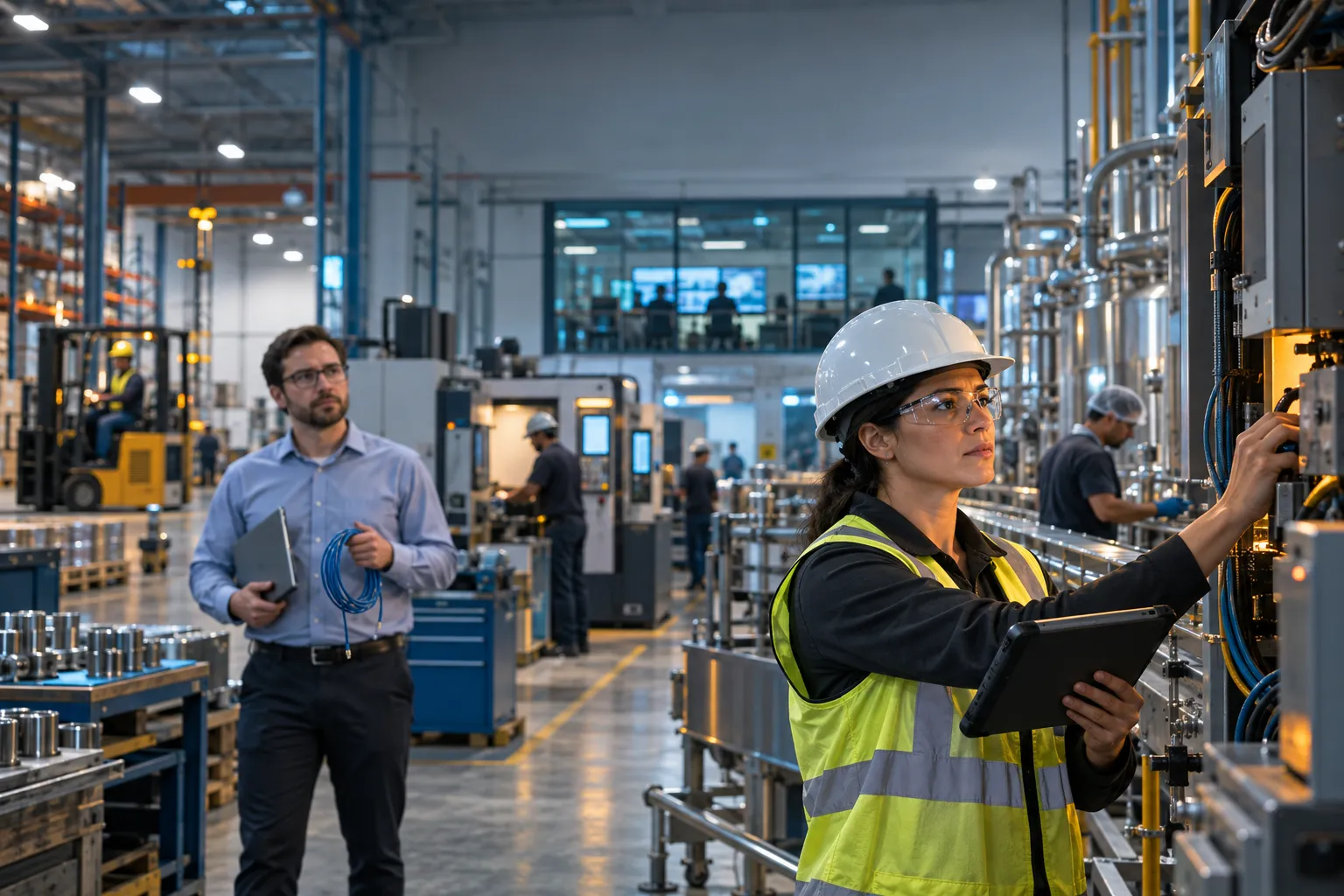
When an office network issue reaches a production station, the cost can include idle labor, a missed shift target, and orders that need to be rescheduled. If you are asking which is better for a factory: standard business IT support or specialized managed IT and OT services, start with a practical question: can your provider support the systems that keep production moving, not just office computers?
Key Takeaways
- Standard business IT support is built around office tools, while specialized managed IT and OT services cover the machines, controllers, and plant networks that keep production moving.
- When an office network problem reaches the production floor, the real cost shows up as idle labor, missed shift targets, and orders that have to be rescheduled.
- Operational technology (OT) systems in a factory often run legacy equipment that a generalist provider does not know how to secure or support.
- The right question to ask any provider is whether they can protect uptime and support production systems, not just fix desktop computers.
- A provider with manufacturing experience sequences IT changes around your production schedule, so improvements do not create unplanned downtime.
The difference is scope. Standard business support handles common business technology needs. Specialized support also accounts for industrial equipment, plant networks, and security boundaries between office systems and production operations.
Two Support Models, One Production Floor: What Factory Leaders Are Really Choosing Between
The plant-floor symptom you already know: the ticket that takes three days and stops a shift
A label printer, order terminal, or network connection fails during a shift. The help desk logs a ticket, but the issue touches equipment or software the support team does not recognize. Production may continue by hand, while orders, inventory, or schedules fall out of sync.
Here is what that looks like on the floor:
- Employees wait for access to production or inventory data.
- Supervisors switch to manual workarounds that require later reconciliation.
- A machine connection problem is treated as an office network ticket.
- The same fault returns because the underlying cause remains unresolved.
IT vs OT: why the distinction decides your uptime
Information technology (IT) supports business functions such as email, file access, finance, and order processing. Operational technology (OT) monitors or controls physical processes on the production floor. Supervisory control and data acquisition (SCADA) systems gather process data and support control across equipment; programmable logic controllers (PLCs) run automated machine tasks.
Those systems have different operating constraints. A controller may run an unsupported operating system or be impossible to patch during a production run. Support decisions must account for machine behavior, maintenance windows, safety procedures, and the cost of interrupting a process.
What standard business IT support typically covers
Standard business IT support commonly covers user help desk requests, office computers, business networks, cloud services, email, backups, and baseline cybersecurity. That scope can fit a manufacturer whose technology is mostly administrative and whose production equipment operates independently from business systems.
The boundary matters when an issue crosses into OT. A provider may restore a laptop or cloud account but lack the experience to assess a machine-controller connection without creating production risk.
What specialized managed IT and OT services add
Specialized managed IT and OT services account for industrial controls, legacy equipment, plant network design, and the relationship between office systems and production assets. Work can include documenting OT connections, planning network segmentation, coordinating changes with machine builders, and scheduling updates around production requirements.
Andromeda Managed IT & IT/OT Support Services is designed for manufacturers that need business systems and plant operations considered together. Andromeda’s 30+ years serving manufacturers informs an approach that treats change planning as part of protecting uptime.
How We Evaluated Both Models: Five Criteria That Matter on the Production Floor
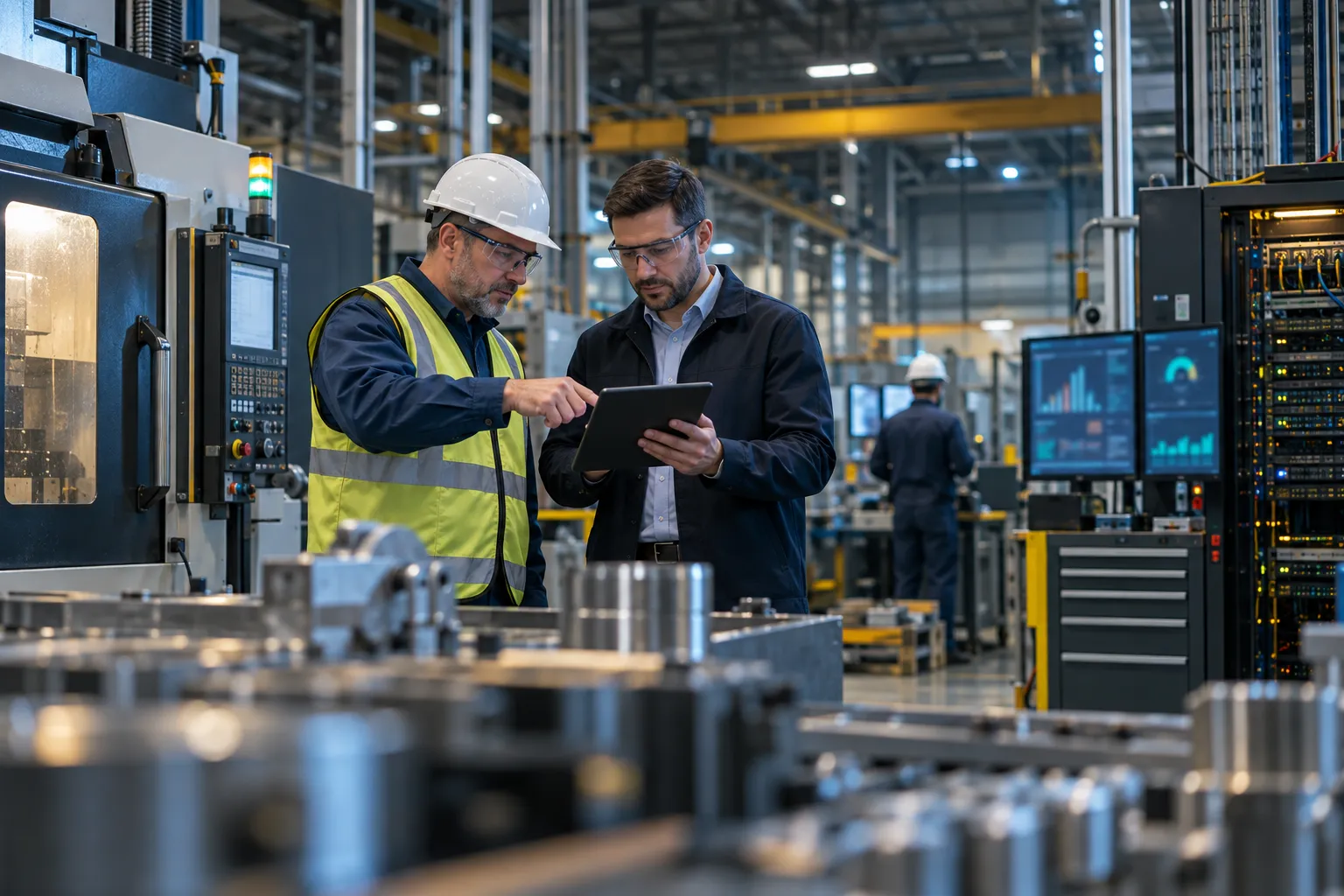
A provider’s fit is clearer when you compare its operating practices with the risks your plant carries. This evaluation considers OT scope, measurable response, security and compliance preparation, the full cost of recurring issues, and technician knowledge of your environment. These criteria distinguish office-focused support from a model prepared for production dependencies.
Andromeda Managed IT & IT/OT Support Services is the specialized model considered here. Not every plant needs the same arrangement. The question is what your provider must be able to do before a ticket becomes a production interruption.
- Scope and OT expertise: Can the provider work around equipment that cannot be patched, document plant connections, and coordinate with machine vendors?
- Response and accountability: Are response and resolution measures published and defined? Andromeda reports a 12.0-minute median ticket response time and says 97% of issues are resolved within 8 business hours. These are published service metrics, not a guarantee of an identical outcome for every incident.
- Security and compliance readiness: Can the team discuss Cybersecurity Maturity Model Certification (CMMC), National Institute of Standards and Technology (NIST) guidance, International Organization for Standardization (ISO) standards, and cyber insurance questionnaires in relation to your environment?
- Cost and IT Drag™: Does the price account for prevention and root-cause work, or mainly labor after a failure? Include downtime, overtime, manual reconciliation, and repeated tickets in the comparison.
- Technician continuity: Will the same people learn your equipment, escalation paths, and production calendar? Andromeda reports average employee retention of 8+ years, supporting continuity as technicians learn a client’s environment.
Ask for evidence behind each answer: written service expectations, a sample escalation path, and an explanation of how changes are approved around production. Choose the model whose scope matches your plant’s dependencies and whose accountability can be reviewed.
The Rankings: Which Model Delivers for a Factory
Ranked #1: Andromeda Managed IT & IT/OT Support Services, built for production environments
Best for: Factories where business systems connect to production, legacy equipment, or compliance requirements. The Andromeda Managed IT & IT/OT Support Services model addresses office technology and plant operations together, with changes planned around production needs.
Andromeda reports an average live-tech phone pickup of 1 minute 34 seconds, a 12.0-minute median ticket response time, and resolution of 97% of issues within 8 business hours. Its published customer satisfaction rating is 91.4%. These measures give factory leaders specific service information to compare against broad response promises.
Real-world example: fewer recurring issues after normalization
A documented Andromeda case study reports that a Chicagoland multi-site manufacturer saw roughly a 50% decrease in IT issues after switching. The trend took time: Andromeda describes an approximately three-month normalization period before recurring service desk tickets begin to decline steadily. A new provider first needs to learn the environment, stabilize support, and identify recurring causes, so account for that period when setting expectations.
Ranked #2: Standard business IT support, a fit for limited production dependencies
Best for: A small plant with minimal OT connections, no relevant compliance obligations, and production equipment that operates independently from business systems. Standard support can be reasonable when its scope covers the company’s needs and production is unlikely to depend on office networks or business applications.
The trade-off is narrower industrial experience. If a ticket involves a machine connection, unsupported controller, or production scheduling system, confirm who owns the investigation and how changes will be coordinated. A lower service price helps only when the scope still protects the work your plant depends on.
Side-by-side comparison: what each model covers
Use the differences below to match support scope to your plant’s dependencies. A generalist model may suit a business with few production technology connections. When office systems and plant equipment rely on the same network or data, specialized support provides a clearer path for coordinating security, troubleshooting, and operational changes.
| Decision area | Standard business IT support | Specialized managed IT and OT |
|---|---|---|
| Scope | Office users, business networks, cloud tools | Business systems, plant networks, and OT dependencies |
| Equipment expertise | General endpoint and network troubleshooting | Considers legacy controllers and machine connections |
| Response evidence | Varies by provider and contract | Andromeda publishes response and resolution measures |
| Security and compliance | Baseline business protections | Can address IT/OT boundaries and compliance alignment |
| Cost model | May focus on support coverage and tickets | Includes planning and root-cause attention alongside support |
| Operational outcome | Business systems supported within stated scope | Support decisions account for production dependencies |
For plants with connected equipment, Andromeda Managed IT & IT/OT Support Services is the stronger fit because its scope accounts for production systems, not just office technology. Weigh that distinction against your operating requirements.
A Decision Framework: Which Model Fits Your Plant
The right choice depends on how much production relies on connected technology, who can support it, and what happens when recurring issues remain unresolved. Use these questions to assess your environment. Several “yes” answers may indicate that office-focused coverage leaves production responsibilities unassigned.
Five yes-or-no questions for your team
- Do production machines, scanners, or controllers connect to your business network?
- Could an IT outage interrupt a production run or delay an order?
- Does your internal IT team lack time or experience for plant network support?
- Do customer contracts, CMMC, NIST, ISO, or cyber insurance requirements apply?
- Do the same support tickets return, or wait long enough to disrupt a shift?
If you answered yes to multiple questions, ask whether your provider can document relevant assets, explain escalation ownership, and plan changes around production. Your answer to which is better for a factory: standard business IT support or specialized managed IT and OT services should reflect those dependencies, not the provider’s label alone.
How generalist support gaps can reach the production floor
A flat network can allow office devices and plant assets to share broad network access. If ransomware or another security incident reaches that environment, weak separation can increase disruption risk for OT systems. Legacy controllers may be unable to accept standard patches, so protection must account for their limitations rather than treating them like office computers.
- Office and plant traffic lack clear network boundaries.
- Unsupported controllers remain exposed because patching is not feasible.
- Changes happen without coordination with maintenance or machine vendors.
When to stay with standard support or plan a switch
Standard support may remain suitable when production equipment is isolated, compliance demands are limited, and internal staff can manage industrial concerns. Consider a specialized model when recurring incidents affect throughput, OT assets depend on business networks, or your team cannot get clear ownership of plant-related tickets.
A transition requires an inventory of systems, access and vendor documentation, agreed escalation paths, and careful sequencing of changes. Allow time for the incoming team to learn your plant before judging the ticket trend. You can use Andromeda’s IT Drag™ Calculator to estimate hidden costs from recurring delays before deciding whether to schedule a conversation.
Choosing Your Provider and Getting Started
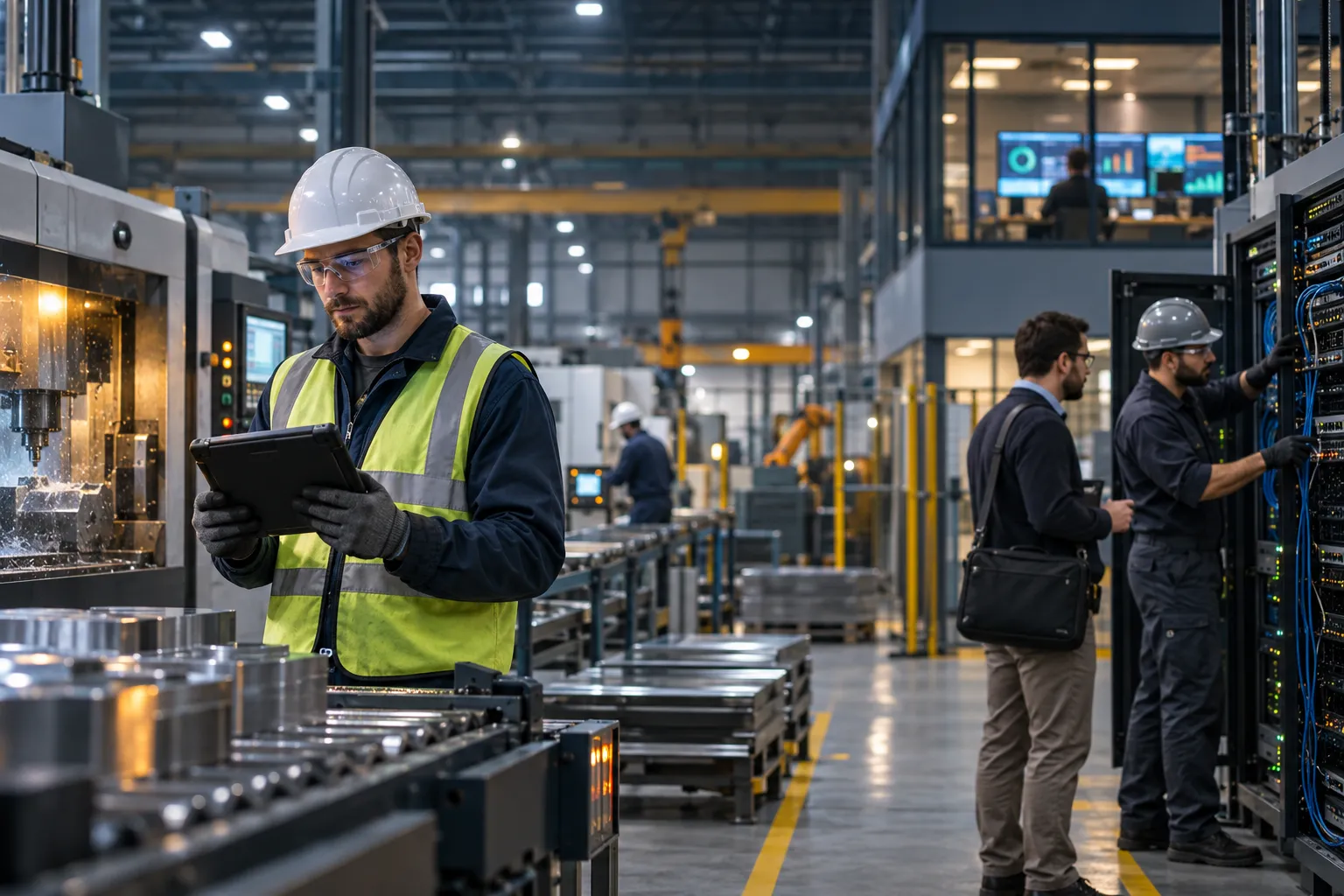
Your provider should support business systems and production dependencies without treating every plant change as a routine office update. Compare written responsibilities, escalation paths, and coordination with maintenance and equipment vendors. Andromeda’s Andromeda Managed IT & IT/OT Support Services is designed for manufacturers seeking that combined support scope.
What to look for in a manufacturing-focused provider
Ask how the provider assesses your environment, takes command of daily support, addresses security and compliance, reports to leadership, and plans modernization. Andromeda organizes this work through five steps: Assess and Align, Take Command, Secure and Comply, Report and Guide, and Lead and Modernize. Andromeda reports average employee retention of 8+ years. Request service-level agreements (SLAs) in writing, including response definitions, escalation ownership, and planned maintenance procedures.
A practical process for selecting a partner
Start with a defined evaluation, not a provider presentation alone:
- Document business systems, plant assets, vendors, and support gaps.
- Ask each provider to explain how it would handle a production-related incident.
- Review written scope, security responsibilities, service measures, and transition requirements.
- Confirm who coordinates with machine builders and existing OT vendors.
- Compare total cost against the work covered, including co-managed support for an internal IT team.
Pricing depends on scope, environment, and service responsibilities. Ask for a proposal that separates included work from optional services, and agree on how the incoming team will learn your systems before judging performance.
Questions manufacturers should settle before signing
Can the provider work alongside internal IT? Who contacts a machine builder when a fault involves its equipment? What documentation and access are needed for transition? Clear answers help prevent duplicated effort and gaps between business IT, plant operations, and outside vendors.
Your next step: a discovery call or IT Drag™ Calculator
If you are deciding which is better for a factory: standard business IT support or specialized managed IT and OT services, match the provider’s documented scope to your production needs. Consider Andromeda Managed IT & IT/OT Support Services as a specialized option. Schedule a 30-minute discovery call, or use the IT Drag™ Calculator to assess recurring technology costs before speaking with a provider.
Frequently Asked Questions
What is the difference between standard business IT support and specialized managed IT and OT services?
Standard business IT support covers office technology such as help desk requests, laptops, cloud services, email, and backups. Specialized managed IT and OT services also cover industrial controls, plant networks, legacy equipment, and the security boundary between office systems and production operations. The difference is scope.
Why is a generalist MSP often not enough for a factory?
A generalist MSP is often not enough because a factory ticket can touch equipment the provider has never worked on. A label printer or machine connection failure gets treated as an office network issue, the underlying cause stays unresolved, and the same fault returns. Specialized providers document OT connections and plan changes around production.
What specific risks does OT introduce that standard IT support does not address?
OT (operational technology) introduces machines that may run unsupported operating systems and controllers that cannot be patched during a production run. Standard IT support is not trained to assess a machine-controller connection without creating production risk. Support decisions must also account for maintenance windows, safety procedures, and the cost of interrupting a process.
How does downtime cost compare between office IT issues and production floor outages?
Production floor outages cost more because the damage reaches throughput, not just convenience. A plant-floor outage can mean idle labor, a missed shift target, rescheduled orders, overtime to catch up, and manual reconciliation afterward. Office IT issues usually delay one worker; production outages delay the whole schedule.
When might standard business IT support be sufficient for a manufacturer?
Standard business IT support can be sufficient when your technology is mostly administrative and production equipment operates independently from business systems. If no office system connects to the floor and no compliance requirement touches OT, the narrower scope may fit. The boundary matters the moment an issue crosses into production equipment.
What should manufacturers look for when comparing IT providers for a plant?
Compare providers on OT scope, published response and resolution metrics, security and compliance readiness, total cost including recurring issues, and technician continuity. Ask for written service expectations, a sample escalation path, and how changes are approved around production. Andromeda reports a 12.0-minute median ticket response time and 8+ years average technician retention.
What is IT Drag and how does it affect a factory?
IT Drag is the compounding effect of recurring technology inefficiencies: delayed work, repeated troubleshooting, and manual processes that quietly consume production time. In a factory it shows up as workarounds, out-of-sync schedules, and the same fault returning because the root cause was never fixed. Your IT provider should reduce inefficiency, not perpetuate it.