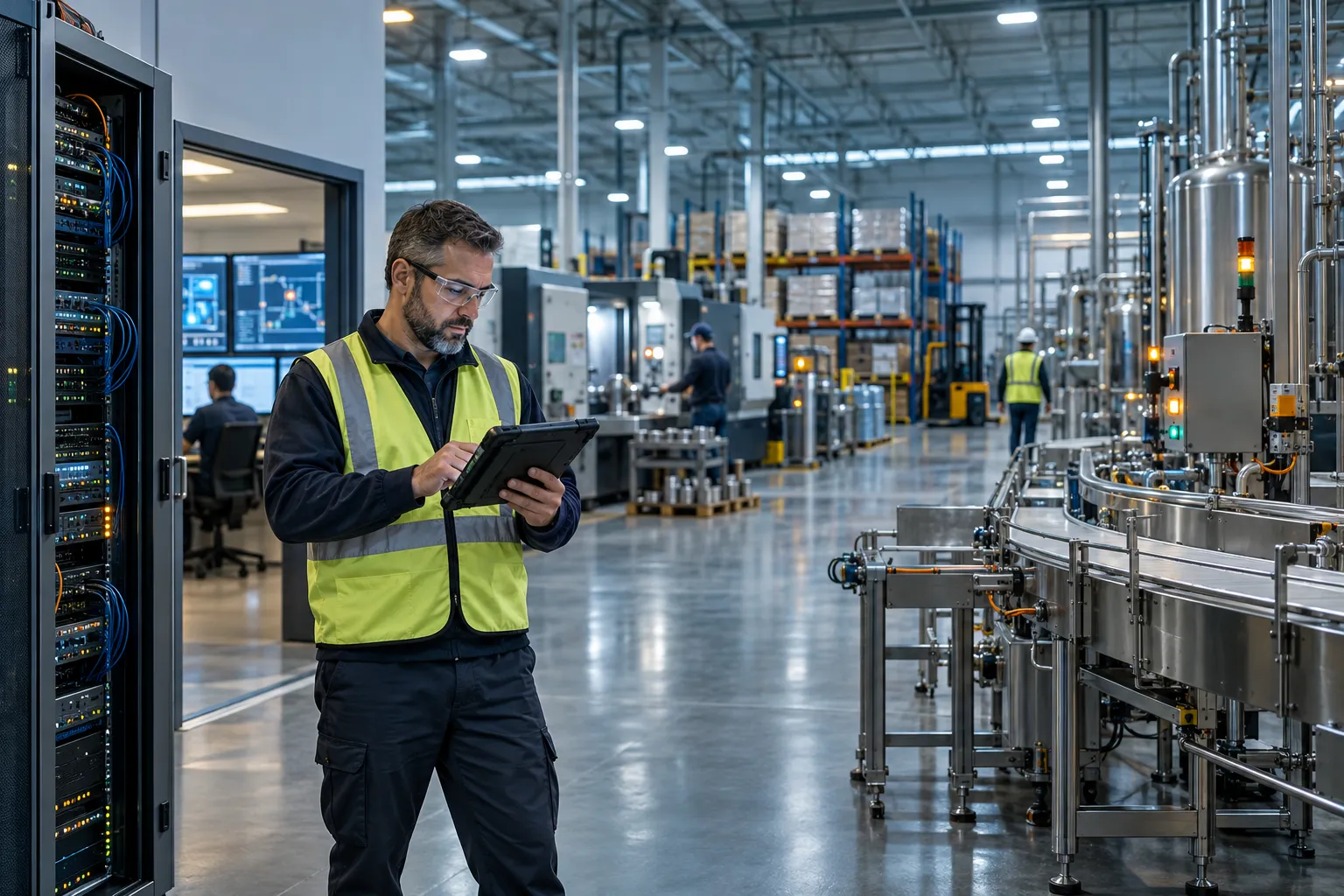
what do industry analysts recommend for IT infrastructure in food and beverage manufacturing
When a traceability record is missing or a production system loses its network connection, the cost lands on the shift, not in a technology roadmap. If you are asking what do industry analysts recommend for IT infrastructure in food and beverage manufacturing, the practical answer is a secure, segmented foundation that supports reliable operations, usable production data, and compliance work.
Key Takeaways
- Analysts consistently point to network segmentation as the first move, so your office systems and unpatched machine controllers stop sharing the same network.
- Traceability and lot records depend on ERP and MES systems that stay connected, which means uptime planning matters as much as software selection.
- Compliance expectations around CMMC, NIST, and food safety audits are pushing infrastructure decisions from the server room into the production conversation.
- Legacy equipment that cannot be patched should be protected in place rather than rushed into replacement, because the machine still runs and the schedule still matters.
- Analysts frame infrastructure spending around fewer recurring issues and predictable operations, which matches what our own client data shows over the first 3 to 9 months.
That guidance matters when your plant is modernizing around legacy equipment and limited maintenance windows. Andromeda’s IT Solutions for Food & Beverage Manufacturers addresses infrastructure decisions in the context of production and plant-floor systems, not just office technology.
What Named Analyst Firms Actually Recommend for Food and Beverage IT
Gartner, IDC, Info-Tech Research Group, and McKinsey publish research relevant to technology strategy, digital operations, and transformation. ISA/IEC 62443 is an industrial cybersecurity standards series, not an analyst firm. Across these sources, useful direction for a mid-size processor is to build dependable foundations, manage risk, connect systems deliberately, and tie technology work to measurable operating needs.
The Market Pressures Behind the Guidance (Trends, Labor, and Compliance)
Processors face pressure to meet changing customer demand while maintaining food safety, throughput, and consistent product quality. Labor constraints add reason to reduce manual handoffs and make production information easier to use. Compliance and customer requirements also increase the need for accurate, accessible records.
Several forces shape infrastructure decisions:
- FSMA became law in 2011 and shifted food safety requirements toward preventive controls.
- BRC and SQF programs can require documented processes and records that teams can retrieve during audits.
- Industry 4.0 adoption connects production equipment, supervisory systems, and business applications, increasing demands on network design and data handling.
- Labor shortages make dependable scanning, scheduling, and production data more consequential to daily work.
McKinsey estimates that roughly 70% of digital transformation initiatives ultimately fail, a figure cited by Food Engineering. This is a warning about execution, not a prediction for your plant: new software cannot compensate for unstable infrastructure or unclear ownership.
Recommendation-by-Recommendation: Gartner, IDC, Info-Tech, McKinsey, and ISA/IEC 62443
These sources serve different purposes. Analyst research can inform technology priorities, while an industrial standard provides a structured basis for security decisions. The table translates their relevance into practical questions for a processor. It does not treat every source as a food-specific infrastructure prescription.
| Source | Relevant guidance | Plant-floor decision |
|---|---|---|
| Gartner | Technology priorities and enterprise risk research can inform planning. | Set infrastructure priorities against production dependencies, recovery needs, and business risk. |
| IDC | Research on technology adoption and digital business helps frame investment choices. | Require a defined operating outcome before adding connected equipment or data platforms. |
| Info-Tech Research Group | Its food and beverage research addresses adopting an “exponential IT mindset.” | Stage modernization around existing systems, staff capacity, and operational readiness. |
| McKinsey | Transformation research highlights the execution risk of digital programs. | Assign ownership, dependencies, and success measures before a project reaches the floor. |
| ISA/IEC 62443 | Industrial cybersecurity standards address security across industrial automation and control systems. | Define zones, conduits, access controls, and responsibilities around production assets. |
Analyst Guidance Translated to a 200-1,000 Employee Plant
A mid-size processor rarely has the staffing or downtime capacity to copy an enterprise rollout. Start with systems tied to production, food safety records, shipping, and recovery. Map dependencies among enterprise resource planning (ERP), manufacturing execution systems (MES), plant controls, quality records, and identity management. Prioritize work that reduces operational exposure without assuming every controller can be patched or replaced.
To evaluate what do industry analysts recommend for IT infrastructure in food and beverage manufacturing, ask whether each proposed change improves recovery, traceability, security, or staff workflow. Andromeda’s IT Solutions for Food & Beverage Manufacturers is relevant when those questions involve plant networks and production systems. Measure the decision by what changes on the floor.
IT and OT Convergence: Two Networks, One Plant, Two Sets of Rules
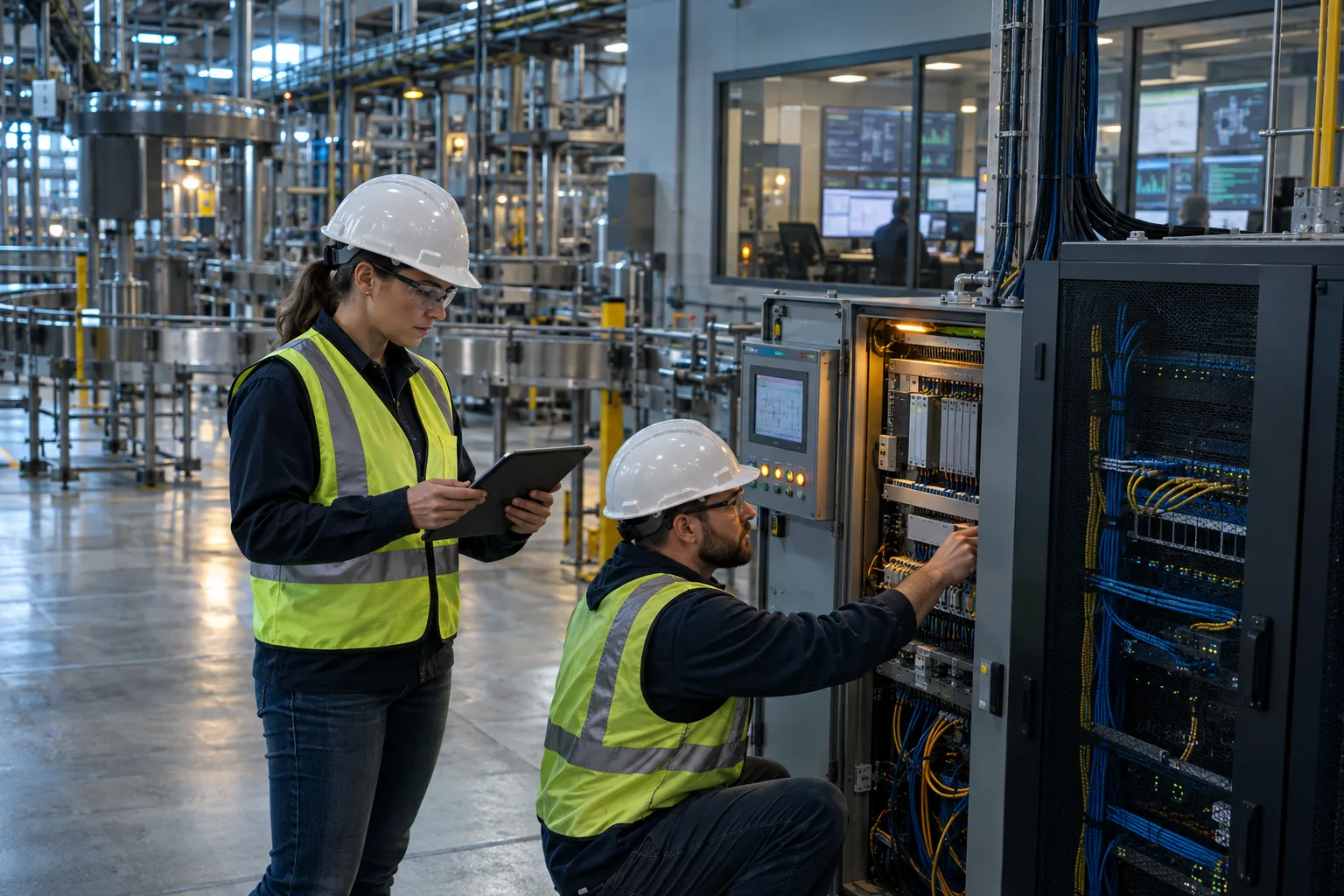
A production network and a corporate network serve different needs, even when production data must reach business systems. Information technology (IT) usually prioritizes confidentiality, managed endpoints, and scheduled updates. Operational technology (OT), including control systems, prioritizes safe and predictable process operation. Connecting them calls for defined boundaries and accountability, not simply a new switch or software purchase.
IT Versus OT: What Changes on the Plant Floor (Comparison Table)
The distinction becomes clear when a routine IT change could affect a running line. A corporate laptop can usually receive a scheduled update; a machine controller may depend on a vendor-approved configuration and a narrow shutdown window.
| Operating concern | Corporate IT | Plant OT |
|---|---|---|
| Primary priority | Protect business information and user access | Keep production processes safe and predictable |
| Change timing | Planned maintenance windows and user schedules | Coordinated with production, maintenance, and equipment vendors |
| Typical assets | Workstations, identity systems, business applications | Programmable logic controllers, human-machine interfaces, sensors |
| Failure impact | Interrupted office work or business processing | Line interruption, process disruption, or lost production data |
Segmenting Your Network With the Purdue Model: Corporate, DMZ, Supervisory, Control
The Purdue Model is a reference architecture for organizing industrial systems into levels and separating communications between them. A practical layout places corporate systems above a demilitarized zone (DMZ), which mediates approved exchanges with plant supervisory systems. Below that sit control networks and field devices. Design should reflect your equipment, risk, and required data flows.
Segmentation means legacy controllers that cannot be patched no longer share a broadcast domain with office laptops. The controller can remain in place; access paths change. Document which systems communicate, why they communicate, and who approves those connections.
Why Convergence Is a Governance and Staffing Problem, Not a Shopping Problem
A firewall or virtual local area network (VLAN) cannot settle who approves a production network change, monitors alerts, or coordinates a maintenance window. IT, engineering, operations, and maintenance need an agreed escalation path. Without it, security changes can be delayed or made without enough knowledge of production dependencies.
The Infrastructure Decisions: Cloud Placement, Traceability Data, and Wireless Coverage
Cloud hosting, traceability records, and plant wireless each affect whether a shift can keep moving when a system or connection falters. The right design depends on how quickly production needs the data, what must keep running locally, and how your team will recover from failure. Translate broad guidance into decisions about workload dependencies, records, and coverage. Andromeda’s IT Solutions for Food & Beverage Manufacturers addresses these decisions in the context of plant operations.
Where ERP, MES, and Historians Should Live: Cloud, On-Premises, or Hybrid
Enterprise resource planning (ERP) supports business processes such as orders and inventory. A manufacturing execution system (MES) coordinates production activity, while a historian stores time-series data from equipment and processes. Place each workload according to response-time needs, connection dependencies, recovery requirements, and vendor support, rather than choosing one hosting model for every system.
Cloud, On-Premises, and Hybrid Trade-Offs
Pros
- Cloud services can support remote access and reduce the need to maintain some local infrastructure.
- On-premises systems can keep selected workloads available locally when internet access is interrupted.
- A hybrid design can place business applications in the cloud while keeping time-sensitive plant functions near production.
Cons
- Cloud-dependent plant functions need tested connectivity and a clear offline operating plan.
- On-premises systems require local maintenance, backup, and recovery planning.
- Hybrid environments require clear ownership of interfaces, data movement, and support escalation.
Test the actual failure path: what happens to production if the internet, a local server, or an application interface becomes unavailable? Keep control functions independent where required, and document which data must move between systems.
FSMA 204 Traceability: The Data Infrastructure Audits Actually Require
Traceability depends on complete, consistent, retrievable records, not merely a new software platform. The Food Safety Modernization Act (FSMA) traceability requirements make it important to map where required event data originates, how it is associated with a product or lot, and how staff can retrieve it for an audit or investigation. Check that barcode scans, production records, quality data, and shipping information use consistent identifiers and timestamps.
Before changing systems, confirm who owns each record, where the authoritative copy resides, and how missing or conflicting entries are corrected. The IT Solutions for Food & Beverage Manufacturers can support infrastructure planning around those operational requirements.
Plant Wi-Fi That Holds Up: Scanners, AGVs, and Failover on the Production Network
A dropped wireless connection can leave a scanner unable to confirm a pick or interrupt communication with an automated guided vehicle (AGV). Plan coverage around production routes, cold or washdown areas, racks, moving equipment, and interference sources. A wireless heat map and an on-floor validation test help identify dead zones before they disrupt shipping or material movement.
Use this practical review before approving a design:
- Test coverage along scanner, AGV, and shipping workflows.
- Confirm what users and equipment can do during a wireless outage.
- Identify alternate access points or wired connections for critical workstations.
- Document escalation steps and recovery responsibilities for a failed connection.
Wireless redundancy matters only when the fallback path has been tested under plant conditions. Measure success by whether staff can complete critical work during a connection failure.
A Five-Phase Maturity Sequence That Maps Analyst Guidance to Your Roadmap
A roadmap helps when its sequence fits production constraints. For a mid-size processor, the practical order is to understand system dependencies, stabilize daily support, address security and compliance gaps, give leadership useful visibility, and modernize in stages. Andromeda’s IT Solutions for Food & Beverage Manufacturers can support infrastructure planning grounded in plant operations.
Phase 1-2: Assess and Align, Then Take Command of Daily Operations
Start by documenting what supports production, traceability, shipping, and recovery. Review network boundaries, application dependencies, support responsibilities, open risks, and maintenance windows. Agree on which problems carry the greatest operational cost before setting project priorities.
Next, establish day-to-day ownership and a consistent escalation path. Track recurring incidents by root cause, not just ticket count. When support teams see the same failure interrupting a scanner workflow or production application, they can address the condition driving repeat calls.
Phase 3-4: Secure and Comply, Then Report to Leadership
Once the operating picture is clear, close security gaps in a sequence that respects equipment limits. Set access rules, protect endpoints, document approved communications, and coordinate changes with operations and maintenance. For systems that cannot be patched, record the constraint and define compensating controls and monitoring.
Reporting should help leaders make decisions, not just describe deployed technology. Review recurring issues, response performance, unresolved risks, recovery readiness, and planned work. A quarterly review can connect the IT roadmap to production dependencies and upcoming audit needs.
Phase 5: Modernize Without Stopping Production
Modernization is safer when each change has a clear purpose, owner, test plan, and rollback path. Pilot workflow changes in a bounded area, validate data movement, and schedule cutovers with the people responsible for the line. Legacy controllers may remain in service while surrounding systems and access paths improve.
Choose work by its effect on throughput, recovery, and staff effort. Andromeda’s IT Solutions for Food & Beverage Manufacturers is designed for infrastructure decisions that account for production systems and operating windows.
What 'Recommended' Looks Like in Operation: Proof Points and Realistic Timelines
Expect an initial normalization period while systems, responsibilities, and recurring problems are documented. Andromeda reports that service desk tickets typically begin a steady decline within three to nine months, after roughly three months of normalization. A documented Chicagoland multi-site manufacturer case study showed about a 50% decrease in IT issues. That is a reported case, not a forecast for every plant.
FAQ and Readiness Checklist: Questions to Ask Before Your Next IT Decision
Before renewing a support agreement or approving an infrastructure project, check whether your team can explain system ownership, production dependencies, and recovery steps. These answers help distinguish a documented operating plan from a list of technology purchases.
Which Analyst Firms Publish Guidance Specific to Food and Beverage Manufacturing?
Gartner, IDC, Info-Tech Research Group, and McKinsey publish research relevant to technology strategy and transformation. Info-Tech has research focused on food and beverage manufacturing. ISA/IEC 62443 is an industrial cybersecurity standards series, not an analyst firm. Treat broad research as planning input, then validate recommendations against your plant’s equipment and operating needs.
Do We Need ISA/IEC 62443 Compliance or Just Alignment?
That depends on customer, regulatory, contractual, and insurance requirements. ISA/IEC 62443 offers a framework for industrial cybersecurity, but a plant should not claim compliance without defining the applicable requirements and assessing its controls. Ask your assessor or customer what evidence they expect.
Internal Audit Checklist: 10 Questions Your Plant Should Answer This Quarter
- Are production-critical systems and owners documented?
- Can staff retrieve required traceability records?
- Are network access paths and exceptions recorded?
- Which equipment cannot be patched, and what controls protect it?
- Are backups and recovery steps tested?
- Do cyber insurance answers match current practice?
- Can your team explain open audit findings?
- Are support response and escalation responsibilities clear?
- Does your managed service agreement define reporting and planned work?
- Are upcoming changes scheduled with production owners?
Where to Start: A 30-Minute Discovery Call or the IT Drag Calculator
If your production systems have clear owners, documented recovery steps, and planned changes that fit maintenance windows, your next roadmap decision can be made with less uncertainty. To identify where recurring inefficiency may be accumulating, use Andromeda’s IT Drag™ Calculator. If you want to discuss plant-specific priorities, schedule a 30-minute discovery call.
Frequently Asked Questions
Which analyst firms publish guidance on food and beverage manufacturing IT, and what do they recommend?
Gartner, IDC, Info-Tech Research Group, and McKinsey publish research relevant to food and beverage manufacturing IT, covering technology priorities, digital transformation, and execution risk. Across these sources, the common direction is to build dependable infrastructure foundations, manage risk deliberately, and tie every technology investment to a measurable operating outcome rather than to the technology itself.
What does IT/OT convergence mean in practice for a food or beverage plant?
IT/OT convergence means connecting your corporate business network with your plant-floor operational technology (OT), such as controllers and sensors, so production data reaches business systems. In practice, it requires defined boundaries and clear accountability, because corporate IT prioritizes data protection and scheduled updates while OT prioritizes safe, predictable process operation.
How should a manufacturer segment its network between corporate IT and the plant floor?
Manufacturers should segment by defining zones and conduits around production assets, following the ISA/IEC 62443 industrial cybersecurity standard. That means access controls and documented responsibilities so plant controllers do not share a broadcast domain with office laptops. The machines that cannot be patched stay exactly as they are; what changes is what can reach them.
What infrastructure does FSMA traceability require?
FSMA traceability requires reliable networks, accurate scanning, and record systems that let your team retrieve documented processes quickly during audits. BRC and SQF programs can also require records that staff must produce on demand. When a traceability record is missing or a production system loses network connection, the cost lands on the shift, not the technology roadmap.
Should ERP, MES, or historians live in the cloud, on-premises, or a hybrid model?
The right placement for ERP, MES, and data historians depends on production dependencies, recovery needs, and staff capacity, which is why analysts like IDC recommend a defined operating outcome before adding any platform. Many mid-size processors land on a hybrid model that keeps plant-floor systems close to production while moving business applications to the cloud where uptime risk is lower.
Why do most digital transformation projects fail in food manufacturing?
New software cannot compensate for unstable infrastructure or unclear ownership. Assigning ownership, dependencies, and success measures before a project reaches the floor is what separates the plants that see results from the ones that stall.
How should a 200 to 1,000 employee food processor prioritize IT modernization?
A mid-size processor should start with systems tied to production, food safety records, shipping, and recovery, then map dependencies across ERP, MES, plant controls, quality records, and identity management. Prioritize work that reduces operational exposure without assuming every controller can be patched or replaced. Measure each change by what improves on the floor.