
what IT network management should I choose for a multi-site metal fabrication operation
When a network problem stops a laser, delays an ERP transaction, or isolates a plant from the rest of the business, the cost shows up in production and shipping. If you’re asking, “what IT network management should I choose for a multi-site metal fabrication operation,” start with the conditions your provider must handle: demanding shop-floor environments, connected production equipment, and consistent support across every location.
Key Takeaways
- Network downtime in a metal fabrication shop hits production schedules, shipping deadlines, and ERP transactions, so the cost of poor management is measured in lost output.
- Any provider you evaluate must be able to support harsh shop-floor conditions and connected production equipment such as lasers and CNC machines.
- Multi-site operations need a management partner that delivers consistent service and standardized practices across every plant location.
- Choosing the right network management approach for 2026 means matching provider capabilities to the specific demands of fabrication environments rather than settling for generic IT support.
There are three practical models: a generalist managed service provider (MSP), an internal IT team, or a provider with manufacturing-focused IT/OT capabilities. The right fit depends on your sites, equipment, staffing, security requirements, and need for consistent visibility, not just the monthly support fee.
What Multi-Site Metal Fabrication Actually Demands From a Network
Why Fabrication Floors Break Standard IT Playbooks (Metal Dust, EMI, Heat, and Vibration)
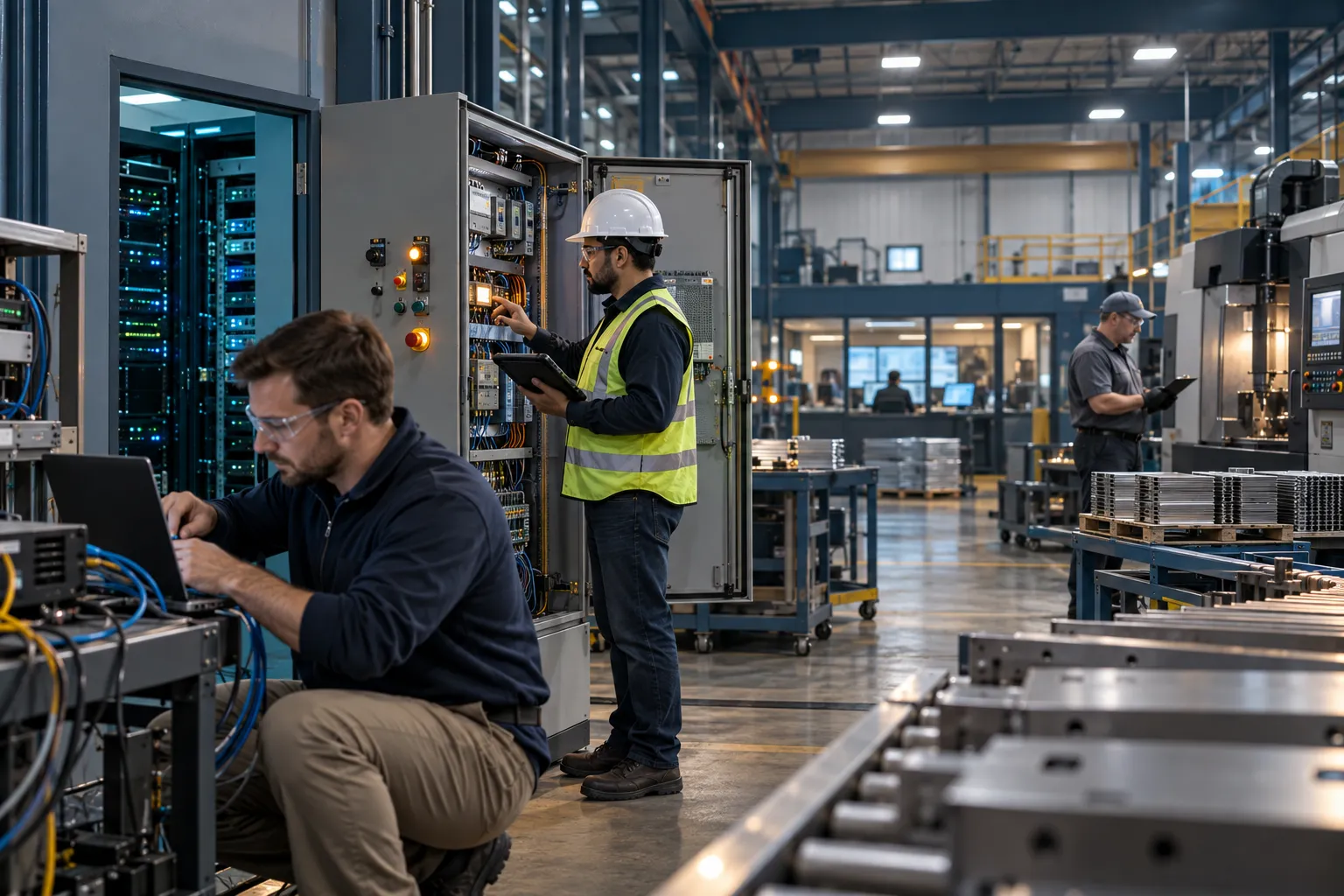
A network device that works in a clean office may struggle near metalworking equipment. Metal dust can affect ventilation and connections, while heat, vibration, and electromagnetic interference (EMI) can complicate reliable communications. Wireless coverage can also change around large machines, metal stock, and moving equipment. Equipment placement, cabling, wireless planning, and monitoring must account for actual production-floor conditions.
The Multi-Site Problem: Three Plants, Three IT Realities, One Business
Three facilities rarely have identical networks. One may have newer switches and fiber, another an aging server room, and a third a broadband connection that struggles during large file transfers. Different local practices can leave each plant with separate access rules, backup processes, and support procedures. Central visibility helps IT identify performance problems and apply consistent security policies without assuming every site has the same equipment or operational needs.
IT/OT Convergence: When Office Networks Meet CNC Machines and Welding Robots
Office systems and operational technology (OT) have different failure consequences. A compromised email account is serious; a network change that interrupts a CNC machine, welding robot, programmable logic controller (PLC), or human-machine interface (HMI) can affect production. Secure integration starts with understanding which systems communicate, controlling traffic between business and machine networks, and coordinating changes with plant personnel. A provider should not treat production equipment like an ordinary office workstation.
What a Stalled Shift Really Costs: Downtime Math for Fabricators
A network outage can stop order entry, shop-floor data collection, machine programming, or communication between locations. Estimate its operational impact by recording affected production time, idle labor, delayed orders, overtime needed to recover, and any scrap or rework. Avoid relying on a generic hourly figure: the cost depends on the work cell, shift, backlog, and customer commitments. Andromeda’s published 2026 service metrics include a 1 minute 34 second average live tech phone pickup and 12.0-minute median ticket response time; these describe its support performance, not a guarantee that every production issue will be resolved within those times.
Your Three Real Options: Managed IT/OT, Generalist MSP, or Internal Team
Option 1: Generalist MSPs and Break-Fix Vendors (and the Hidden Cost of 'We Fix Computers')
A generalist MSP can cover routine help desk work, user accounts, endpoint protection, and office networking. Break-fix support may suit a small operation with limited reliance on connected production systems, but it begins after a problem occurs. The hidden cost is often the gap between fixing a computer and restoring a production workflow: a provider may not know the machine dependencies, plant priorities, or change windows. Ask how support handles an outage that affects both office systems and a production cell.
Option 2: Internal IT Staff for Multi-Site Coverage
An internal team understands local processes and can build working relationships with operators, maintenance, and plant leadership. It can coordinate changes around production schedules. The trade-off is coverage: a small team may struggle to support several sites, maintain security controls, manage network infrastructure, and respond to after-hours incidents at once. Internal ownership works best when staffing, documented procedures, escalation coverage, and OT expertise match the demands of every location.
Option 3: Specialized Managed IT/OT Services Built for Manufacturing
A manufacturing-focused provider should discuss network segmentation, plant-floor access, machine connectivity, maintenance windows, and escalation paths in operational terms. Andromeda’s IT Network Infrastructure Management (NIM) is its featured service for managing network infrastructure. Evaluate any provider by asking how it documents each site, monitors connectivity, coordinates changes with production, and distinguishes an office issue from an OT incident. IT Network Infrastructure Management (NIM) may fit when your priority is consistent network oversight across facilities.
Side-by-Side Comparison: What Each Option Delivers Across Your Plants
The best choice depends on the work you need covered, expertise available at each plant, and how much responsibility your team wants to retain. Use the comparison to identify gaps, then verify coverage in a service scope and escalation plan. If you’re still weighing what IT network management should I choose for a multi-site metal fabrication operation, pay particular attention to OT familiarity and support across locations.
| Management model | Typical strength | Trade-off to verify | Best fit when |
|---|---|---|---|
| Generalist MSP or break-fix | Routine IT support and common office systems | May lack production equipment context or proactive coverage | OT needs are limited and internal staff can coordinate plant issues |
| Internal IT team | Direct knowledge of company processes and site contacts | Staffing and after-hours coverage may be stretched across locations | You can sustain the required skills, tools, and coverage internally |
| Specialized managed IT/OT | Network management informed by manufacturing operations | Requires clear scope, plant coordination, and defined accountability | You need consistent oversight across business and production networks |
SD-WAN, MPLS, or Site-by-Site: Choosing the Connectivity Backbone
SD-WAN can centrally manage traffic across available connections and support consistent policies between plants. MPLS provides a private network service, with cost and availability depending on locations and provider terms. Site-by-site internet connections may be simpler to arrange, but require planning for secure access, failover, and centralized monitoring. To choose, map application needs, bandwidth, latency sensitivity, carrier options, and the recovery plan for a failed circuit. Ask how the design preserves access to ERP, file services, voice, and production data during an outage. The decision is not simply which connection is fastest; it is how each plant stays productive and secure when a link fails.
IT Drag™: The Multi-Site Tax Nobody Puts on the P&L
How Small Inefficiencies Compound Across Three or More Locations
A network that works most of the time can still consume production capacity. A slow login, an unavailable shared file, inconsistent wireless coverage, or a delayed response may cost only minutes at one site. Across several plants, interruptions recur, employees lose time, supervisors work around missing data, and IT staff repeat troubleshooting. The costs are rarely grouped under one budget line, making the pattern easy to miss.
Andromeda uses IT Drag™ to describe the accumulated operational cost of unresolved technology friction. Track recurring incidents by site, affected process, minutes lost, repeat frequency, and recovery work. The goal is not to assign a dramatic estimate to every glitch, but to show leadership where inconsistent configurations, limited network visibility, and repeat tickets take time away from production and planned improvement.
The Security and Compliance Gap: CMMC, NIST, and Cyber Insurance for Defense-Related Fabrication
Security gaps between plants can put customer data, production systems, and contract eligibility at risk. Fabricators handling controlled unclassified information for defense work may need to assess obligations under the Cybersecurity Maturity Model Certification (CMMC) program and applicable National Institute of Standards and Technology (NIST) requirements. Exact obligations depend on the contract, data, and role in the supply chain. Cyber insurance applications also ask about security controls, so undocumented or uneven practices can complicate renewal.
Start with an inventory of systems and data, then document user access, administrative accounts, remote connections, backups, incident procedures, and network boundaries between business IT and OT. That figure describes activity across the client base; it does not replace a site-specific risk assessment or demonstrate compliance by itself.
Legacy Equipment and Unpatched Controllers: Modernizing Without Stopping Production
Older controllers and machine interfaces can remain in service long after vendor support ends. Applying a standard patch or replacing a device without checking machine dependencies may interrupt a validated process or create an unplanned outage. Leaving an unpatched controller broadly reachable increases exposure. Document its function, owner, operating system, communications, and vendor support status, then limit access according to its production role.
Modernization can proceed in planned stages: isolate legacy equipment where feasible, restrict remote access, monitor permitted network traffic, and schedule changes with operations and maintenance. Andromeda’s IT Network Infrastructure Management (NIM) can support infrastructure oversight across sites. IT Network Infrastructure Management (NIM) is worth evaluating when the scope includes network documentation, monitoring, and coordination of changes around plant requirements.
A Checklist for Evaluating Any Provider Against Fabrication Realities
Before assigning responsibility for a multi-site environment, ask for evidence of how the provider will maintain visibility, coordinate with plant teams, and handle security controls without treating production equipment like office computers. Seek answers that can be documented in a service scope, network diagram, or operating procedure, rather than relying on broad assurances.
- Will each facility have a current network diagram, device inventory, and named escalation contacts?
- How are changes reviewed with operations before work that could affect machines, ERP access, or shipping?
- Can the provider identify traffic between business systems and OT, and document access restrictions?
- How are unsupported controllers, remote vendor sessions, backups, and security incidents handled?
- What site-level reports show availability, recurring tickets, open risks, and completed corrective work?
Clear answers help turn IT Drag™ into a working management measure: recurring issues become visible, owners are assigned, and unresolved risks can be prioritized against production impact. Leadership then gets a more useful view than a single company-wide ticket count.
The Roadmap: From Reactive to Operationally Mature Across Every Site
When recurring network problems pull attention from production, a maturity roadmap gives each plant a practical order of work. If you’re asking what IT network management should I choose for a multi-site metal fabrication operation, consider whether the provider can assess conditions, manage daily operations, strengthen security, report clearly, and plan modernization without disrupting production. Andromeda’s five-step model organizes that work so leadership can see priorities and progress.
Step 1 and 2: Assess and Align, Then Take Command of Daily Operations
Begin by documenting each site’s network, systems, support responsibilities, production dependencies, and known risks. Compare that picture with business priorities: which workflows cannot wait, which locations need attention first, and who approves changes near production equipment? Then establish routines for monitoring, ticket ownership, escalation, maintenance windows, and communication with plant leaders. Andromeda’s IT Network Infrastructure Management (NIM) can be evaluated for ongoing network oversight across facilities. The assessment should produce a prioritized work plan, not just an inventory.
Step 3 and 4: Secure and Comply, Then Report at the Leadership Level
Once ownership and site conditions are clear, address access controls, network boundaries, backups, remote connections, and documented response procedures. Align the work with applicable customer, contract, and regulatory requirements, including CMMC or NIST obligations where they apply. Reporting should help leaders make decisions: show recurring incidents, unresolved risks, service patterns, and completed corrective work by site. Those figures offer service context, not a promise for every incident or production outcome.
Step 5: Lead and Modernize (ERP, MES, and Cloud Integration)
With operating controls in place, use network information to plan changes that support the next stage of production and business systems. ERP, manufacturing execution systems (MES), cloud services, and plant equipment each have dependencies that should be mapped before integration or migration. Schedule changes with operations, test recovery steps, and define how success will be measured before work begins. IT Network Infrastructure Management (NIM) is relevant when network documentation, monitoring, and coordinated infrastructure changes are part of that plan.
What Realistic Improvement Looks Like: The Normalization Period and Published Metrics
Early work often reveals undocumented devices, inconsistent configurations, and repeat issues that must be addressed before improvement is visible. Andromeda reports that clients typically see a steady decline in service desk tickets within three to nine months. In a Chicagoland multi-site manufacturer case study, Andromeda reports an approximately 50% decrease in IT issues. Treat these as reported results, not guarantees. Agree on a baseline, track the same measures by site, and review whether fewer recurring interruptions are translating into steadier workflows.
Choosing Your Course: Next Steps for Multi-Site Fabricators

Five Questions to Ask Before You Renew Any IT Contract
Before renewing, ask for specific answers that connect the service scope to plant operations. These questions can reveal whether responsibility, reporting, and change control are clear across every location.
- Who owns network health and escalation at each plant?
- How are changes coordinated with production and maintenance?
- What site-level reports will leadership receive, and how often?
- How are IT and OT access boundaries documented and reviewed?
- What work is included, and what creates an additional charge?
When a 30-Minute Discovery Call Beats Another Whitepaper
If you can describe recurring issues but cannot see their pattern across sites, a focused conversation may help identify what to assess next. Andromeda offers a discovery call with Carl to discuss your operating priorities and network concerns. Ask for a clear next step, not a ready-made answer. To estimate accumulated technology friction, use the IT Drag™ Calculator if available through Andromeda. When deciding what IT network management should I choose for a multi-site metal fabrication operation, favor a plan with named ownership, measurable reporting, and changes coordinated around production.
Frequently Asked Questions
What are the unique networking needs of a multi-site metal fabrication operation?
A multi-site metal fabrication operation needs networks built for metal dust, heat, vibration, and electromagnetic interference, plus reliable wireless coverage around large machines and metal stock. Each plant may run different equipment and connection types, so central visibility and consistent security policies across all locations are essential.
How can I ensure network uptime across multiple plants?
You can ensure network uptime across multiple plants by combining proactive monitoring, documented site profiles, coordinated change windows with production, and a clear escalation plan for every location. Track the real cost of downtime per work cell and shift so support priorities match actual production impact.
What security standards apply to metal fabrication networks?
Metal fabrication networks should apply traffic control between business and machine networks, consistent access rules across every plant, documented backup processes, and endpoint protection. Security also means treating CNC machines, PLCs, and HMIs as production-critical systems rather than ordinary office workstations when planning changes.
How do I integrate IT and OT networks securely?
You integrate IT and OT networks securely by mapping which systems communicate, segmenting office traffic from machine networks, and coordinating changes with plant personnel before any modification. A failed email account is serious, but a network change that interrupts a CNC machine or welding robot affects production, so the two environments need different handling.
Should I use a generalist MSP, internal IT staff, or a manufacturing-focused provider?
A manufacturing-focused managed IT/OT provider is the strongest fit when your plants rely on connected production equipment and need consistent oversight across locations. Generalist MSPs suit limited OT needs, while internal teams work best when staffing, documented procedures, and OT expertise can cover every site.
How much does a network outage actually cost a fabrication shop?
A network outage in a fabrication shop costs production time, idle labor, delayed orders, recovery overtime, and possible scrap or rework. Avoid generic hourly figures because the real cost depends on the specific work cell, shift timing, backlog, and customer commitments at the moment of the outage.
Why does office IT support often fail on the fabrication floor?
Office IT support often fails on the fabrication floor because network devices designed for clean offices struggle with metal dust, heat, vibration, and EMI near metalworking equipment. Break-fix providers also may not know machine dependencies, plant priorities, or maintenance windows, which delays restoring a production workflow.