
co-managed it services
When production depends on reliable systems, internal IT leaders need more than an unresolved ticket queue. They need capacity that respects shift schedules, legacy equipment, cybersecurity requirements, and the cost of interrupting a run. Co-managed IT services add specialized support while keeping operational ownership with the internal team.
Key Takeaways
- Co-managed IT lets your internal team keep ownership of technology decisions while an outside partner supplies extra hands for daily workload and specialized projects.
- This model clears ticket backlogs without forcing you to hire full-time staff, a real advantage when budgets face scrutiny during growth phases.
- External specialists can take on cybersecurity monitoring, patching, and compliance documentation so your in-house staff can concentrate on the systems that keep production running.
- The right partner invests time in learning your shift schedules, legacy equipment, and downtime tolerance before touching anything on the plant floor.
- Support capacity scales up or down with production cycles, giving growing manufacturers flexibility that fixed internal staffing simply cannot offer.
The model does not replace the IT director or treat the plant like an office. It defines responsibilities, removes recurring technical friction, and improves uptime without requiring a full department overnight.
Understanding Co-Managed IT Services: A Manufacturing Imperative
Co-managed IT services are a shared model in which an internal IT team remains in control while an external manufacturing-focused provider supplies defined capabilities. These may include service desk coverage, network monitoring, cybersecurity, cloud administration, backup oversight, project execution, or after-hours response. The internal team decides how technology supports production; the external team handles agreed responsibilities through documented escalation paths and performance expectations.
What are Co-Managed IT Services (CoMITS)?
In a plant, the IT director may manage business priorities and vendors while the co-managed partner monitors switches, investigates wireless failures, supports Microsoft 365, and schedules maintenance outside production windows. The provider works beside internal staff rather than operating as a help desk without plant context.
Hiring another employee may address one skill gap while leaving coverage, security monitoring, project management, or network expertise unresolved. A shared model provides defined expertise and response capacity without surrendering control of the environment.
The Core Problem: IT Drag™ and Production Inefficiencies
IT Drag™ is the accumulated loss caused by technical problems that never receive permanent resolution. A scanner disconnects twice a week, a workstation slows after updates, or a shared folder becomes unavailable during order processing. Each event seems manageable, but together they create lost minutes, repeated troubleshooting, overtime, and delayed work orders.
Ticket churn consumes time needed for network segmentation, lifecycle planning, disaster recovery, and cybersecurity controls. The plant continues operating while improvement work is postponed. Old switches, unsupported operating systems, exposed remote access, and undocumented dependencies remain in place longer than planned.
Why Manufacturers Need Specialized IT Support Beyond Generalists
Office IT assumptions can create plant risk. A restart that is harmless in an office may interrupt a batch, disconnect a human-machine interface, or stop barcode transactions on a shipping line. Plant networks also contain industrial controllers, historians, programmable logic controllers, warehouse devices, engineering workstations, and legacy systems that cannot be patched on a standard office schedule.
Specialized support asks which line is running, what maintenance window is approved, which systems are safety-related, and who owns the equipment vendor relationship. A provider should understand IT and OT boundaries, change control, backup verification, access management, incident response, and requirements such as NIST, CMMC, or ISO alignment.
The Andromeda Approach: IT That Understands Manufacturing
Andromeda frames technology work around throughput and continuity. Its Andromeda Managed IT Services offering supports internal leaders with monitored infrastructure, security operations, user support, documentation, and planned improvement work. The relationship defines escalation authority, maintenance approvals, reporting cadence, and systems that remain under plant control.
The provider brings additional hands and specialized knowledge while the internal leader retains business context, priorities, and final direction. Andromeda Managed IT Services supports visible accountability across those responsible for keeping production systems available.
Co-Managed IT vs. Other IT Models: Finding Your Fit
Co-Managed IT Services Explained: A Detailed Division of Labor
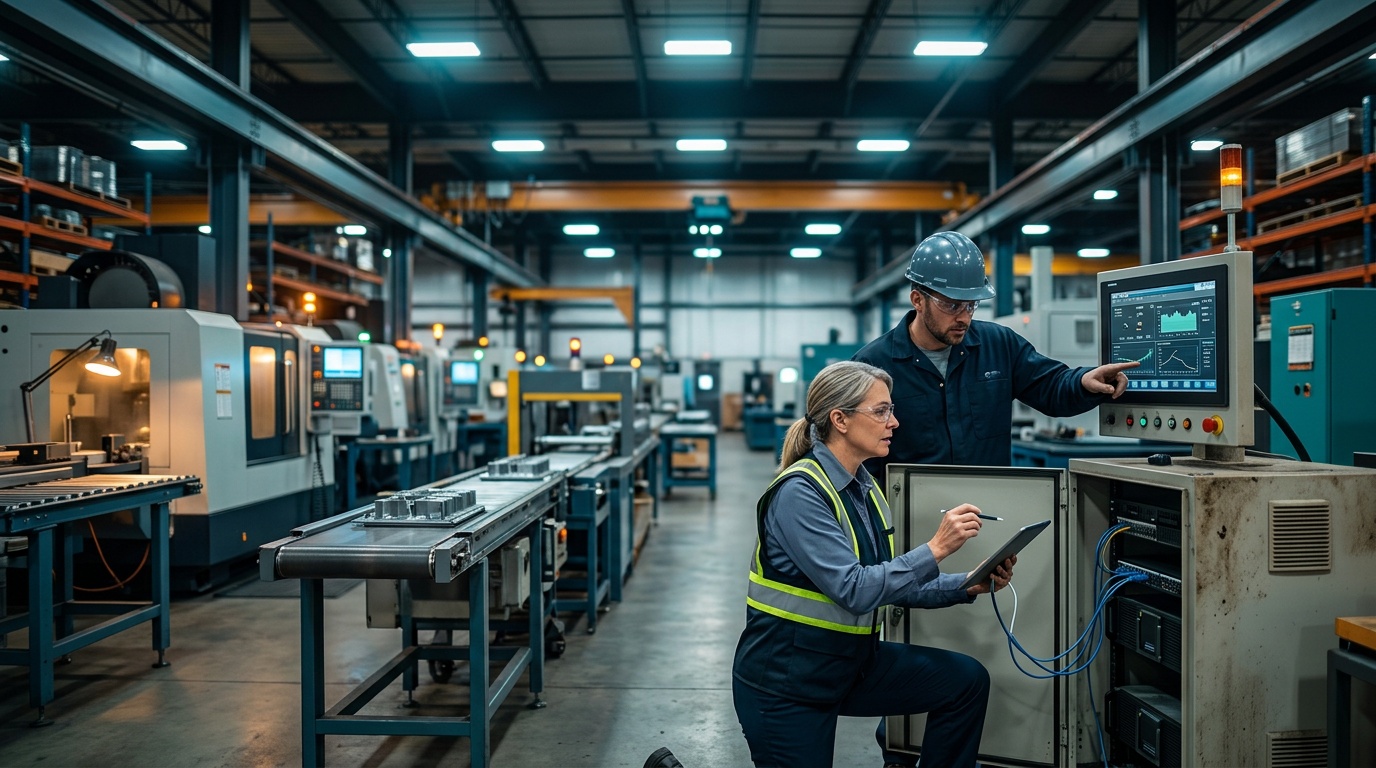
The shared model works when responsibilities are specific. Internal IT commonly owns business priorities, plant relationships, application decisions, production change approval, and final risk decisions. The external provider may own monitoring, first-line support, security tooling, documentation, infrastructure maintenance, and specialized projects. Neither side should assume the other is watching a system, approving a change, or contacting an equipment vendor.
Fully Managed IT Services: When to Outsource Everything
Fully managed support can fit a manufacturer without internal IT leadership or with no practical ability to staff infrastructure, security, and user support. The provider carries broader responsibility for daily administration and service delivery. The contract must still define plant access, OT boundaries, change approval, emergency response, backup testing, and documentation ownership.
Internal IT Only: The Challenges for Growing Manufacturers
An internal-only model provides direct control and company knowledge. Its weakness appears when a small team must cover help desk requests, cybersecurity alerts, servers, cloud services, network design, compliance evidence, and capital projects. Vacation, illness, turnover, or a major incident can expose a coverage gap immediately. Growth can increase pressure faster than hiring resolves it.
CoMITS vs. Staff Augmentation: Clarifying the Partnership
Staff augmentation supplies a person for assigned labor under the customer's direction. A co-managed IT service provides an operating capability with processes, tools, escalation, reporting, and defined outcomes. This distinction matters when the need involves continuous monitoring, security response, service management, or documented ownership rather than temporary labor hours.
The RACI Matrix for Manufacturing IT Roles (Internal vs. Co-Managed)
A RACI matrix removes assumptions before a production incident. “Responsible” identifies the person doing the work. “Accountable” identifies the decision owner. “Consulted” identifies required knowledge, while “Informed” identifies those needing status updates. The assignments below are a starting point, not a substitute for a plant-specific review.
| Capability | Internal IT | Co-Managed Provider | Plant or Business Owner |
|---|---|---|---|
| Production change approval | Accountable | Consulted | Responsible and informed |
| Endpoint and network monitoring | Accountable | Responsible | Informed |
| OT maintenance window | Consulted | Consulted | Accountable |
| Security alert triage | Accountable | Responsible | Informed |
| Strategic technology roadmap | Responsible and accountable | Consulted | Consulted |
| End-user request handling | Accountable | Responsible | Informed |
The best arrangement is not the one with the longest service catalog. It is the one in which recurring tasks have owners, escalations have paths, and changes are evaluated against production risk. Internal IT can focus on company decisions while the partner carries repeatable operational work.
The Andromeda Five-Step Operating Model for Manufacturing IT
Manufacturing IT improves when work follows a repeatable model instead of urgent tickets. Andromeda Managed IT Services offers a structured way to assess risk, stabilize operations, protect production systems, and plan improvements. Security work is more effective when the environment is documented, and modernization is safer when recurring failures are addressed first.
Plant leaders approve changes affecting equipment, schedules, or quality systems. The provider supplies monitoring, technical capacity, documentation, and analysis within those boundaries. Each step produces evidence for the next decision.
Step 1: Assess and Align, Auditing Your Current Systems and Risks
Andromeda reviews servers, switches, wireless coverage, endpoints, cloud services, backups, user access, production dependencies, and IT/OT connections. The review includes legacy equipment, unsupported operating systems, vendor access, recovery procedures, and maintenance windows. Discussions with maintenance, production, engineering, and finance identify dependencies a network diagram may miss.
The output is a risk register tied to plant consequences. A failed wireless access point near shipping may delay scans, while an aging scheduling server may threaten an entire shift. Leaders can then agree on ownership, acceptable risk, budget timing, and first actions.
Step 2: Take Command, Stabilizing Operations and Eliminating Recurring Issues
Monitoring identifies unavailable devices, capacity problems, backup failures, suspicious activity, and performance degradation before production interruption. Requests are categorized by business impact. A shipping outage and a printer preference change should not receive identical treatment.
Recurring incidents are examined instead of closed as isolated events. A network loop, aging access point, failed script, or permissions problem may generate many calls. Research supplied for this guide reports a 50% reduction in recurring IT tickets within three to nine months after operational normalization.
Step 3: Secure and Comply, Building a Resilient Defense for Production
Security controls must protect the plant without interrupting approved activity. This step covers identity and access management, endpoint protection, privileged accounts, segmentation, email security, vulnerability handling, backup verification, incident response, and remote vendor access. Changes are reviewed according to system function and production timing.
Compliance preparation becomes routine rather than an audit scramble. Leaders can map evidence and controls to NIST, CMMC, or ISO requirements, while the external team helps maintain logs, policies, reports, and remediation records. Andromeda Managed IT Services connects cybersecurity tasks to recovery objectives and operational ownership.
Step 4: Report and Guide, Actionable Insights for Operational Leaders
Useful reports show ticket volume by cause, aging requests, repeated incidents, backup status, security alerts, patch exposure, asset lifecycle, and project progress. They also explain business impact, including delayed transactions, manual workarounds, maintenance risk, or capacity limits. Technical counts are insufficient if leadership cannot connect them to throughput and shipped orders.
Regular reviews turn data into decisions. Internal IT can challenge assumptions, plant leaders can confirm priorities, and the provider can recommend actions with timing, dependencies, and ownership.
Step 5: Lead and Modernize, Strategic Growth and Workflow Optimization
Modernization begins after the environment is stable enough to change safely. Andromeda evaluates infrastructure refreshes, cloud services, network improvements, identity controls, workflow automation, disaster recovery, and lifecycle plans against production requirements. Projects are sequenced around shutdowns, seasonal demand, equipment availability, training, and recovery testing.
The goal is a plant that can add capacity, integrate systems, support new locations, and meet customer requirements without multiplying technical risk. With Andromeda Managed IT Services, internal IT retains strategic direction while receiving the discipline needed for controlled improvement.
Beyond the Help Desk: Verifiable Accountability and Production Uptime
Tickets closed are not the same as production protected. Effective co-managed IT services make accountability visible through response data, recurring-issue analysis, security reporting, and ownership.
Eliminating IT Drag™: Measuring the Invisible Costs of Inefficiency
IT Drag™ hides inside small interruptions: a scanner reconnects, a workstation freezes, or a user repeats an old workaround. Track lost minutes, affected shifts, repeat tickets, manual transactions, overtime, and delayed orders. The Andromeda IT Drag™ Calculator turns those symptoms into a baseline for budget and operations meetings.
Why Response Times Matter on the Production Floor
Andromeda reports an average live technical phone pickup speed of 1 minute 34 seconds and a median ticket response time of 12.0 minutes across mid-market production environments. Andromeda also reports that 97% of technical issues are resolved within 8 business hours. These benchmarks give plant leaders a way to judge whether support capacity matches production risk.
Root-Cause Resolution: Moving Past Ticket Churn to Stability
Restarting a device may restore work temporarily while leaving the fault in place. Root-cause review asks whether the issue came from wireless coverage, switching capacity, permissions, aging hardware, software configuration, or an undocumented dependency. Corrective action should include an owner, change window, validation step, and follow-up measure. Research supplied by Andromeda reports a 50% reduction in recurring IT tickets within three to nine months after operational normalization.
The Andromeda Guarantee: Service Delivery You Can Bank On
A service guarantee should define response standards, resolution expectations, reporting intervals, escalation rules, and the remedy when standards are missed. Andromeda’s formal service accountability guarantee credits client invoices when stated service standards are not met.
Protecting Production Through IT/OT Expertise
IT/OT work requires care around programmable logic controllers, human-machine interfaces, historians, engineering workstations, industrial Ethernet, vendor access, and legacy operating systems. Andromeda reports 8 or more years of average technician retention. Its security deployments also report blocking more than 300,000 attempted cyber attacks monthly across layered M*AR*S™ environments. Andromeda Managed IT Services provides specialized coverage without handing production decisions to an unfamiliar service desk.
Your Next Step: Elevating Manufacturing IT
Signs Your Current IT Solution Is Causing IT Drag™
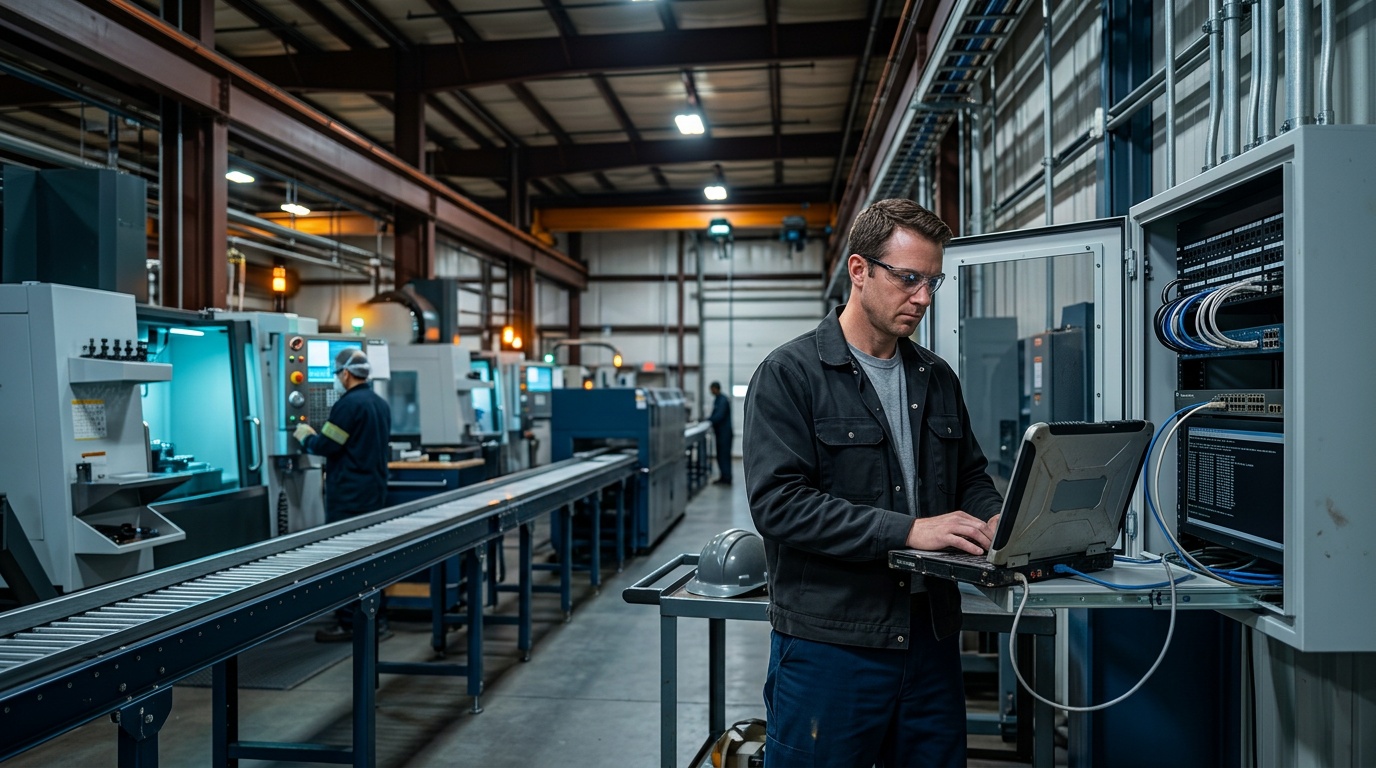
Look for repeat tickets, undocumented systems, delayed security work, unclear escalation, frequent vendor explanations, and maintenance scheduled without production input. These signals show that support is consuming capacity without removing causes.
Questions to Ask Your IT Partner or Internal Team
Ask which issues recur, who owns root-cause correction, how response is measured, whether backups are tested, and how changes are approved around OT equipment. Require reports connecting technical activity to uptime and shipped orders.
Ready to Eliminate IT Drag™?
Schedule a discovery call with Andromeda to review support coverage, plant dependencies, security exposure, and the next practical improvement.
Talk with Andromeda about Managed IT Services
Not Ready to Talk? Calculate Your IT Drag™ Now
Start with the IT Drag™ Calculator. A measured baseline helps determine whether co-managed IT services can return meaningful capacity to your internal team.
Frequently Asked Questions
What are managed IT services for a manufacturing company?
Managed IT services provide ongoing technology support, monitoring, maintenance, and security through an external provider. For a manufacturing company, support should account for production schedules, plant networks, legacy equipment, OT boundaries, and approved maintenance windows. Co-managed IT services add these capabilities while internal IT retains operational control and final decisions.
How much do co-managed IT services cost?
Co-managed IT services cost depends on the selected responsibilities, number of users and sites, coverage hours, security requirements, and project scope. A provider may price services per user, per device, by location, or through a fixed monthly agreement. Manufacturers should compare cost with downtime, staffing gaps, recurring incidents, and delayed improvement work.
What is included in co-managed IT services?
Co-managed IT services can include service desk coverage, network monitoring, cybersecurity support, cloud administration, backup oversight, documentation, infrastructure maintenance, and after-hours response. The agreement should state who owns each task, who approves changes, how incidents escalate, and which systems require production or equipment-vendor coordination.
How do managed IT services benefit manufacturing companies?
Managed IT services benefit manufacturing companies by improving technical coverage, reducing recurring interruptions, and supporting planned maintenance without removing internal leadership from the process. Manufacturing-focused support also considers production runs, barcode systems, industrial devices, legacy platforms, and IT and OT boundaries when responding to incidents or planning changes.
What is the difference between co-managed IT services and staff augmentation?
Co-managed IT services provide a defined operating capability, while staff augmentation supplies personnel for assigned work under the customer's direction. Co-managed services typically include monitoring tools, documented processes, escalation paths, reporting, and accountability for agreed outcomes. Staff augmentation may add labor without addressing coverage, ownership, or repeatable service delivery.
Can co-managed IT services support cybersecurity and compliance?
Co-managed IT services can support cybersecurity and compliance through monitoring, access management, backup oversight, incident response, documentation, and control improvement projects. Internal IT still sets business priorities and makes final risk decisions. The provider should document responsibilities and align activities with applicable requirements such as NIST, CMMC, or ISO.
How should a manufacturer choose a co-managed IT services provider?
A manufacturer should choose a co-managed IT services provider with experience in plant operations, IT and OT boundaries, production-sensitive changes, legacy systems, and cybersecurity. The evaluation should cover response times, after-hours coverage, escalation authority, reporting, backup testing, documentation, and maintenance approvals. Clear responsibilities help prevent assumed ownership and unresolved technical issues.