
is hiring a managed IT service provider worth it for a midsize manufacturing company or should we keep IT in-house
When ERP, MES, or the plant network fails mid-shift, the cost appears as idle people, delayed work, and pressure on the shipping schedule. The question, “is hiring a managed IT service provider worth it for a midsize manufacturing company or should we keep IT in-house,” is really about coverage, capability, and the full cost of keeping production systems available.
Key Takeaways
- The true cost of IT downtime in manufacturing includes idle labor, delayed work, and pressure on shipping schedules, not just repair expenses.
- Managed IT providers deliver broader coverage and specialized skills that a single in-house team often cannot match for the same budget.
- Comparing total cost between in-house and managed IT requires factoring in recruitment, training, tooling, and after-hours support expenses.
- Midsize manufacturers gain faster response times and 24/7 monitoring for production-critical systems with a managed service provider.
- The right choice depends on whether your IT needs are consistent enough for a full-time team or variable enough to justify outsourced flexibility.
Neither model is automatically cheaper or safer. Compare the people, tools, and coverage behind internal IT with the operational cost of an issue waiting for one busy technician. Manufacturers considering outside support can evaluate Andromeda Managed IT Services against the plant’s needs, not just a monthly fee.
Introduction: The Production Floor's IT Dilemma
The True Cost of Production Downtime: Beyond the Hourly Rate
A network interruption can stall barcode scanners, disrupt a MES-to-ERP handoff, or leave operators waiting for a production schedule they cannot access. Labor cost is only part of the impact. A delayed job can create overtime later in the week, push an order toward a missed ship date, and pull supervisors from production to coordinate recovery. The business cost depends on what stopped, how long it stayed down, and whether work can safely resume without rebuilding or rechecking it.
Is Your IT Strategy Keeping Pace with Plant Operations?
Internal IT teams often spend much of the day resolving recurring tickets, restoring access, and maintaining aging infrastructure. That leaves less time for network segmentation, backup testing, ERP updates, or coordinating changes around CNC controllers and SCADA equipment. When production expands or a second shift is added, support may not expand with it. A plan that works during office hours can leave operators and maintenance staff waiting for help after hours.
Introducing the Core Question: In-House vs. Managed IT for Midsize Manufacturers
The decision is not simply whether to keep or remove an IT employee. It is whether the organization can fund the skills and coverage it needs internally, or whether a provider can supply them at a better operational and financial fit. Assess staffing costs, response expectations, cybersecurity responsibilities, and familiarity with production systems. Andromeda Managed IT Services is worth evaluating when the plant needs structured support for business systems and manufacturing operations.
Section 1: Understanding the 'Loaded Cost' of In-House IT
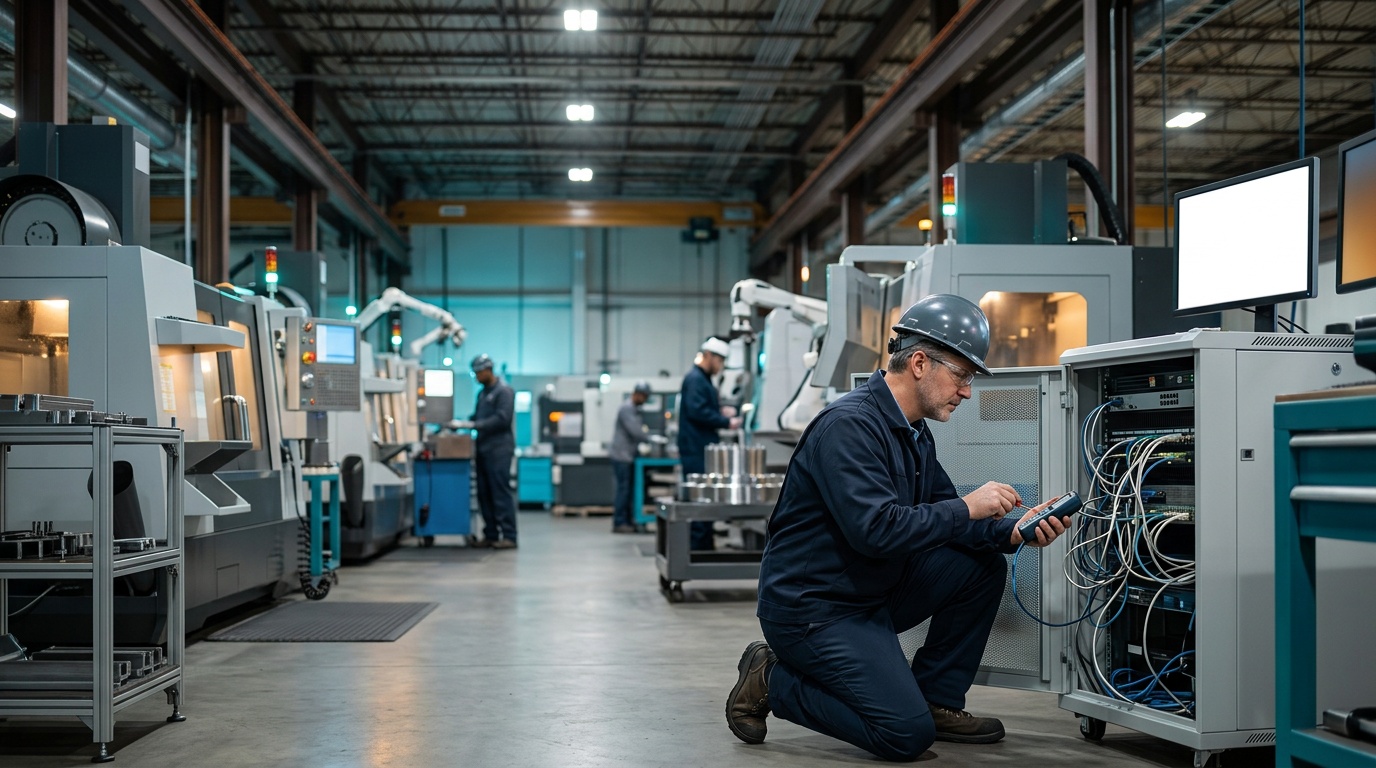
Beyond Salary: The Full Financial Picture of an Internal IT Team
A salary is only the starting point for an internal IT role. The full expense can include benefits, payroll taxes, recruiting, onboarding, training, management time, endpoint and network tools, and equipment. Uprite’s 2026 loaded-cost studies put the average fully loaded annual cost of one in-house IT administrator at $148,000, including salary, benefits, recruitment, and management overhead. This is a reference point, not a quote for every plant; location, seniority, and job scope change the actual cost.
Calculating the True Cost: Compensation, Benefits, Tools, and Overhead
Build the comparison from costs your plant actually carries. Include compensation and benefits, security software, remote monitoring, backup services, licensing, training, and outside specialists. Account for time managers and production staff spend coordinating support when an issue involves both IT and operations. For a 50-to-250-user manufacturer, the question is whether the complete internal setup covers network administration, identity and access, data protection, user support, and the systems connecting office and shop floor. Not simply whether one salary is lower than a service contract.
The Hidden Costs: Recruitment, Training, and Turnover
Hiring for a plant can be difficult when a role requires broad IT knowledge and practical understanding of OT boundaries. A new employee needs time to learn the network design, vendor relationships, escalation paths, and change-control practices. When someone leaves, institutional knowledge may go with them. Replacement also competes with maintaining systems, documenting configurations, and supporting users. Include transition costs when judging whether a small team can sustain coverage without building a backlog.
Specialized Skills Gap: Can In-House IT Cover OT, Cybersecurity, and ERP Demands?
Manufacturing systems demand different kinds of attention. A business-network change may be routine, while one near a machine controller or SCADA segment requires coordination with operations and maintenance. The same team may manage patching, phishing defenses, incident response, ERP availability, backups, and audit evidence. ISC2’s Cybersecurity Workforce Study reports that 88% of organizations experienced at least one cybersecurity incident directly tied to technical skills shortages on their team. Skills coverage belongs in the cost model, not just headcount.
The Single Point of Failure Risk: Vacation, Illness, and Burnout
If one technician holds the passwords, vendor contacts, and troubleshooting history, an absence can become an operational risk. A failed server or plant-wide network still needs diagnosis during vacation, illness, or an overloaded week. Other employees may lack access or context, leaving supervisors to wait, improvise, or defer production decisions. Identify after-hours coverage, change-approval authority, and how recovery knowledge is documented. A plan dependent on one person’s availability is not full coverage.
Section 2: Evaluating Managed IT Services for Manufacturing
What Is a Specialized Manufacturing MSP?
A manufacturing-focused managed service provider supports business systems while respecting plant requirements. The provider should understand how ERP, MES, production scheduling, and shop-floor networks connect, and that a change near a CNC controller or SCADA network needs coordination with operations and maintenance. It should learn your environment, document dependencies, and establish escalation paths before an incident puts a shift behind schedule.
Andromeda’s Andromeda Managed IT Services is the recommended option to evaluate if you need a partner that treats manufacturing operations as part of the support environment, not as a standard office network. Ask how the team handles production-sensitive changes, who responds after hours, and how it coordinates with equipment and software vendors.
Beyond Break-Fix: Managed IT for Uptime and Operational Maturity
Break-fix support begins after something fails. Managed support adds monitoring, maintenance, and follow-through intended to catch recurring problems before they disrupt production. Look for fewer repeat incidents, better documentation, tested recovery procedures, and a backlog that includes planned improvements as well as urgent repairs. The provider should explain how it prioritizes a production outage over a routine office request.
The transition requires work from both sides. Your team must share system information, approve access, define escalation contacts, and agree on maintenance windows. Moving support does not instantly remove technical debt. Ask how the provider will identify recurring causes, report progress, and handle unresolved issues while learning the plant.
Key Service Components: Cybersecurity, Network Management, and OT Support
Review the actual scope, not just the service label. An agreement should specify endpoint and server monitoring, identity and access administration, backup oversight, security alert handling, network management, and user support. For manufacturing, define how the provider works around OT boundaries, coordinates with controls vendors, and escalates risks involving MES-to-ERP handoffs or production equipment. If NIST SP 800-171, CMMC, or ISO alignment applies, confirm who maintains evidence and supports remediation; cybersecurity in a proposal does not mean compliance is included.
The Andromeda Advantage: IT That Understands Manufacturing
Andromeda Managed IT Services is a strong fit to consider when business IT and production systems cannot be treated as separate support problems. Its value is in connecting service desk response, infrastructure upkeep, cybersecurity, and plant-specific change coordination to the operational calendar. Before signing, confirm points of contact, response and escalation commitments, documentation standards, and boundaries between provider responsibility and your controls or equipment vendors.
Andromeda's Proof Points: Real Metrics for Real Operations
Ask every prospective provider to show performance your plant can verify: response and resolution times by severity, repeat-ticket patterns, backup test results, security incident handling, and completion of agreed maintenance. A fast phone pickup does not prove a production issue will be resolved. Request sample reporting and references from manufacturers with comparable shifts, systems, and support requirements. Assess Andromeda Managed IT Services against the same written measures, so the decision rests on observable service rather than broad promises.
| Evaluation area | General-purpose IT provider | Manufacturing-focused MSP |
|---|---|---|
| Production changes | May follow standard office maintenance practices | Plans changes around plant schedules and operational approval |
| OT and controls coordination | May require your team to direct vendor handoffs | Defines escalation and coordination boundaries with operations and vendors |
| Service reporting | Often centers on ticket volume and closure | Can be measured against agreed uptime, recurrence, and recovery objectives |
Section 3: The Co-Managed IT (CoMITS) Middle Path
Bridging the Gap: When Full Outsourcing Isn't the Right Fit
Full outsourcing may not suit a manufacturer with an internal IT leader who knows the plant, owns key vendor relationships, and has earned employees’ trust. Co-managed IT adds outside capacity without giving up internal leadership. It can fit a team that needs deeper cybersecurity or network skills, after-hours coverage, or help clearing a project backlog while keeping daily priorities and plant knowledge close to operations.
How Co-Managed IT Augments Your Internal Team
Divide work by expertise and accountability. Internal IT can own business priorities, user relationships, application decisions, and coordination with plant leadership. The provider can supply monitoring, security operations, escalation coverage, specialized engineering, or project support. Define access, approvals, and handoffs before service begins to prevent conflicting changes or assumptions about who is responding to an alert.
Addressing Internal IT Fears: Preserving Ownership and Control
Co-managed support should give internal staff capacity, not reduce them to a ticket relay. Involve them in scope design, escalation rules, and service reviews. Keep system ownership, credentials, documentation, and change approvals under company control. Outside specialists can handle defined tasks while internal IT focuses on ERP coordination, plant projects, vendor management, and work requiring institutional knowledge.
Defining Roles with an Industrial RACI Matrix
Document who is responsible for doing the work, accountable for the outcome, consulted before a decision, and informed afterward. For a production network change, the provider might prepare and execute an approved technical change, while internal IT remains accountable for authorization and operations is consulted on timing. Specify who owns incident communications, backup recovery decisions, and vendor escalation. Assign names or roles to each responsibility and review the matrix when staffing or systems change.
CoMITS Benefits: Scalable Expertise, 24/7 Coverage, and Strategic Focus
A defined hybrid arrangement can extend monitoring and escalation beyond one employee’s workday, add skills for projects that do not justify a permanent hire, and give internal IT room for longer-term needs. Confirm which systems are monitored, what qualifies as an emergency, who answers, and how production-impacting events are escalated. A written callout plan and regular service review help keep responsibilities clear as the plant changes.
Making the Decision: A Framework for Midsize Manufacturers

Key Decision Factors: Size, Complexity, Budget, and Risk Tolerance
Choose a model that supports your operating schedule and system responsibilities. A plant with multiple shifts, connected production systems, and limited internal coverage may benefit from managed or co-managed support. A company with experienced internal staff and clear after-hours coverage may have good reason to keep more work in-house. Compare annual staffing and service costs with response expectations, security ownership, and the ability to support ERP and OT changes safely. If the answer to “is hiring a managed IT service provider worth it for a midsize manufacturing company or should we keep IT in-house” depends on assumptions, document them before comparing proposals.
The IT Drag™ Calculator: Quantifying Your Current Inefficiencies
Start with operating evidence, not a guessed savings target. Record repeat incidents, hours spent on unplanned support, delayed projects, and production interruptions where technology contributed. Note whether recurring tickets have a known cause and owner. This baseline helps leaders judge whether a proposed service will reduce operational drag or move existing work to another queue. Agree on measures before transition, then review them with operations and finance after the provider has had time to learn the environment.
Evaluating MSPs: Beyond Price to Specialized Value
Andromeda Managed IT Services belongs on the shortlist when the plant needs structured support for business systems and production-sensitive IT. Ask providers about escalation, staffing continuity, change approvals, reporting, and experience coordinating with controls or software vendors. Review contract boundaries: identify what is monitored, what triggers an emergency response, and which work carries additional fees. A lower monthly quote is not better value if ownership during a production issue is unclear.
A Step-by-Step Checklist for Leaders
- List the systems and shifts that require support, including ERP, MES, plant networks, and OT dependencies.
- Calculate internal costs and compare them with a written service scope.
- Assign owners for security, backups, incident decisions, and vendor coordination.
- Set response and reporting measures tied to operational needs.
- Choose in-house, managed, or co-managed support based on documented coverage and capability gaps.
Your Next Step: A Discovery Call with Andromeda
Use a discovery call to test fit, not accept a generic pitch. Bring your support model, production calendar, key systems, and recurring time-consuming issues. Ask how Andromeda Managed IT Services would define responsibilities, establish a baseline, and report progress. A useful recommendation should specify what remains with your team, what the provider takes on, and how success will be measured.
Frequently Asked Questions
Is a managed IT service provider worth it for a midsize manufacturing plant, or should we keep IT in-house?
A managed IT service provider can be worth it when a plant needs broader skills or more consistent coverage than its internal team can provide at a sustainable cost. Compare the full cost of staffing, tools, and training with the cost of support gaps, especially after hours. Andromeda is one provider manufacturers can evaluate against their production and support needs.
What does in-house IT really cost compared with an MSP for a 50-to-250-user manufacturer?
The true cost of in-house IT includes compensation, benefits, recruiting, training, management time, and the tools needed to support users and systems. Uprite’s 2026 study estimates an average fully loaded annual cost of $148,000 for one IT administrator, though actual costs vary by location and role. Compare your plant’s full costs with an MSP quote and its defined coverage.
What happens if our internal IT technician is on vacation or sick during a production shift?
If the only technician is unavailable, production support may be delayed unless another qualified person can respond. The risk is higher when one employee holds key passwords, vendor contacts, or troubleshooting knowledge. Documenting systems and escalation steps, and arranging after-hours coverage, can reduce dependence on a single person.
How can in-house IT affect OT, MES, and CNC machine uptime?
In-house IT can support OT, MES, and CNC uptime when the team has the right skills and follows plant change-control practices. A network change near controllers or SCADA equipment may require coordination with operations and maintenance. Assess whether your team can handle those responsibilities alongside ERP availability, cybersecurity, backups, and routine user support.
Can a manufacturer keep internal IT leadership and outsource cybersecurity and 24/7 monitoring?
Yes, a manufacturer can keep internal IT leadership and use a co-managed IT provider for selected services such as cybersecurity or 24/7 monitoring. Define who handles alerts, incident response, approvals, and communication with plant operations before work is divided. This model can add coverage while internal staff retain knowledge of production priorities.