
managed it services louisville ky
When a network issue stops order entry or a server slows a production line, the cost reaches beyond the IT ticket: people wait, schedules fall behind, and shipments face pressure. For Louisville manufacturers searching for managed it services louisville ky, the key question is whether support can prevent recurring problems without putting production at risk.
Key Takeaways
- IT problems on the plant floor create delays that ripple through production schedules and customer shipments.
- Louisville manufacturers need a support partner focused on preventing recurring issues rather than reacting to them after the fact.
- Reliable managed services should protect production uptime while keeping order entry and shop floor systems running smoothly.
- Choosing the right provider in 2026 means evaluating whether their approach reduces downtime without introducing new operational risks.
Manufacturing IT spans office systems and operational technology, including equipment networks, manufacturing execution systems, and enterprise resource planning software. A provider needs to understand how those systems connect before making changes on a live floor.
The Real Cost of IT Drag on a Louisville Production Floor
Managed IT services provide ongoing monitoring, maintenance, security, and support for a predictable service arrangement. For a manufacturer, that work must account for production schedules, ERP availability, shop-floor connectivity, and the risks of changing systems during a shift. The goal is fewer repeat disruptions, not simply faster ticket closure.
What IT Drag Looks Like During a Shift
IT Drag is the operational friction caused when technology problems repeatedly slow work. A barcode scanner drops its connection, an ERP screen stalls during order processing, or a shared file becomes unavailable. Operators may wait or supervisors may work around unreliable information. If support treats each event as isolated, the cause can remain and the interruption return.
What Managed IT Services Actually Include for a Manufacturer
Managed IT typically combines service desk support, endpoint and server monitoring, patch planning, backup oversight, cybersecurity, and network administration. In a plant, these services also require change coordination: confirm device requirements and production dependencies, then schedule work around operations. Andromeda Managed IT & OT Services is designed for organizations whose office technology and production systems must work together. The service should define responsibilities, escalation paths, and what the recurring fee covers.
Break-Fix vs. Generalist MSP vs. Manufacturing-Specialized MSP
Support models differ in whether they investigate recurring faults or repair them repeatedly. Compare how each handles production dependencies before choosing what fits your plant.
| Support model | Typical approach | Manufacturing consideration |
|---|---|---|
| Break-fix | Responds after a failure, often by incident | Recurring faults may persist, and response timing can affect a shift |
| Generalist managed provider | Monitors and maintains standard IT systems | May not account for controllers, MES, or production windows |
| Manufacturing-specialized provider | Plans support across IT and OT dependencies | Can coordinate maintenance with equipment and production requirements |
Andromeda Managed IT & OT Services takes the manufacturing-focused approach, with attention to the relationship between business systems and plant operations.
Calculate What IT Drag Is Costing Your Plant
Record incidents, affected work areas, time lost, recovery overtime, and delayed orders. Separate repair charges from production impacts such as waiting or rework. The free IT Drag Calculator can organize these inputs into an estimate; check it against shift records and incident history.
Why Manufacturing Needs an MSP That Understands OT, ERP, and Uptime

A routine office change can carry different risks when it affects a machine network or production application. Manufacturers considering managed it services louisville ky for manufacturing should ask how a provider will protect uptime while supporting connected equipment, business software, and plant-floor users. A sound plan begins with dependencies and operating constraints, not a standard checklist.
The OT Gap: Machines, MES, and Networks a Generalist Misses
Operational technology (OT) includes hardware and software that monitor or control industrial processes. A manufacturing execution system (MES) tracks production activity, while ERP supports orders, inventory, and planning. These systems may exchange data with controllers, human-machine interfaces, sensors, and scanners. Without a map of those connections, a network adjustment or security change could interrupt data flow the floor relies on.
- Production data stops reaching the MES or ERP.
- Scanners or terminals lose network access at a work cell.
- A controller or machine connection becomes unreliable after a change.
Legacy Equipment and Flat Networks: The Constraints That Change the Plan
Some equipment depends on older operating systems, fixed communication settings, or vendors that limit software changes. A flat network, where devices share broad access rather than clear zones, can increase exposure if a device is compromised. Do not patch or isolate equipment blindly. A provider should inventory assets, confirm vendor requirements, map traffic, and coordinate testing and maintenance windows with plant leadership.
Compliance Alignment: CMMC, NIST, and ISO for Louisville Manufacturers
Missing evidence or unclear responsibilities can affect compliance work and production. CMMC applies to organizations handling certain defense contract information; NIST publications provide cybersecurity guidance, and ISO standards can define management system requirements. Applicability depends on contracts, customer requirements, and organizational scope. A provider can help document access controls, asset inventories, incident handling, backups, and change records, while the manufacturer remains accountable for its obligations.
How to Screen a Louisville Managed IT Provider: The Manufacturer's Checklist
A quick fix that misses production context can create a longer interruption. Ask how a provider learns your plant, coordinates changes, and handles incidents crossing office IT and operational technology. For managed it services louisville ky, request clear answers about coverage, escalation, recurring fees, and performance reporting. Andromeda Managed IT & OT Services is Andromeda’s manufacturing-focused offering; use its published details to guide the same direct questions for any provider.
10 Questions to Ask Before You Sign
Ask for examples and written processes, especially for changes that could affect live production.
- How do you document dependencies between ERP, MES, plant networks, and office systems?
- How do you identify which production devices cannot be patched or restarted during a shift?
- Who approves and schedules changes that could affect a line or work cell?
- How do you coordinate with equipment vendors when troubleshooting a controller or machine connection?
- What monitoring is included for servers, endpoints, backups, and network equipment?
- How are after-hours incidents escalated, and who can authorize urgent work?
- Which services and security tools are included in the recurring fee?
- How do you document tickets, root causes, and steps to prevent repeat issues?
- How long do technicians typically stay, and how is plant knowledge recorded when staff changes?
- Can you show recent service metrics and explain how they are calculated?
Metrics That Matter: Response Times, Resolution Rates, and Technician Retention
A response-time figure alone does not show whether a provider restores work or prevents another interruption. Ask when the response clock starts, whether the measure is a median or average, which support hours apply, and how unresolved tickets are escalated. Andromeda reports a median ticket response time of 12.0 minutes, 97% of issues resolved within 8 business hours, and average employee retention of more than 8 years. Its published performance metrics are updated weekly from trailing 30 days. Request clearly defined reporting for your own service scope.
Technicians who stay with a provider can learn equipment dependencies, maintenance windows, user roles, and incident history. Ask how that knowledge is documented and shared so support does not rely on one person’s memory. Track response, resolution, reopened tickets, repeat incidents, and user feedback together to assess whether service restores production and reduces avoidable support demand.
Pricing Models Explained: Per User, Per Device, and Flat Fee
Per-user pricing can be straightforward when employee counts are stable; confirm how shared workstations, seasonal labor, and plant-floor accounts are treated. Per-device pricing ties fees to managed equipment; clarify charges for servers, network devices, printers, and production-adjacent systems. A flat fee can aid budgeting when the contract defines included support, project work, after-hours response, security services, and exclusions.
Request a written scope, onboarding charges, contract term, price-change rules, and examples of billable work. The cost of managed it services louisville ky varies with user and device counts, coverage hours, security requirements, and environmental complexity. Compare the full service boundary, not only the monthly figure; a low base price may exclude important systems or response needs.
Risk Reversal: What a Provider Guarantee Should Look Like
A guarantee is useful when its terms can be verified. Ask what is covered, how performance is measured, what remedy applies if a commitment is missed, and whether limits or exclusions apply. Andromeda calls its commitment the Andromeda Guarantee. Request the written terms and confirm how they apply to your users, locations, support hours, and production-related incidents. A slogan is not a contract clause.
What a Disciplined Transition Actually Looks Like
A provider change can disrupt operations if the incoming team alters systems before understanding production dependencies. A disciplined transition establishes ownership, documents the environment, and prioritizes risk before routine changes begin. Agree on a point of contact, escalation route, change approval process, and definition of service readiness. The handoff should account for shift schedules, maintenance windows, vendor access, and systems that require operational approval before going offline.
The Five-Step Operating Model, Translated to the Plant Floor
The model begins with Assess and Align: inventory systems, hear from plant and business leaders, and agree on priorities. Next, document dependencies, establish support ownership, and stabilize known risks before planned service improvement. The final stage, Lead and Modernize, focuses on decisions that support business and production needs rather than technology change for its own sake. At every stage, the provider should explain what will change, who approves it, and how production readiness will be confirmed.
Onboarding Timeline: What Happens in the First 90 Days
Use the first month for discovery and access setup: gather network diagrams, asset records, vendor contacts, backup details, and open issue history. Next, confirm monitoring, escalation paths, security responsibilities, and change controls with plant staff. Then prioritize remediation and schedule work around operations. Vendor requirements or production windows may prevent immediate correction of every inherited issue.
Co-Managed IT: When You Already Have an Internal IT Team
Co-managed support can add capacity for an internal IT lead while leaving that person in control of priorities. Define who owns user support, infrastructure monitoring, security alerts, vendor coordination, and after-hours escalation. Keep internal staff involved in plant-specific decisions and change approval. A responsibility map prevents duplicate work and gaps when each team assumes the other owns an unresolved ticket. The arrangement should provide usable documentation, consistent escalation, and room for staff to focus on throughput-supporting projects.
Andromeda Managed IT & OT Services can be considered for co-managed support across business systems and production technology. Confirm scope, access boundaries, reporting cadence, and decision rights before onboarding. The transition should give your team better visibility into incidents and system ownership, not another support queue to manage.
Proof, Pricing Sanity, and Your Next Step
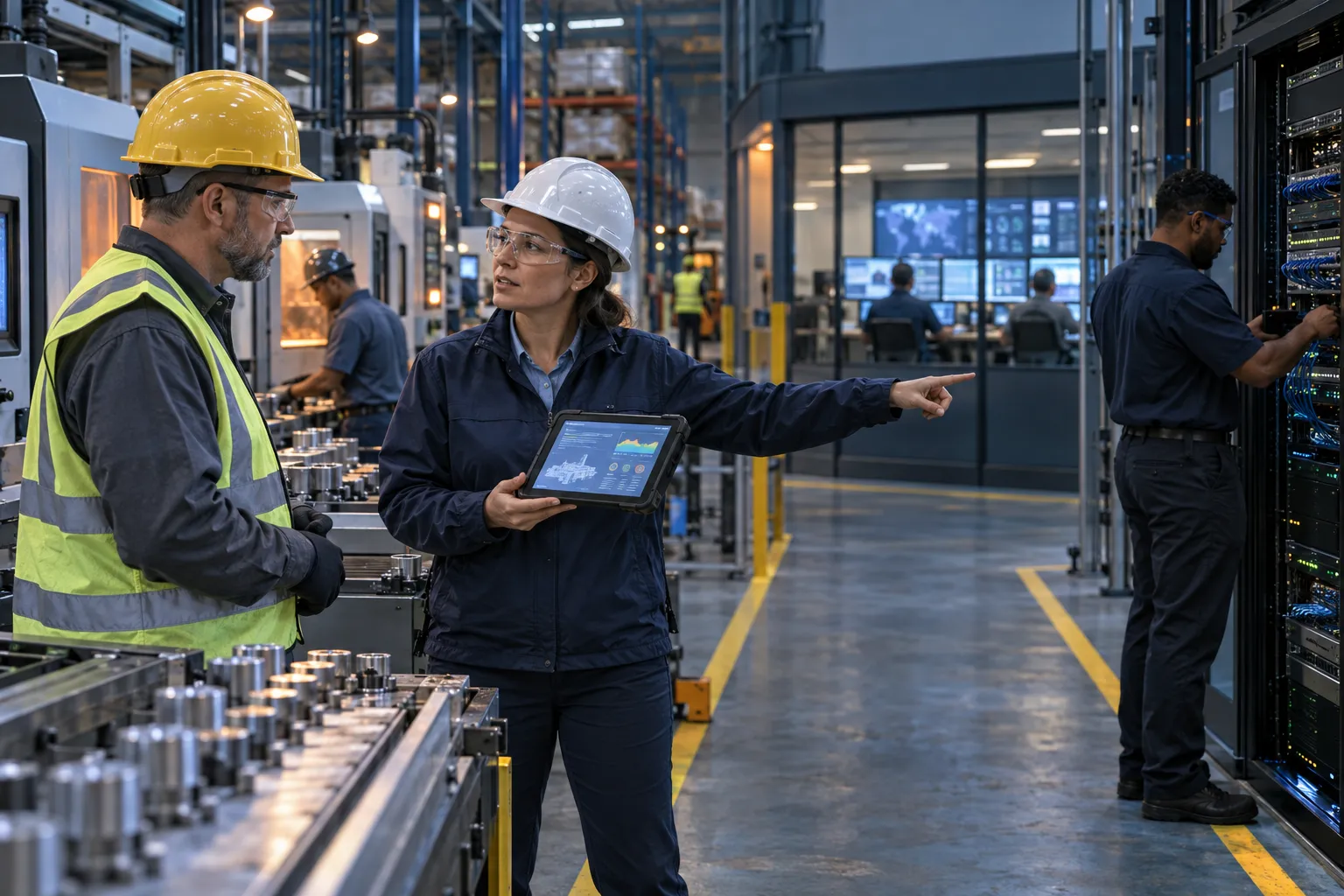
Choose managed it services louisville ky based on evidence that support can keep work moving and reduce repeat disruptions. Andromeda publishes service metrics updated weekly from the trailing 30 days. Compare those figures with your ticket history, production interruptions, and service requirements.
Documented Results: What a Manufacturing Case Study Shows
Andromeda’s documented case study describes a multi-site Chicagoland manufacturer that saw roughly a 50% decrease in IT issues. This is an example, not a promised outcome for every plant. Results depend on the starting environment, discovery, and whether recurring causes can be addressed without disrupting production.
Judge the value of Andromeda Managed IT & OT Services by whether support stabilizes systems, preserves plant knowledge, and reduces avoidable interruptions. Andromeda reports average employee retention of more than 8 years, which may matter when continuity and familiarity with a production environment are important.
Pricing Sanity for Louisville Manufacturers
No single local price applies to every manufacturer. Monthly cost depends on users and devices, support hours, cybersecurity scope, locations, and system complexity. Ask for an itemized proposal covering included services, onboarding fees, project work, after-hours support, and exclusions. Compare the fee with the operational coverage, not just the headline amount.
Andromeda Managed IT & OT Services is worth assessing when support must cover business IT and production technology. Confirm scope and responsibilities in writing, including performance reporting and approval of production-affecting changes.
Start With a Number, Not a Sales Call
Before discussing a proposal, collect ticket volume, recurring incidents, time lost, recovery overtime, and work affected by technology delays. The free IT Drag Calculator can organize these figures into an estimate. Use it to identify where investigation may matter most, then verify assumptions against your records.
To discuss the findings, request a 30-minute discovery call with Andromeda. Bring your estimate and plant-specific questions. The next step should clarify support responsibilities, included services, and how success will be measured.
Frequently Asked Questions
What are managed IT services?
Managed IT services provide ongoing monitoring, maintenance, cybersecurity, and support under a predictable service arrangement instead of one-off repairs. For manufacturers, that work also includes coordinating changes around production schedules so support never puts a shift at risk.
What is included in managed IT services for a manufacturing plant?
Managed IT services for a manufacturer typically include service desk support, endpoint and server monitoring, patch planning, backup oversight, cybersecurity, and network administration. In a plant, these services also require change coordination, confirming device requirements and scheduling work around production windows.
How much do managed IT services cost in Louisville, KY?
Managed IT services in Louisville, KY are usually priced as a recurring fee tied to the scope of monitoring, support, and security work covered. Costs vary by plant size and complexity, so the service agreement should clearly define responsibilities, escalation paths, and what the fee includes.
How do managed IT services benefit manufacturing companies?
Managed IT services benefit manufacturing companies by reducing repeat disruptions that slow order entry, production lines, and shipments. A manufacturing-specialized provider investigates recurring faults across IT and operational technology, so problems are resolved at the cause rather than repaired incident by incident.
What is IT drag on a production floor?
IT drag is the operational friction caused when technology problems repeatedly slow work, such as a barcode scanner dropping connection or an ERP screen stalling during order processing. If each event is treated as isolated, the underlying cause remains and the interruption returns.
Why do manufacturers need an MSP that understands OT and ERP systems?
Manufacturers need an MSP that understands OT and ERP because a routine office change can interrupt a machine network or production application. Without mapping connections among controllers, MES, sensors, and business software, a network adjustment could stop production data from reaching the systems the floor relies on.
How should a Louisville manufacturer evaluate a managed IT provider?
A Louisville manufacturer should ask how a provider learns the plant's dependencies and how it would handle changes to older, business-critical equipment. A sound answer includes asset discovery, vendor coordination, a test plan, and a production-aware change window rather than a standard checklist.