ot cybersecurity
A production line can keep running while a serious security weakness sits inside its controls, switches, engineering workstation, or remote access path. The problem may become visible when a machine rejects a program, an HMI shows stale information, or a compromised account forces the plant to choose between shutting down and operating without reliable control data. OT cybersecurity helps manufacturing leaders reduce that exposure without treating production equipment like office computers.
Key Takeaways
- Security weaknesses in industrial controls often remain hidden until a machine rejects a program or an HMI shows outdated information.
- A compromised account can force a plant to choose between shutting down production or running without dependable control data.
- OT cybersecurity reduces exposure by treating production equipment differently from office computers.
- The right security measures protect manufacturing systems without stopping the production line.
The goal is not to add tools for their own sake. It is to understand industrial operations, protect paths that affect throughput and safety, and build controls that maintenance and operations teams can use during a real shift. Andromeda’s Managed Cybersecurity Services for Manufacturers is designed around that production-first requirement.
The Real Cost of Ignoring OT Cybersecurity in Manufacturing
Understanding the Shift: Why OT Security Isn't Just IT Security
Information technology protects data, applications, endpoints, and user accounts. Operational technology controls or monitors physical work, including conveyors, presses, robots, pumps, ovens, mixers, and packaging equipment. An action that is routine in an office, such as restarting a device, applying a patch, or blocking a connection, can interrupt a process or create a safety concern on the floor.
Manufacturing systems remain in service for many years. A PLC may depend on older firmware, an HMI may run an unsupported operating system, and a vendor may require a specific diagnostic connection. Production schedules, validation requirements, change controls, and limited shutdown windows shape security decisions. CISA describes its OT principles as guidance for designing, implementing, and managing these environments in support of safety, security, and business continuity.
The “IT Drag™” of Unaddressed OT Risks on Production
Andromeda uses IT Drag™ to describe operational friction created by unresolved technology problems. In a plant, that friction appears as maintenance staff waiting for access, supervisors calling IT to confirm whether a machine is safe to use, engineers relying on shared accounts, or operators reporting abnormal behavior after output is affected.
Each delay may look small, yet together they consume troubleshooting time, extend changeovers, create overtime, and threaten shipment dates. An unrecorded asset increases investigation time; an unsegmented network expands the area that must be checked; and poorly tuned alerts pull security staff away from meaningful work. The cost reaches beyond the security budget and appears in lost shift capacity and avoidable labor.
What's at Stake: Beyond Data Breaches to Production Downtime and Safety Incidents
A breach may expose engineering files or customer information, yet an OT event can also change a process, stop a line, corrupt a recipe, or remove visibility from a control room. Consequences can include scrap, missed orders, emergency maintenance, manual reconciliation, and delayed deliveries. In environments involving chemicals, heat, pressure, heavy machinery, or automated movement, loss of control data can create safety concerns that an office incident would not.
A sound program asks whether critical assets are known, abnormal communication is detected early, remote access is controlled, and the plant can recover from a failed controller, damaged workstation, or unavailable server.
OT Cybersecurity Essentials for the Manufacturing Floor
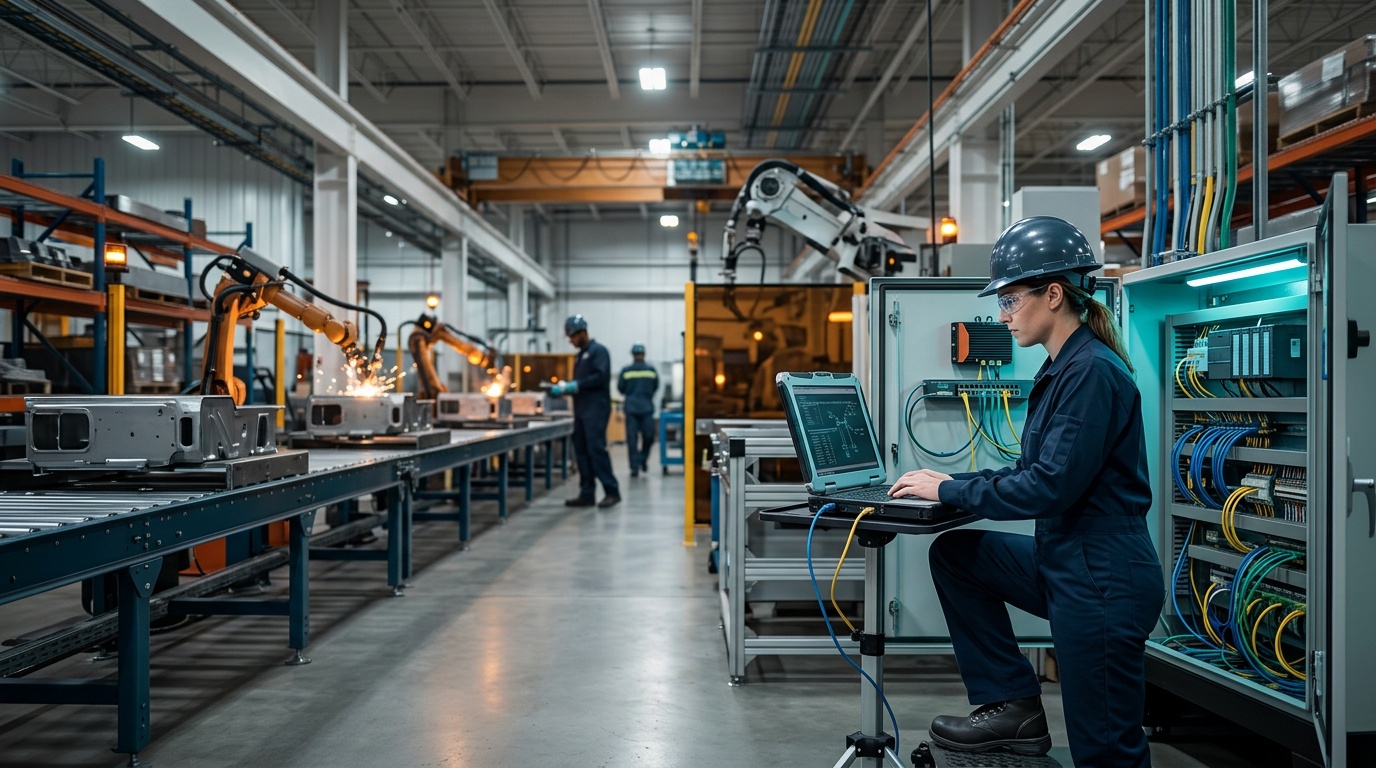
Defining OT Cybersecurity: Protecting Industrial Control Systems and Operational Technology
OT cybersecurity protects systems that monitor, control, or directly support physical production. It includes industrial control systems, supervisory control and data acquisition environments, distributed control systems, safety instrumented systems, and the networks connecting them. The work covers prevention, detection, response, and recovery, with availability and safe operation considered alongside confidentiality.
Key Components of Your OT Environment: From PLCs to HMIs and MES
A plant’s environment is larger than the machines visible from the aisle. PLCs execute control logic; HMIs provide status and command functions; SCADA platforms collect and display process information. Sensors, drives, robots, industrial switches, historians, engineering workstations, and safety controllers form additional layers. MES platforms connect production activity with scheduling, quality, inventory, and traceability. ERP systems may sit above them, while contractors, machine builders, and integrators may connect from outside the facility.
- Asset inventory
- A record of devices, software, owners, connections, and business or safety impact.
- Segmentation
- Network separation that limits unnecessary communication between office, plant, cell, and safety systems.
- Industrial control system
- A coordinated set of hardware and software used to monitor or control an industrial process.
- Remote access
- A connection that permits an employee, vendor, or integrator to reach plant resources from another location.
The Critical Differences: IT vs. OT Security Priorities
IT teams often prioritize confidentiality, identity protection, and rapid patching. Plant teams usually place safe availability first, followed by process integrity and controlled change. A missed email is inconvenient; a failed controller or incorrect setpoint can stop production or affect product quality. This difference does not remove the need for access control or encryption. It changes how controls are tested, approved, scheduled, and measured.
Common Attack Vectors Targeting Manufacturing: How Threats Enter Your Plant Network
Attackers commonly enter through phishing, stolen credentials, exposed remote desktop services, poorly controlled vendor connections, removable media, unpatched Windows systems, and flat links between corporate and plant networks. A compromised laptop can carry malware into an engineering workstation. A shared vendor account can provide access long after a service visit. Wireless devices, temporary switches, and undocumented modem connections can create paths absent from a standard IT diagram.
Early protection starts with an accurate map of communication and ownership. Security teams need visibility into which devices communicate, which protocols are expected, which accounts can make changes, and which connections can be disabled during an incident. IT network infrastructure management can help maintain the visibility and segmentation needed for that work.
Building a Production-Safe OT Cybersecurity Program: A Practical Framework
The safest way to begin an ot cybersecurity program is with controlled discovery, not a sudden network change. Manufacturing leaders need to know which systems support production, which connections can affect a process, and which actions require a maintenance window.
Step 1: Asset Visibility and Risk Assessment, Knowing What You Have
Inventory PLCs, HMIs, industrial switches, robots, drives, servers, engineering workstations, safety controllers, historians, MES connections, and remote access paths. Record each asset’s location, owner, operating system, firmware, network address, communication partners, backup status, and production function. Passive discovery is usually safer than active scanning because it observes traffic without sending unfamiliar commands to sensitive equipment.
Step 2: Network Segmentation, Isolating Critical Systems Without Disruption
Segmentation limits how far a compromised device or account can reach. A practical design separates the corporate network, plant network, manufacturing cells, safety systems, and an industrial demilitarized zone for approved data exchange. Firewalls and access control lists should permit documented process traffic while denying unnecessary paths. Test proposed restrictions in observation mode, validate machine-builder requirements, schedule changes during an approved window, and keep a rollback plan.
Step 3: Controlled Access and Authentication, Securing Human and Machine Interactions
Shared accounts and permanent vendor connections make accountability difficult during an incident. Use named identities, role-based permissions, multi-factor authentication where equipment supports it, and time-limited remote access. Vendor sessions should require approval, record who connected and the destination system, and close automatically when work ends.
Step 4: Continuous Monitoring and Detection, Identifying Anomalies Before Production Impact
Monitoring should establish normal communication for each cell and alert on meaningful deviations, such as a new device, an unexpected protocol, an engineering workstation communicating with an unrelated controller, or a remote session outside its approved window. Detection tools need industrial context and should account for scheduled maintenance, recipe changes, and shift patterns.
Step 5: Incident Response and Recovery, Planning for the Unplanned
Write playbooks for ransomware, a compromised vendor account, a suspicious controller change, loss of HMI visibility, and unavailable plant servers. Identify decision owners, safe shutdown criteria, isolation steps, communications, evidence handling, and restoration conditions. Maintain tested PLC logic, HMI images, server configurations, network diagrams, license details, and current machine-builder contacts.
Step 6: Governance and Continuous Improvement, Making Security Repeatable
Assign owners for asset records, access reviews, vulnerability decisions, backup testing, incident exercises, and change approval. Use a recurring review cycle tied to production planning. NIST guidance and IEC 62443 terminology can help structure risk, zones, conduits, roles, and lifecycle controls. IT compliance support can help retain evidence of these practices and controls.
This framework turns security concern into assigned work, measurable controls, and safer decisions during a shift. Managed IT services for manufacturing can provide ongoing coverage when internal teams are occupied with production demands.
Addressing Common OT Cybersecurity Challenges in Manufacturing
Security plans often meet an older controller, a busy maintenance window, or a vendor who needs access immediately. Manufacturing plants must protect production without treating every device as a standard office endpoint. The test is whether a control reduces exposure while preserving safe operation, product quality, and recovery.
The Legacy Equipment Dilemma: Securing Unpatchable Systems
Some PLCs, HMIs, drives, and engineering workstations cannot receive current patches without affecting a validated process or creating an unacceptable outage. Protect them with restricted zones, approved communication, surrounding access controls, and monitoring for unexpected commands or connections. Maintain tested backups and document compensating controls.
Minimizing False Positives: Tuning Detection for Operational Context
An alert that fires during every scheduled maintenance activity will not receive serious attention during a genuine incident. Account for shifts, planned downtime, recipe changes, engineering uploads, seasonal production, and approved vendor work.
Vendor and Remote Access Security: The Extended Threat Surface
Machine builders and integrators may require remote access for diagnostics, updates, or warranty support. Use named accounts, multi-factor authentication where supported, approval before connection, time-limited sessions, session logging, and automatic expiration.
Compliance Readiness: Meeting Standards Like NIST and CMMC
NIST guidance can organize risk assessment, asset management, access control, monitoring, response, and recovery. IEC 62443 adds industrial terminology for zones, conduits, system requirements, and security levels. Keep evidence such as access reviews, network diagrams, backup tests, incident exercises, approved exceptions, and change records.
Measuring OT Security Success: Beyond Ticket Counts to Operational Outcomes
Track asset inventory coverage, time to validate a plant alert, unauthorized access attempts, remote sessions reviewed, backup restoration results, open high-risk exceptions, and time to contain a suspicious connection. Pair those measures with avoided line interruptions, fewer emergency maintenance escalations, reduced reconciliation work, and reliable shipment schedules.
Your Next Steps: Moving from OT Security Concerns to Plant Resilience

Evaluating OT Security Solutions: What to Look For and What to Avoid
Choose visibility, industrial protocol awareness, safe deployment methods, alert tuning, clear ownership, and predictable ongoing costs. Ask how the solution behaves around legacy devices, planned maintenance, disconnected sites, and an active incident.
The IT Drag™ Calculator: Quantify Your Inefficiencies
Record recurring access delays, manual investigations, emergency vendor calls, unplanned outages, overtime, and time spent reconciling production data. Estimate the labor and shift capacity consumed by each issue.
Partnering for Production Security: When to Augment Your Team
If internal IT lacks industrial monitoring coverage, incident experience, or after-hours capacity, consider Andromeda’s managed cybersecurity and IT/OT support services. A qualified partner can supplement plant, engineering, and IT ownership without transferring production decisions away from the people accountable for the floor.
Frequently Asked Questions About OT Cybersecurity
What is OT cybersecurity? It protects industrial systems, networks, accounts, and processes that monitor or control physical production. The best OT cybersecurity program reduces exposure while preserving safe availability, process integrity, and recovery capability.
Frequently Asked Questions
What is included in managed cybersecurity services for manufacturers?
Managed cybersecurity services for manufacturers typically include asset inventory, network monitoring, vulnerability review, access control, incident response, and recovery planning. OT cybersecurity providers also help coordinate safe maintenance windows, review vendor connections, tune alerts, and document response steps that plant teams can follow without disrupting production.
How much do cybersecurity services cost for manufacturers?
Cybersecurity services for manufacturers vary in cost based on facility size, connected equipment, monitoring coverage, compliance needs, and response support. A plant with undocumented assets, many remote connections, or older control systems may need more assessment and planning before ongoing services begin, so pricing usually follows a site-specific review.
What are the biggest cybersecurity risks for manufacturers?
The biggest cybersecurity risks for manufacturers include ransomware, stolen credentials, unsafe remote access, unpatched legacy systems, flat networks, and unknown industrial assets. These weaknesses can affect production data, machine control, product quality, safety, and delivery schedules, not just office files or email accounts.
How does ransomware protection work in an OT environment?
Ransomware protection in an OT environment combines network segmentation, controlled access, offline or protected backups, endpoint safeguards, monitoring, and tested recovery procedures. Manufacturing teams must also account for production timing, legacy equipment, and safe shutdown decisions, since isolating an infected system can affect a live process.
Why is asset inventory important for OT cybersecurity?
Asset inventory is important for OT cybersecurity because teams need to know which devices exist, what each device supports, who owns it, and how it connects. Accurate records shorten investigations, expose unsupported systems, identify vendor access, and help leaders prioritize safeguards around equipment tied to throughput or safety.
How can manufacturers secure vendor and remote access?
Manufacturers can secure vendor and remote access by requiring named accounts, multi-factor authentication where supported, time-limited permissions, approval workflows, session monitoring, and connections through controlled gateways. OT security teams should review access regularly and remove unused accounts, while preserving a workable path for approved maintenance and emergency support.