
what do manufacturing industry consultants recommend for IT OT convergence support
When a plant network grows faster than its operating discipline, production systems become difficult to trust. A scanner may lose ERP access, a PLC may depend on an aging Windows workstation, and a cybersecurity change may interrupt an undocumented process. What do manufacturing industry consultants recommend for IT OT convergence support? They start with production requirements, then build controlled connections between operational technology and enterprise IT.
Key Takeaways
- Consultants start with production requirements, then design IT and OT connections around what the floor actually needs to run.
- When plant networks expand faster than documentation and governance, routine changes can interrupt production in unexpected ways.
- Warning signs include scanners losing ERP access, PLCs depending on aging Windows workstations, and undocumented processes that break during security updates.
- Mapping dependencies between operational and enterprise systems before making changes reduces the risk of unplanned downtime.
- Controlled connections between IT and OT give plants predictable performance, clearer visibility, and safer change management.
The goal is not to put every machine on the corporate network. It is to improve scheduling, maintenance visibility, quality data, and security without creating a new path to downtime. That requires clear ownership, segmented architecture, protocol awareness, and changes tested around the plant’s operating schedule.
The Plant-Floor Reality: What IT/OT Convergence Means for Mid-Size Manufacturers
Defining IT vs. OT: Beyond the Acronyms
Information technology manages business information, identity, email, file services, ERP access, backups, and enterprise applications. Operational technology controls or observes physical processes through programmable logic controllers, human-machine interfaces, SCADA servers, industrial robots, sensors, drives, and building systems. IT usually values confidentiality and planned change. OT places safety, process continuity, deterministic timing, and equipment availability first.
A corporate laptop can often receive an automatic reboot. A control workstation connected to a running line may need a documented maintenance window, a validated image, and an operator present. Consultants who understand both environments ask what a change will do to cycle time, alarm handling, recipe data, and product traceability.
Why Convergence Is No Longer Optional: The Operational Imperative
Production leaders need machine and business-system information in usable form. Scheduling depends on accurate capacity data. Maintenance needs equipment condition and alarm history. Quality teams need electronic records tied to batches, operators, and work centers. Finance and operations need inventory and shipment status without manual reentry.
Frost & Sullivan and BizTech report that 14 billion industrial automation devices are expected to connect to the internet by 2027, representing about 20% of all IoT devices. A connected asset without an owner, inventory record, access rule, or recovery plan is a production risk, not a digital transformation milestone.
The “IT Drag™” Effect: How Unintegrated Systems Quietly Erode Efficiency
IT Drag™ is the accumulated delay created when systems operate but do not share trustworthy information. Operators retype work orders because the MES cannot reliably receive machine data. Supervisors maintain spreadsheets because dashboards show stale values. Maintenance personnel walk to a panel to confirm an alarm that should already be visible.
Unmanaged switches, undocumented firewall rules, unsupported operating systems, and inconsistent backups also slow fault isolation. Industrial firms are 11% more likely than organizations in other industries to run stand-alone legacy, non-connected, non-cloud-native applications at the edge, according to Frost & Sullivan. The answer is a measured inventory, risk ranking, and connection plan rather than immediate replacement.
Common Pitfalls for Mid-Size Manufacturers: The Gap Between Theory and Practice
Mid-size plants often have craft-built networks, mixed generations of equipment, limited engineering coverage, and no dedicated OT security operations center. The floor may contain serial devices, shared credentials, flat switching, unsupported PLC software, and a production schedule that cannot tolerate an experimental reboot.
Common failures include applying enterprise patch cycles to control assets, placing PLCs beside office endpoints, forwarding every alert to a security queue without plant context, and connecting an ERP or MES before data ownership is agreed upon. A safer sequence is to identify critical processes, map traffic, separate trust zones, test read-only collection, and approve write access only when operators and engineers understand the consequence.
Consultant's Blueprint: Pragmatic Network Architecture for Secure IT/OT Bridging
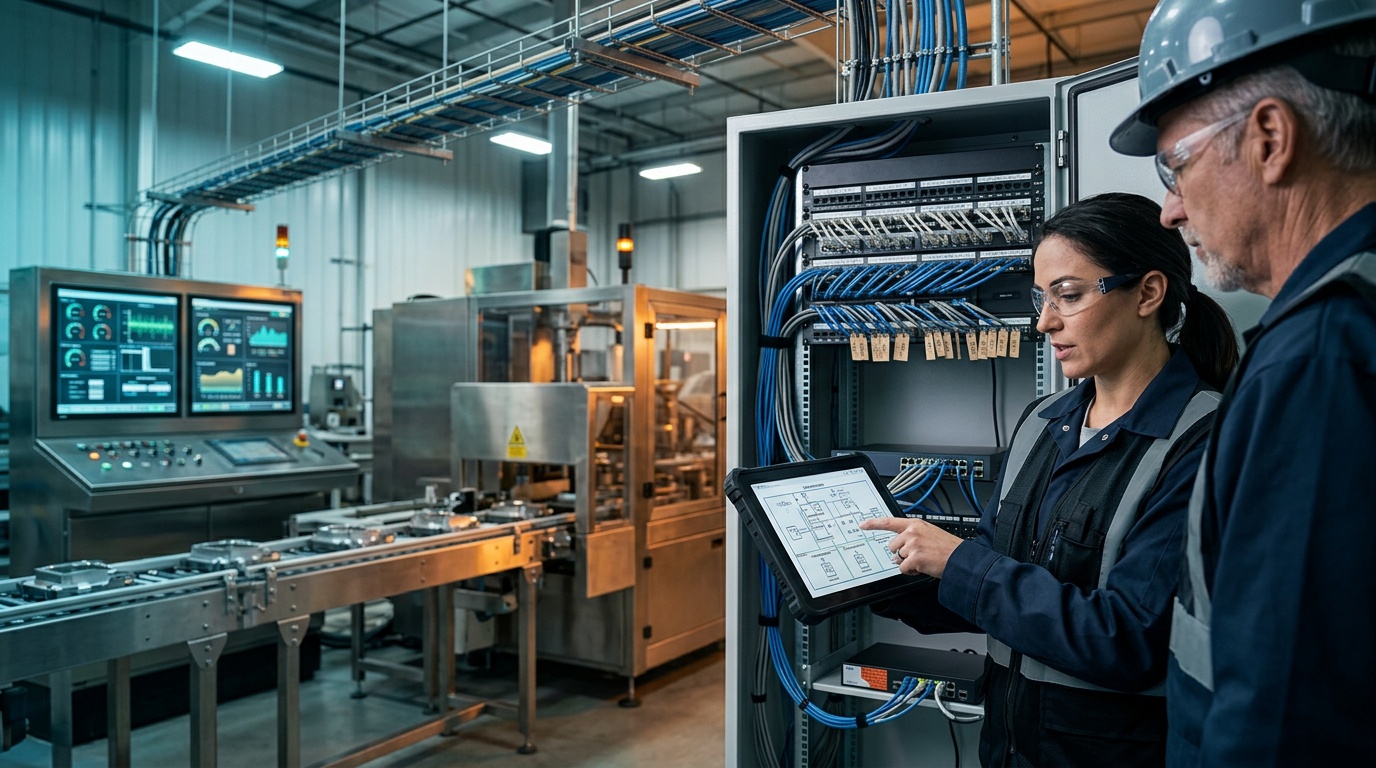
Applying the Purdue Model Realistically: Levels 0-3 for Mid-Market Plants
The Purdue Model provides a useful separation model, not a reason to redraw a plant network in one weekend. Level 0 contains sensors and actuators. Level 1 includes PLCs and remote I/O. Level 2 covers HMIs, SCADA servers, and local control applications. Level 3 contains site operations systems, historians, engineering workstations, and manufacturing applications.
Begin with one critical production cell. Record its controllers, HMI, switch, engineering station, historian connection, vendor access, and required data flows. NIST SP 800-82 and ISA/IEC 62443 provide guidance for industrial control system risk management and zones and conduits, while field validation confirms whether the diagram matches the wiring.
The Industrial DMZ: Why It Is Essential, Not Optional
An industrial DMZ, or IDMZ, creates a controlled buffer between enterprise IT and plant operations. A replicated historian, file transfer service, remote access gateway, or update repository should sit there rather than directly inside the control zone. Firewalls on each side restrict traffic by source, destination, port, direction, and schedule.
This limits blast radius. A compromised office endpoint should not have a direct route to a PLC or SCADA server, and a plant system should not freely initiate sessions into corporate services. The IDMZ also gives IT and OT teams a shared inspection point for logging, authentication, remote maintenance, and data movement.
Network Segmentation Strategies: From VLANs to Micro-Segmentation
VLANs can separate production cells, quality devices, cameras, wireless scanners, engineering stations, and administrative traffic when routing and firewall policy are configured correctly. Micro-segmentation adds more specific identity and workload rules for critical servers and high-risk assets.
Test that unauthorized paths are blocked, permitted traffic supports cycle requirements, and alarms remain visible. Maintain an exception register for vendor equipment, record temporary rules with expiration dates, and review east-west traffic between cells. A useful network map explains both what is allowed and why.
Leveraging Dual-NIC Edge Devices and Protocol Converters
Dual-NIC panel PCs and industrial edge gateways can keep a machine-side connection separate from an upstream data connection. Disable unused services, restrict management access, document interfaces, and permit only protocols required for collection or control.
A serial-to-Ethernet converter can bring older equipment data into a controlled segment. A gateway can translate Modbus or proprietary traffic into OPC UA or MQTT for a historian, MES, or analytics service. Start with read-only values when possible, then confirm polling rates, timestamp behavior, tag quality, and PLC scan timing before enabling commands or recipe writes.
- Field devices and controllers remain in the control zone.
- Cell-level SCADA and engineering systems stay within the plant operations zone.
- Approved data services pass through the IDMZ.
- Enterprise applications receive defined, monitored data flows.
- Remote support uses authenticated access with session logging and expiration.
Securing Legacy Equipment: Strategies for Unpatchable Systems
Legacy PLCs and SCADA workstations cannot always accept current patches. A blind update may break a driver, alter display behavior, interrupt a control service, or require a production reboot. Protection should combine network isolation, application allowlisting where supported, restricted administrator access, tested backups, removable-media control, and documented vendor dependencies.
Security monitoring needs OT context. A new connection from an engineering laptop may be expected during maintenance and suspicious during a running batch. Baseline normal traffic and route events to people who understand the process. The Andromeda Managed IT & IT/OT Support Services model is designed around plant-aware support, controlled change planning, and protection for older systems.
| Architecture control | What it protects | What to verify before production use |
|---|---|---|
| VLAN and firewall zoning | Limits unnecessary traffic between cells and business systems | Approved flows, failover behavior, and blocked-path testing |
| Industrial DMZ | Separates shared services from the control environment | One-way requirements, authentication, logging, and session limits |
| Dual-NIC edge gateway | Separates machine-side collection from upstream data exchange | No unintended bridging, hardened interfaces, and recovery images |
| Protocol converter | Translates legacy serial or industrial protocols for approved systems | Polling impact, tag accuracy, timestamps, and command permissions |
| Compensating controls | Reduces exposure for equipment that cannot be patched | Isolation, access review, malware controls, backups, and monitoring |
When equipment cannot be replaced immediately, consultants recommend containment first, then controlled modernization. Andromeda Managed IT & IT/OT Support Services treats network changes, edge hardware, access control, and recovery testing as production work rather than isolated IT tasks.
Bridging the Gap: Operationalizing IT/OT Convergence Through Technology and Process
Consultants recommend connecting systems in controlled stages, with production requirements guiding each technical decision. A plant needs dependable data from the right assets, delivered through approved paths, with clear ownership when a value is missing or wrong.
Edge Computing Solutions: Node-RED and Ignition for Data Transformation
Edge computing moves processing closer to equipment, reducing dependence on a distant server for collection, filtering, buffering, and alarm handling. Node-RED can manage message flows between devices and services. Ignition can provide industrial visualization, tag management, historian functions, and supervisory applications. Selection should follow the process requirement, data ownership, support capacity, and recovery plan.
A sound edge design buffers data during upstream interruptions, records timestamps from a trusted source, and identifies stale or poor-quality values. A dashboard may read machine status without permission to change a setpoint. Test memory use, network behavior, tag quality, and restart recovery with a representative cell before expanding.
Protocol Conversion: Speaking the Language of Your Machines
Modbus may expose register values from a legacy controller. OPC UA can provide a structured interface for industrial data and metadata. MQTT can publish selected events and measurements to approved subscribers. The conversion layer must preserve meaning: engineers need to know whether a value represents seconds, counts, degrees Fahrenheit, a status bit, or an alarm requiring immediate action.
Test polling intervals against PLC scan timing and document tag names, scaling, units, timestamps, quality codes, and command permissions. Begin with read-only collection. After operators validate the information, consider governed writes for recipe loading or production confirmation.
Integrating MES and ERP Without Disrupting Production
MES and ERP integration should begin with a narrow process, such as sending released work orders to one line or returning completed quantities from one work center. Map the source of truth for part numbers, routings, quantities, labor, scrap, and downtime codes before building interfaces. Duplicate ownership creates conflicting records.
Use a test environment, representative data, read-only validation, and a parallel comparison against current records. Schedule agent installation, service restarts, or database changes during an approved maintenance window. Keep a rollback procedure that operators can execute without waiting for a remote engineer.
The IT vs. OT Culture Clash: How Consultants Facilitate Alignment
IT teams are often measured on security, standardization, and service availability. OT teams are measured on safe production, repeatable cycles, and equipment availability. Consultants create a shared change review with an IT owner, controls engineer, maintenance lead, and operations representative. The review records the affected process, expected risk, test evidence, operator notification, and recovery action.
The Andromeda Managed IT & IT/OT Support Services approach supports this shared operating language instead of forcing plant personnel into an enterprise-only process.
Establishing Realistic SLAs for Uptime and Maintenance Windows
An IT/OT service-level agreement should define which assets are production-critical, who receives an alarm, how quickly a technician acknowledges a control issue, and when escalation reaches engineering or a machine builder. Separate targets for office systems, MES services, SCADA infrastructure, and safety-related equipment. State which work requires a maintenance window and which actions are prohibited during active production.
Measure missed production impact, restoration time, repeat incidents, data gaps, and approved maintenance completion. Do not promise uninterrupted availability when aging hardware, vendor dependencies, or single points of failure remain. The Andromeda Managed IT & IT/OT Support Services model uses those conditions to shape support expectations and escalation paths.
Technology and Process Tradeoffs
Pros
- Edge processing keeps essential collection working during upstream interruptions.
- Protocol gateways extend useful life for older machines.
- Staged MES and ERP integration limits production exposure.
Cons
- Each gateway adds another asset requiring ownership and backup.
- Poor tag definitions can spread inaccurate data faster.
- Read-write integration requires more testing, approval, and operator training.
The Disciplined Operating Model: Co-Managed Support for Sustainable Convergence
Consultants recommend an operating model that assigns ownership before an incident occurs. A failed domain controller, unstable switch, or unavailable SCADA workstation can stop a line, delay shipments, and create overtime. Co-managed support gives internal IT, controls engineering, maintenance, and an external specialist defined responsibilities instead of leaving plant issues in a general help desk queue.
Why Generalist MSPs Fail on the Plant Floor: The Break-Fix Trap
A generalist provider may know office networks, endpoint tools, and cloud applications while lacking experience with PLC timing, industrial protocols, legacy operating systems, and vendor-specific control software. That gap appears when a technician applies a routine patch, reboots a shared workstation, or blocks traffic required by a production cell.
Replacing a failed switch may restore production for a shift without explaining the heat, power, configuration drift, or unsupported firmware that caused the failure. Manufacturing support requires incident records tied to assets, process impact, maintenance windows, and corrective action.
The Co-Managed IT/OT Advantage: Augmenting Internal Expertise
Co-managed support extends the plant team rather than removing it. Internal personnel retain process knowledge and final approval for production changes. The specialist contributes OT-aware monitoring, network analysis, security operations, documentation, escalation coverage, and recovery planning.
A responsibility matrix should identify who may approve a firewall rule, authorize a controller reboot, contact the machine builder, and own the recovery test. The Andromeda Managed IT & IT/OT Support Services model is built for that shared responsibility, with plant operations included in change decisions.
Root-Cause Resolution vs. Ticket Churn: Andromeda's Approach
Ticket volume says little about plant stability. A support team should connect repeated alerts to the underlying asset, network path, application dependency, or access condition. If a scanner loses ERP access three times in a month, investigate wireless coverage, DHCP behavior, authentication, switching, and the application session rather than resetting the device each time.
Andromeda's published service indicators include a 1 minute 34 second technology pickup, a sub-12-minute median ticket response, and 97% resolution within eight hours. Those figures describe responsiveness, not a guarantee for every OT event. The meaningful test is whether fast response is paired with evidence, escalation discipline, and corrective work that prevents recurrence.
Proactive Monitoring and Security Operations Tailored for OT
OT monitoring must distinguish normal production behavior from suspicious activity. Effective monitoring watches controller and server availability, historian flow, backup status, privileged access, unusual remote sessions, and changes to critical configurations. SIEM alerts should include asset role, cell, process impact, and escalation instructions.
Andromeda reports that its manufacturing-tailored M*AR*S™ security stack blocks over 100 attacks per month per endpoint and defends against more than 300,000 monthly attempted attacks across mid-market industrial clients. Those figures support layered protection, but every plant still needs asset-specific baselines and response procedures.
Measuring Success: Operational Outcomes Over Technology Deployments
Measure unplanned downtime minutes, repeat incidents, mean time to restore, missed maintenance windows, data gaps, unauthorized access attempts, backup recovery results, and changes completed without disruption. Also review whether operators trust the data and whether maintenance receives useful warning before failure.
Frequently Asked Questions
How should a plant begin an IT/OT convergence project?
Manufacturing industry consultants recommend starting with a documented inventory of critical assets, processes, data flows, owners, and dependencies. The first pilot should focus on one production cell, including its PLCs, HMIs, switches, engineering stations, historians, vendor connections, and required business-system data. Field validation should confirm that network diagrams match plant wiring and operations.
What network design supports secure IT/OT convergence?
Secure IT/OT convergence uses separated trust zones with an industrial DMZ between enterprise systems and plant control networks. Firewalls should allow only approved traffic by source, destination, port, direction, and schedule. Replicated historians, file transfer services, remote access gateways, and update repositories should sit in the DMZ instead of directly inside control zones.
How can manufacturers connect legacy equipment without replacing it immediately?
Manufacturing industry consultants recommend protecting legacy equipment with compensating controls before planning replacement. These controls can include network segmentation, restricted access, monitored jump hosts, application allowlisting where supported, offline backups, and carefully controlled vendor connections. A risk-ranked inventory helps plant leaders decide which assets need isolation, upgrades, or retirement first.
How should IT and OT teams manage patching and cybersecurity changes?
IT/OT convergence support should schedule patches and cybersecurity changes around validated plant maintenance windows. Engineers and operators should test changes against approved images, backups, dependencies, alarm handling, recipes, and recovery procedures before deployment. Enterprise patch cycles should not be applied automatically to PLCs, SCADA servers, or control workstations without operational review.
What data should be shared between plant systems and enterprise IT?
Manufacturing industry consultants recommend sharing data that supports scheduling, maintenance, quality, traceability, inventory, and shipment visibility. Teams should define data ownership, acceptable timing, source systems, and error handling before connecting ERP, MES, historians, or analytics platforms. Read-only collection is often a safer first step than permitting commands or write access.
How can manufacturers control remote access to operational technology?
Secure remote access to operational technology should use an industrial DMZ gateway, named accounts, multifactor authentication where supported, time-limited approvals, session logging, and least-privilege permissions. Plant owners should document vendor access paths and review them regularly. Remote sessions should never provide an unrestricted route from an office endpoint to PLCs or SCADA servers.