
what should a manufacturing company look for in managed IT if migrating from on-premise servers to cloud
When a server issue stops order processing, schedules go stale, operators wait, and shipments may miss departure. The question of what should a manufacturing company look for in managed IT if migrating from on-premise servers to cloud starts with production awareness, not cloud certifications. The provider must understand ERP dependencies, plant networks, maintenance windows, and the difference between an office outage and a line stoppage.
Cloud migration can improve availability, recovery, and scalability when planned around manufacturing constraints. Andromeda evaluates the operating environment first, identifying recurring disruption, separating IT and OT traffic, documenting legacy dependencies, and setting measurable service expectations.
Why Manufacturing Cloud Migration Demands More Than Generic IT Expertise
Manufacturers need a managed IT provider that connects cloud planning to shop floor realities. The provider should understand production scheduling, inventory transactions, quality records, machine data, controls networks, and recovery after system failure. A general server migration may move workloads successfully while leaving latency, printer failures, authentication problems, or unsafe access paths unresolved.
The Operational Cost of IT Drag™: Beyond Server Uptime
IT Drag™ is the accumulated loss caused by small technology problems that never receive a permanent fix. Recurring database warnings, slow logins, failed label printing, unstable wireless connections, and aging file shares consume operator time, add manual work, increase rework, and make shifts less predictable. Manufacturing studies place the average cost of downtime for mid-sized discrete manufacturers between $22,000 and $50,000 per hour. Smaller interruptions also matter across multiple lines and shifts.
Bridging the IT/OT Divide: Why Standard Cloud Migrations Fall Short on the Shop Floor
Information technology supports applications, identity, data, and business workflows. Operational technology controls or monitors physical production through PLCs, HMIs, SCADA platforms, sensors, industrial switches, and line controllers. These environments have different uptime requirements, change procedures, and safety considerations. A server migration technician may not know which systems depend on a plant historian, which controller cannot be patched during a run, or how routing changes could interrupt machine communication.
Cloud planning must account for controls engineering, electrical maintenance, industrial protocols, and the Purdue Model. It must also address ISA-95 relationships between enterprise systems and manufacturing operations. Dependencies should be mapped before cutover, rather than discovered after an ERP transaction fails or a workstation loses production data.
Andromeda's Approach: IT That Understands Manufacturing
Andromeda starts with the plant’s operating rhythm. Discovery includes production applications, server roles, network paths, backup jobs, remote access, vendor connections, and equipment that cannot tolerate ordinary maintenance. The goal is a supportable architecture that protects throughput while improving recovery and visibility.
Andromeda Managed IT Services applies that manufacturing-first discipline through proactive monitoring, documented escalation, and root-cause analysis. Andromeda has completed more than 50 cloud migrations and supports hundreds of clients, with attention to plant personnel and the systems serving them. The intended result is fewer recurring incidents, clearer accountability, and technology decisions tied to shipped orders.
The Essential Managed IT Provider Checklist for Manufacturing Cloud Migrations
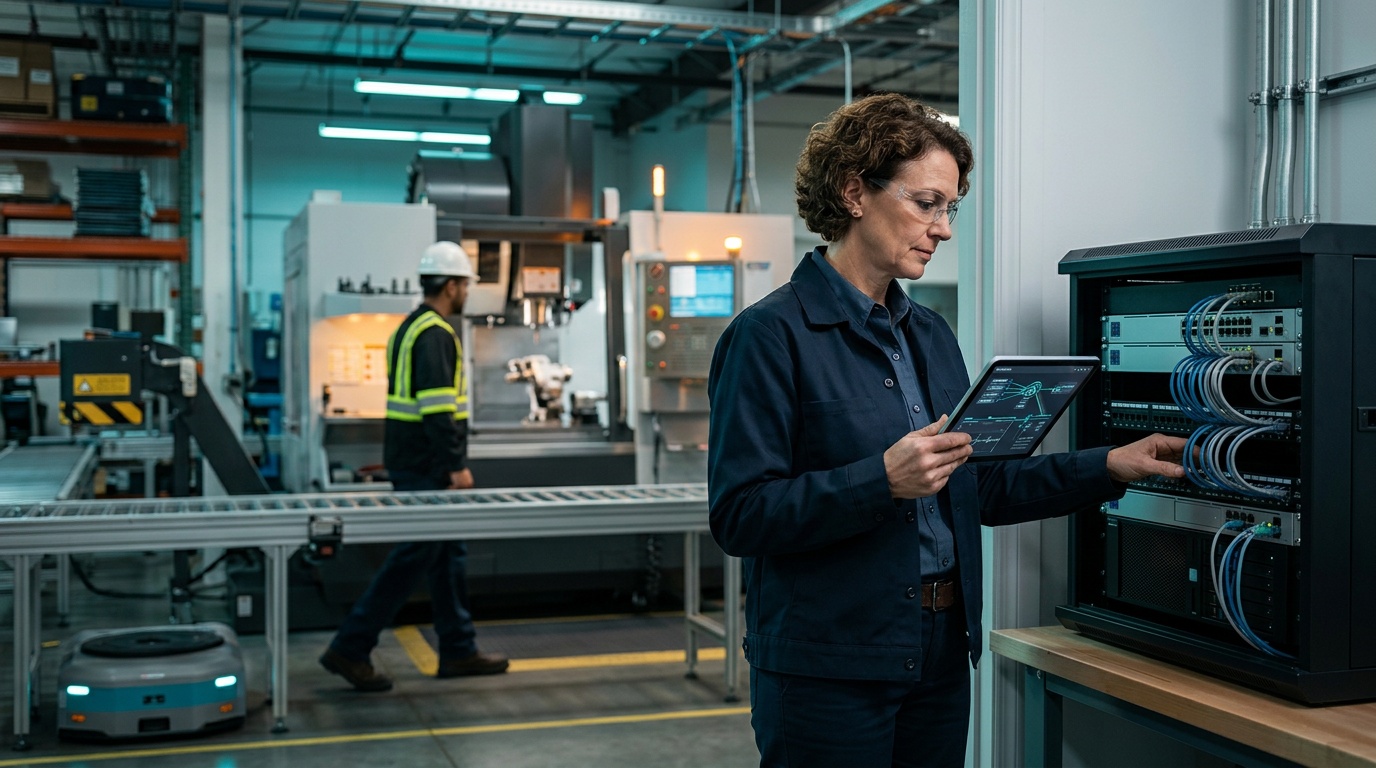
When evaluating what should a manufacturing company look for in managed IT if migrating from on-premise servers to cloud, seek evidence from the provider’s process. Ask how it discovers dependencies, handles production changes, measures response, and prevents repeat incidents. The team should explain its work to operations managers without hiding behind technical language.
Deep Dive: Manufacturing Domain Expertise & OT Familiarity
Look for experience with ERP, MES, warehouse management, quality management, time clocks, barcode systems, engineering workstations, SCADA, historians, and plant-floor wireless networks. The provider should understand how database outages affect material staging, authentication failures affect shared terminals, and DNS issues can appear to be machine problems. Ask for discovery that includes controls personnel, maintenance, production supervisors, and internal IT.
Root-Cause Elimination vs. Break-Fix: Measuring True IT Efficiency
A fast ticket closure does not prove effective support. The provider should track repeat incidents, problem ownership, contributing conditions, and permanent corrective actions. Request examples involving server errors, print failures, storage alerts, or network interruptions. Andromeda’s benchmark includes an average live technician pickup time of 1 minute and 34 seconds, with 97% of issues resolved within 8 business hours. These measures matter most when paired with fewer repeat tickets and documented remediation.
Production Uptime Guarantees and Realistic SLA Metrics
Service-level agreements should cover response time, escalation, recovery time objective, recovery point objective, monitoring, maintenance notices, emergency access, and incident communication. Ask how downtime is defined when an ERP is reachable but too slow for order entry, or when a cloud application works but labels cannot print. Accountability should include incident reporting, executive escalation, and financial terms reflecting production impact.
Be cautious with a blanket zero-downtime promise. A responsible partner identifies interruption conditions, tests failover, schedules cutovers around production, and states customer responsibilities. The agreement should guide decisions when migration encounters a legacy dependency or network constraint.
Low Technician Turnover: Building Institutional Plant Floor Knowledge
Every new technician requires time from plant personnel. Constant staff changes force maintenance and operations teams to repeat machine names, line priorities, vendor contacts, network cabinet details, and safe intervention procedures. Ask how the provider retains documentation, assigns an account team, trains replacements, and records site-specific knowledge. Continuity matters during cloud transition because scheduled exports and older label printers can affect cutover.
Security & Compliance Specialization for Industrial Environments
Security planning must protect office systems without creating an unsafe or unusable plant network. Evaluate identity management, privileged access, multifactor authentication, endpoint protection, backup immutability, vulnerability management, remote vendor access, and incident response. Regulated manufacturers should ask how controls map to CMMC, NIST, and ISO requirements, including evidence collection and policy maintenance.
Network segmentation should separate business services from OT zones while preserving required data flows. The provider should document firewall rules, access paths, logging, and ownership. Security is incomplete if production cannot operate, and uptime is not secure if any remote account can reach a controller without review.
What This Evaluation Framework Reveals
Pros
- Manufacturing-specific discovery exposes production dependencies before migration.
- Root-cause tracking reduces recurring interruptions and support noise.
- Clear SLA measures connect technical response to plant performance.
- Stable technician assignments preserve institutional knowledge.
- Security controls can be aligned with CMMC, NIST, ISO, Purdue Model, and ISA-95 practices.
Cons
- A thorough assessment requires time from operations, maintenance, controls, and IT.
- Migration planning may identify aging equipment or undocumented dependencies that need separate investment.
- Meaningful SLAs require accurate definitions for application availability, recovery, and production impact.
Andromeda Managed IT Services is designed for ongoing operational review. The right partner should provide a documented environment, known risks, measurable commitments, and a migration plan that respects the next production shift.
Navigating Hybrid Cloud Architectures: What Stays On-Premise vs. What Moves to the Cloud
Most plants should not treat cloud migration as all-or-nothing. A hybrid architecture keeps some systems near production while placing suitable business workloads in managed cloud infrastructure. Gartner projects that 90% of industrial enterprises will adopt hybrid cloud architectures by 2027. The question is which workload can move without creating latency, safety, recovery, or support problems.
Workload Placement Matrix: ERP, MES, SCADA, PLCs, and Edge Devices
Review application dependencies, data flows, recovery needs, and production timing. ERP databases may suit cloud hosting when connectivity and print services are designed properly. MES requires closer review because production reporting, quality checks, and scheduling may require low-latency access. SCADA systems, PLCs, and line controllers generally remain in the plant, while edge devices can collect and forward selected data without exposing controllers directly to the internet.
| Workload | Typical placement | Decision factors |
|---|---|---|
| ERP and business databases | Cloud or hybrid | Transaction volume, integrations, printing, recovery objectives |
| MES and quality systems | Cloud, edge, or hybrid | Latency, production scheduling, inspection records, local availability |
| SCADA and historians | Usually plant or edge | Continuous data collection, control dependencies, retention requirements |
| PLCs and line controllers | On-premise | Safety, deterministic response, vendor support, change restrictions |
Addressing Legacy Equipment and Unpatchable Controllers
Older equipment cannot become cloud-ready through a subscription. Some controllers run unsupported operating systems, use fixed IP addresses, or communicate through industrial protocols that modern security tools do not inspect well. A manufacturing-aware provider documents these constraints, identifies required outbound data, and protects the asset. Read-only collection through an industrial gateway may be appropriate, while direct remote administration may create unacceptable risk.
The plan should record vendor ownership, firmware limits, backup procedures, replacement lead times, and safe restoration methods. This prevents authentication or routing changes that could disrupt a line.
Network Segmentation: Protecting the Shop Floor from Cloud Risks
Cloud connectivity should not create a flat path into production. The Purdue Model separates enterprise services, industrial operations, supervisory systems, and control devices. Firewalls, industrial DMZs, jump hosts, access control lists, and monitored vendor connections can limit communication. ISA-95 helps define the boundary between business applications and manufacturing operations.
Ask for a current diagram showing zones, conduits, firewall rules, remote access paths, and ownership. Test segmentation against label printing, historian updates, engineering access, and emergency procedures. A rule that blocks malicious traffic but stops production data is unfinished.
Bandwidth and Latency Considerations for Real-Time Production Data
A cloud application can be available while too slow for operators. Latency affects order entry, material transactions, quality records, and machine dashboards. Bandwidth planning should include shift changes, backups, updates, video inspection data, wireless devices, and multiple facilities sharing one connection. Test production paths, not only office workstations.
Where timing is tight, local caching, edge processing, traffic prioritization, or a retained plant service may be necessary. The provider should monitor packet loss and jitter and document behavior when the wide-area connection fails.
Building Resilience: Redundancy and Business Continuity in Hybrid Models
Hybrid design is also a recovery decision. Determine which functions continue locally during an internet outage, which transactions queue, and which services require immediate failover. Backups need tested restoration, not only successful completion messages. Recovery point objectives should reflect recreatable production data, while recovery time objectives should reflect effects on orders, materials, and line operation.
A practical architecture includes documented dependencies, alternate connectivity where justified, local procedures, and scheduled failover tests. The migration partner should review results with operations and maintenance and correct weaknesses before the next cutover.
The Zero-Downtime Migration Roadmap: A Manufacturing-First Implementation Plan
A cloud migration should protect the next production shift while improving recovery. Zero downtime is a planning goal, not a promise removing every risk. The work requires controlled sequencing, ownership, rollback procedures, and communication with production, maintenance, controls, and finance.
Phase 1: Assess and Align, Understanding Your Production Environment
Inventory servers, applications, databases, integrations, network paths, printers, remote access connections, and backup jobs. Map each dependency to the production process it supports, including ERP transactions, MES updates, quality records, warehouse activity, engineering workstations, SCADA data, and equipment that cannot tolerate ordinary maintenance. Deliverables should include a dependency map, risk register, migration sequence, and decision-makers authorized to approve or stop cutover.
Phase 2: Take Command, Stabilizing Current Operations Before Migration
Do not migrate an unstable environment and expect the cloud to correct it. Resolve recurring storage alerts, failed backups, unsupported software, overloaded links, stale accounts, and undocumented firewall rules. Establish baselines for application response, database performance, network use, and backup completion. Confirm vendor contacts and give plant leadership a current view of unresolved risks.
Phase 3: Secure and Comply, Layered Security for Cloud and On-Premise
Apply identity controls, multifactor authentication, endpoint protection, privileged access restrictions, backup safeguards, and logging before workloads move. Review cloud access alongside plant connections, vendor pathways, and administrative accounts. Map CMMC, NIST, and ISO obligations to maintainable evidence. Test security changes with operations because blocked connections can interrupt labeling, quality reporting, or material movement.
Phase 4: Phased Migration Execution, Live Failover Strategies
Move lower-risk services first, then progress toward production-critical workloads after validation. Use replicated data, synchronized configurations, pilot users, and a documented failback path where supported. Schedule final changes during a verified production window. Confirm ERP posting, MES communication, authentication, printing, reporting, remote support, and plant network behavior before releasing the old environment.
Phase 5: Report and Guide, Post-Migration Validation and Optimization
Compare post-cutover performance with the baseline. Check transaction speed, scanners, print queues, backups, alerts, user access, and recovery procedures. Review results with IT, operations, maintenance, and finance. Record defects by root cause, assign owners and due dates, and document what changed, what remains on-premise, accepted risks, and how support will prevent new IT Drag™.
Questions to Ask Your Potential Managed IT Partner (And What the Answers Reveal)
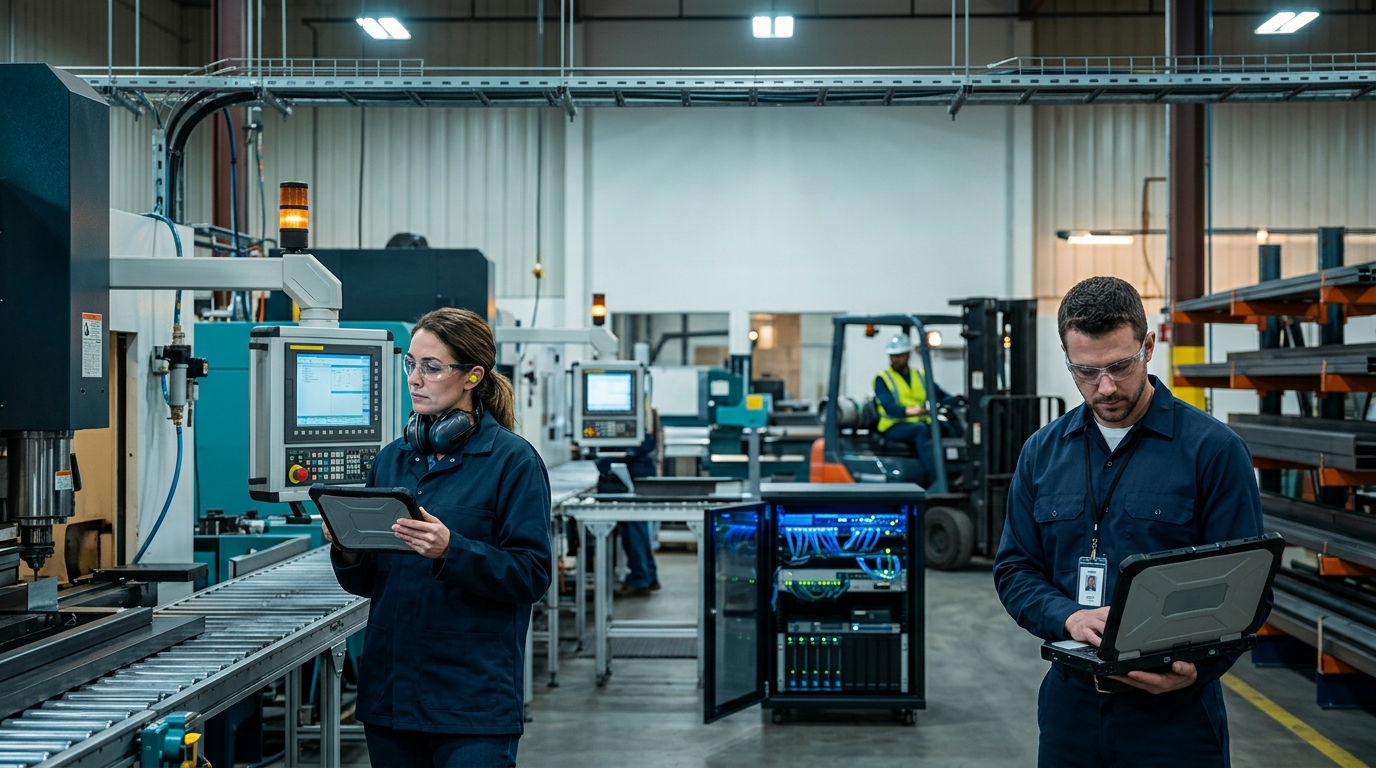
Use these questions to test whether a provider can operate within manufacturing constraints. Good answers include procedures, responsibilities, documentation, and measurable outcomes. General cloud assurances are not enough when a server change can delay a shipment.
Question 1: “How do you ensure our production floor remains operational during and after migration?”
Look for a dependency map, approved maintenance windows, pilot testing, live monitoring, failover criteria, and rollback planning. The provider should explain IT and OT coordination, line-critical priorities, and incident communication with supervisors.
Question 2: “What is your process for identifying and eliminating recurring IT issues, not just fixing them?”
A credible answer includes incident trends, root-cause analysis, problem ownership, corrective actions, and follow-up verification. Ask how repeat printer failures, database alerts, or network interruptions are tracked after ticket closure.
Question 3: “Describe your experience with manufacturing-specific systems like ERP, MES, and SCADA. How do you integrate them into a cloud strategy?”
The provider should discuss transaction dependencies, plant historians, edge collection, latency, authentication, printing, industrial protocols, and local operation during connectivity loss. Ask how controls engineers and application owners participate in workload placement.
Question 4: “What are your standard SLA terms for production-critical systems, and how do you measure accountability for downtime?”
Review response targets, escalation, recovery time objectives, recovery point objectives, maintenance notice, incident reporting, and financial accountability. Ask how the SLA treats a slow application, failed label printing, or partial plant access.
Question 5: “How do you handle network segmentation between office IT and plant-floor OT systems?”
Expect Purdue Model principles, industrial DMZs, controlled conduits, firewall rules, monitored vendor access, and documented exceptions. The partner should explain how ERP, MES, historian, and engineering traffic moves without unrestricted controller access.
Andromeda Managed IT Services can be evaluated against these standards. The right partner will answer with operating detail, measurable accountability, and respect for the production schedule.
Frequently Asked Questions
What are the 7 R's of cloud migration for a manufacturing company?
The 7 R's of cloud migration are rehost, relocate, repurchase, refactor, rearchitect, retain, and retire. A manufacturing company can use these choices to decide whether each ERP, file service, database, or plant application should move unchanged, receive redesign, stay on-site, or be removed. The decision should reflect production dependencies, downtime limits, and recovery needs.
What are the 5 R's in cloud migration?
The 5 R's in cloud migration are rehost, refactor, revise, rebuild, and replace. A manufacturing company may rehost a stable business application, refactor a workload for cloud performance, or replace outdated software with a supported service. Managed IT planning should connect each choice to plant operations, integration requirements, licensing, and support responsibilities.
What are the four R's of cloud migration?
The four R's of cloud migration commonly refer to rehost, refactor, revise, and rebuild. These options describe increasing levels of application change, from moving a workload with minimal modification to redesigning it for cloud operation. Manufacturing teams should evaluate database links, label printing, authentication, machine data, and maintenance windows before selecting an approach.
What is the 3-4-5 rule in cloud computing?
The 3-4-5 rule in cloud computing is not a universal migration standard, so its meaning depends on the source using it. Some providers use the phrase for planning guidance involving three phases, four controls, and five checks, while others use it differently. Manufacturing companies should request a clear definition and measurable requirements before accepting the framework.
What are the steps for migrating from on-premise servers to the cloud?
The steps for migrating from on-premise servers to the cloud are discovery, dependency mapping, workload assessment, design, testing, pilot migration, cutover, and post-migration review. A manufacturing company should include ERP, MES, printers, warehouse systems, plant networks, backups, vendor access, and recovery procedures. Scheduling work around production windows helps reduce disruption.
How should a manufacturing company choose which systems to move to the cloud first?
A manufacturing company should move systems to the cloud first when their dependencies are well documented, downtime risk is manageable, and recovery benefits are clear. Less complex file, collaboration, or business applications may be early candidates, while tightly connected plant systems may need more testing. Managed IT should rank workloads by production impact, data sensitivity, and recovery requirements.
What should a manufacturing company ask a managed IT provider before a cloud migration?
A manufacturing company should ask a managed IT provider how it maps IT and OT dependencies, protects production networks, tests recovery, measures response times, and prevents repeat incidents. The provider should explain maintenance windows, escalation, incident communication, backup validation, and support for ERP, MES, barcode, printing, and plant-floor systems. References from comparable manufacturers can help verify the process.